The locked headline is craig melvin wife new job: A Practical San Francisco Neighborhood Guide, but the useful San Francisco question is not whether a television story is secretly happening here. It is how to move through the city when a timely search phrase sends people looking for local context, meetups, errands, watch plans, or a neighborhood day built around conversation. Treat craig melvin wife new job as the hook, not the evidence. There is no basis here to claim a local appearance, affiliation, private access, scheduled event, or endorsement. The plan below uses public, official planning habits: check SFMTA before leaving, anchor the day to transit exits, watch for active alerts, keep one indoor fallback, keep one outdoor fallback, and avoid crossing town on vibes alone.
Want a quick neighborhood decision before you leave? Text Karpo with your start point, time window, mobility needs, and backup preference, and ask for a verify-first San Francisco plan.

Translate the headline into a neighborhood question
A search phrase can be loud without being locally actionable. If you searched craig melvin wife new job and landed in San Francisco planning mode, separate the media curiosity from the street-level decision. The practical question is: which neighborhood lets you complete your actual task with the least uncertainty today? That task may be meeting someone, finding a public place to sit, coordinating a transit-friendly stop, or choosing a backup before weather, crowds, or service alerts change the day.
Start with a simple rule: do not build the plan around an unverified celebrity connection. Build it around public access and official conditions. SFMTA’s official site is the useful first stop because it publishes trip-planning tools, Muni route and stop information, transit updates, accessibility information, calendars, projects, and alerts. If an item can change, such as a reroute, service adjustment, elevator status, or street condition, treat the official page as the check, not as background reading.
Choose the area by the actual task
San Francisco is compact on a map and slow when the wrong crossing is chosen. The neighborhood should follow the task. If the goal is a short conversation, choose the area closest to the people involved. If the goal is a public errand, choose the area with the easiest Muni route and the fewest transfers. If the goal is a flexible afternoon, choose the area with both an indoor option and an outdoor option close enough that you can switch without restarting the whole trip.
Use SFMTA’s neighborhood and route information to narrow the choice instead of assuming that the most talked-about area is the easiest one. The agency’s public navigation groups include Muni routes and stops, visitor transportation, neighborhoods, projects, permits, parking and citation services, travel maps, accessibility, and current updates. That matters because a neighborhood guide is only useful if it tells you what to verify before you spend forty minutes getting there.
For a cautious citywide plan, pick one primary neighborhood and one adjacent backup rather than three distant stops. If SFMTA shows an active alert near your intended path, downgrade that area unless the errand truly requires it. An alert shown on the official page noted that inbound and outbound 14 service continued to reroute around Mission and 26th due to SFFD activity; that kind of notice is exactly why the final check should happen close to departure.
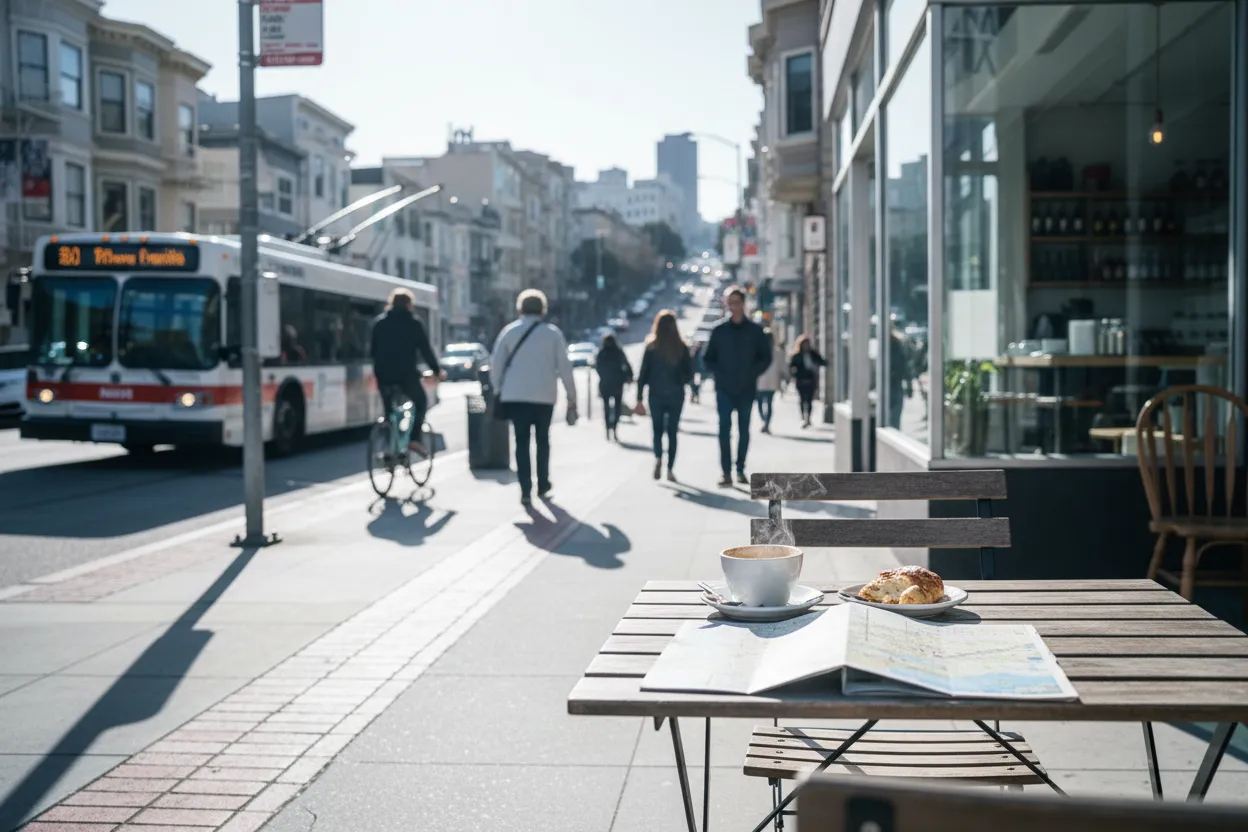
Use transit exits as planning anchors
The most reliable San Francisco meeting point is not a vague neighborhood name. It is a transit exit, stop, or route choice that everyone can verify independently. SFMTA’s Trip Planner lets users enter a starting location, ending location, and travel mode, including Muni, bike, walk, drive, and parking-related options. Use that structure to define the day: origin, destination, mode, transfer risk, and a second route if the first one breaks.
Plan from the exit outward. Decide where you will arrive, how far you are willing to walk, and what you will do if the route changes while you are already moving. If elevators or step-free access matter, check SFMTA’s Muni Metro Elevator Status and accessibility resources before committing. Do not assume that yesterday’s access condition is still true today. The same verification habit applies to travel maps, route pages, and stop-level decisions.
If driving is part of the plan, avoid treating the car as a guarantee. SFMTA’s public categories include drive and park information, permits, citations, towing information, and street-closure-related services. That is a reminder that curb access, enforcement, and street use can be operational issues, not personal preferences. For a neighborhood guide, transit exits make better anchors because they keep the plan adaptable.
Add one indoor and one outdoor backup
A useful San Francisco plan has a soft landing. Your indoor backup should be a public, reachable option that does not depend on a rumor, a private invitation, or a fragile schedule. If the purpose is transit help, SFMTA lists customer service, offices, 311, and regional information links among its official support channels. If your indoor backup is a museum, café, library, lobby, or event space, verify the official page directly before going; do not infer hours or access from old posts.
Your outdoor backup should be equally boring in the best way: public, reachable, and checked close to departure. For parks, fields, plazas, or recreation sites, verify changing details on the San Francisco Recreation and Park Department’s official site before relying on them. The official extraction available here did not provide current park-specific hours, programming, closures, or amenities, so this guide will not pretend to know them. The point is to choose the outdoor fallback only after a live official check.
Keep the backup within the same general travel zone as the primary stop. If the first plan is in or near a corridor with an active reroute, do not make the backup another stop along the same fragile route. Give yourself a clean switch: same meeting group, different setting, minimal extra crossing. This is how a neighborhood plan survives crowds, service changes, or a surprise closure.
Avoid treating online attention as a local promise
The phrase craig melvin wife new job may be timely, but timeliness is not proof of a San Francisco event. Do not tell friends that a person will appear, that a venue is involved, that a broadcast is happening locally, or that access is available unless an official source says so. This article makes no such claim. It uses the search interest only as a reason to build a smarter public city plan.
That skepticism protects your time. San Francisco plans often fail when people confuse buzz with logistics. A headline can explain why people are talking; it cannot confirm Muni reliability, elevator access, street activity, crowd levels, or whether your destination is open. The official pages decide the operational details. If you cannot verify a claim, convert it into a question and keep the plan flexible.
A good neighborhood guide also avoids overpromising mood. Hayes Valley Shared Spaces appeared on SFMTA’s travel and transit updates for Fridays and Saturdays in August 2026, but that listing is still something to check before building a day around it. The same goes for any calendar item, meeting, service change, or project notice. Use official listings as prompts for verification, not as permanent facts.

Verify conditions before crossing the city
Run the final check in this order: SFMTA alerts, route and stop information, Trip Planner, elevator status if relevant, and any official destination page. SFMTA’s homepage surfaced current alerts, transit updates, a calendar, service-change notices, Muni routes and stops, travel maps and guides, and visitor transportation resources. Those are the checks that turn a vague San Francisco idea into an executable plan.
Timing matters. Check once when choosing the neighborhood, then again shortly before leaving. SFMTA listed upcoming items such as Muni Service Changes starting August 29 and public meetings on its calendar, which shows why dates cannot be treated casually. If your plan is after a service-change date, re-run the route. If your plan crosses a known activity area, re-run it again.
If the official tourism site is unavailable behind security verification when you try it, do not fill the gap with guesswork. Use the available official transportation and recreation sources, then verify any destination directly. The safest San Francisco neighborhood plan is not the fanciest one; it is the one with a confirmed route, a realistic access check, a nearby backup, and a decision point before you cross town.
Tags: #AskKarpo #BeforeYouGo #SanFrancisco #NeighborhoodGuides #SFMTA #Muni #TransitPlanning #SFNeighborhoods #CityGuide #AccessCheck #CrowdRisk #BackupPlan #PublicTransit #VerifyFirst
Sources consulted: sftravel.com · sfmta.com · sfrecpark.org
All trademarks are the property of their respective owners.
Ask Karpo first
Ask Karpo first before you turn a trending headline into a cross-town plan. Send your start point, target neighborhood, time window, mobility needs, and backup style. Karpo can help you pressure-test the route, spot verification gaps, and choose the simplest public option before you go.