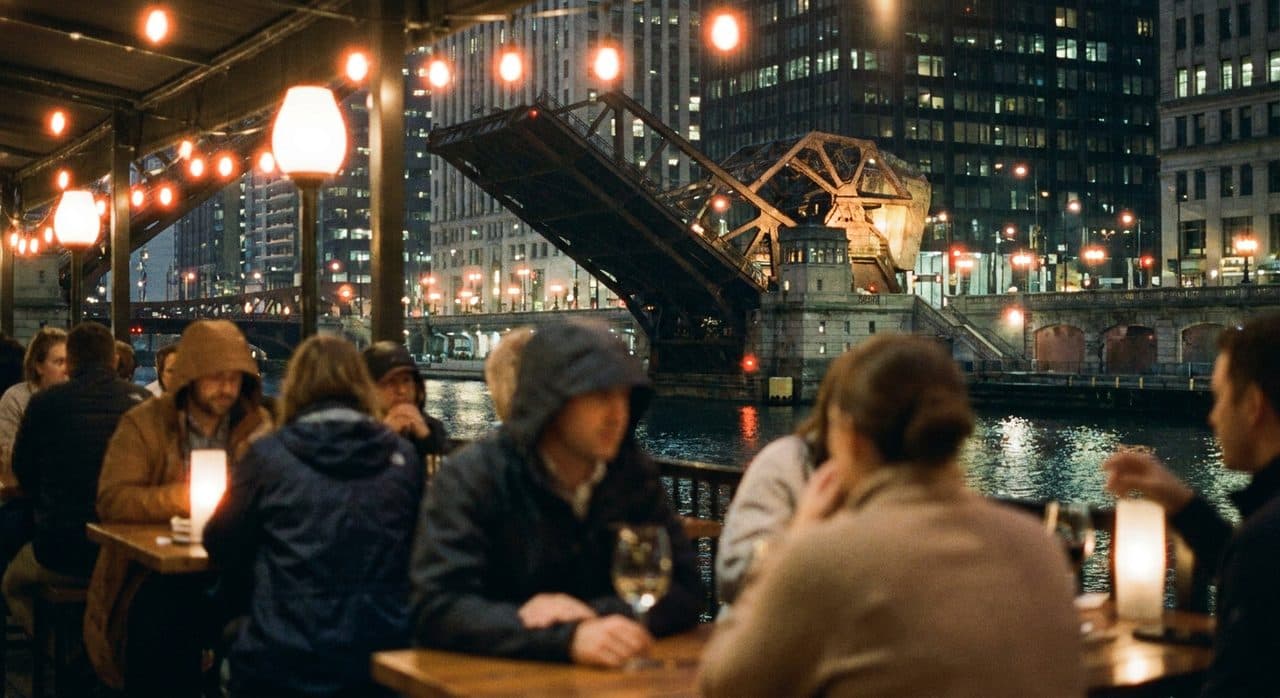
The Chicago Riverwalk has always been a study in compression—narrow paths wedged between water and office towers, crowded with tourists photographing the bridges, vendors selling gelato, kayak tours launching every fifteen minutes. But the extension south from Lake Street to Ping Tom Memorial Park changes the equation entirely. Two miles of continuous pavement now trace the river's path from the dense Loop core down through the South Branch's industrial corridor to Chinatown, and the walk shifts character as decisively as the water changes width. What begins as classic downtown spectacle—steel and limestone, architectural tours, the constant thrum of foot traffic—gradually empties into something quieter, wider, almost contemplative.
The downtown gauntlet
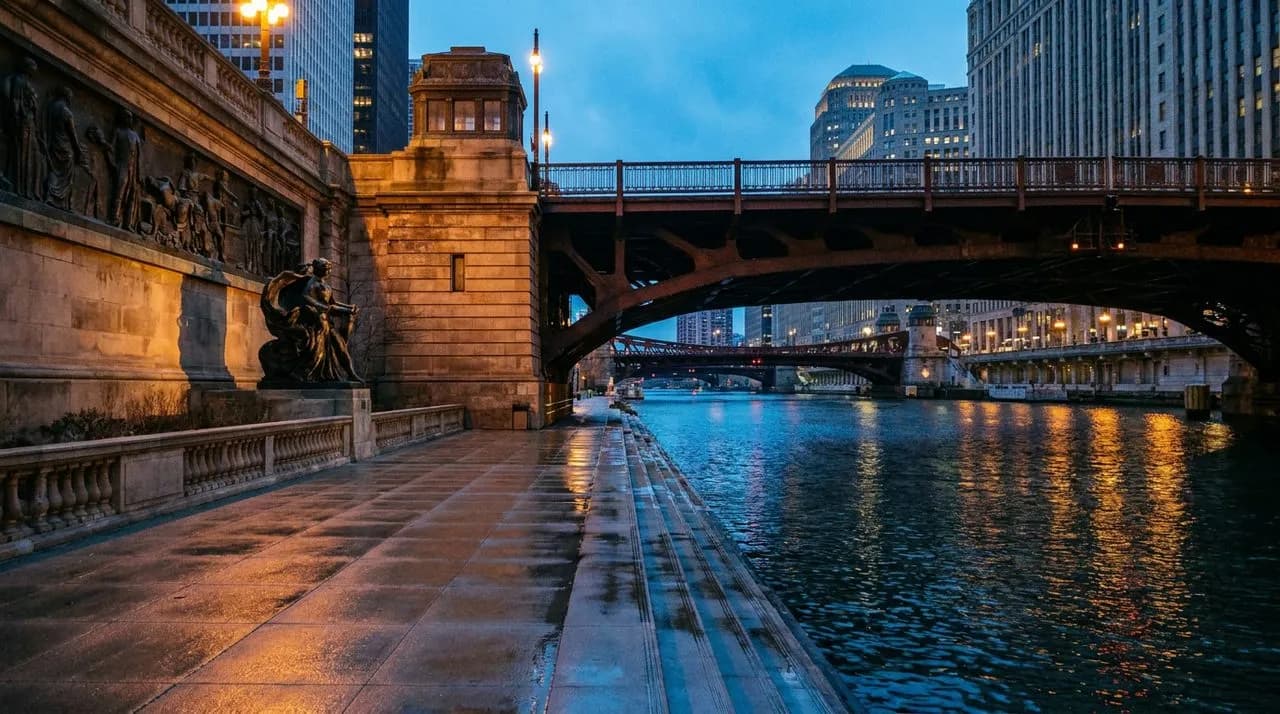
The Riverwalk entrance at Lake Street is a three-minute walk from the Brown, Orange, Purple, and Pink lines' Lake stop, making it one of the easiest downtown starting points if you're coming by train. The path drops you immediately into the rhythm of the Loop section: a string of bridges overhead—Lake, Randolph, Washington, Madison, Monroe—each casting its own stripe of shadow, each engineered with just enough clearance that pedestrians pass underneath in brief, cool tunnels before stepping back into daylight. It's engineering as punctuation.
The architecture crowds in here. Glass facades bounce river light in hard flashes. The water is narrow, almost canal-like, and the Riverwalk clings to the south bank with cafés, stairs, floating wetland gardens. Spring in late 2026 means the planters are full again after winter's absence, ornamental grasses bending in the wind off the lake. This stretch hums—joggers weaving between families, office workers eating lunch on the wide steps near Wabash. It's one of the better free things to do in the city, and it shows in the density of use.
The turn south
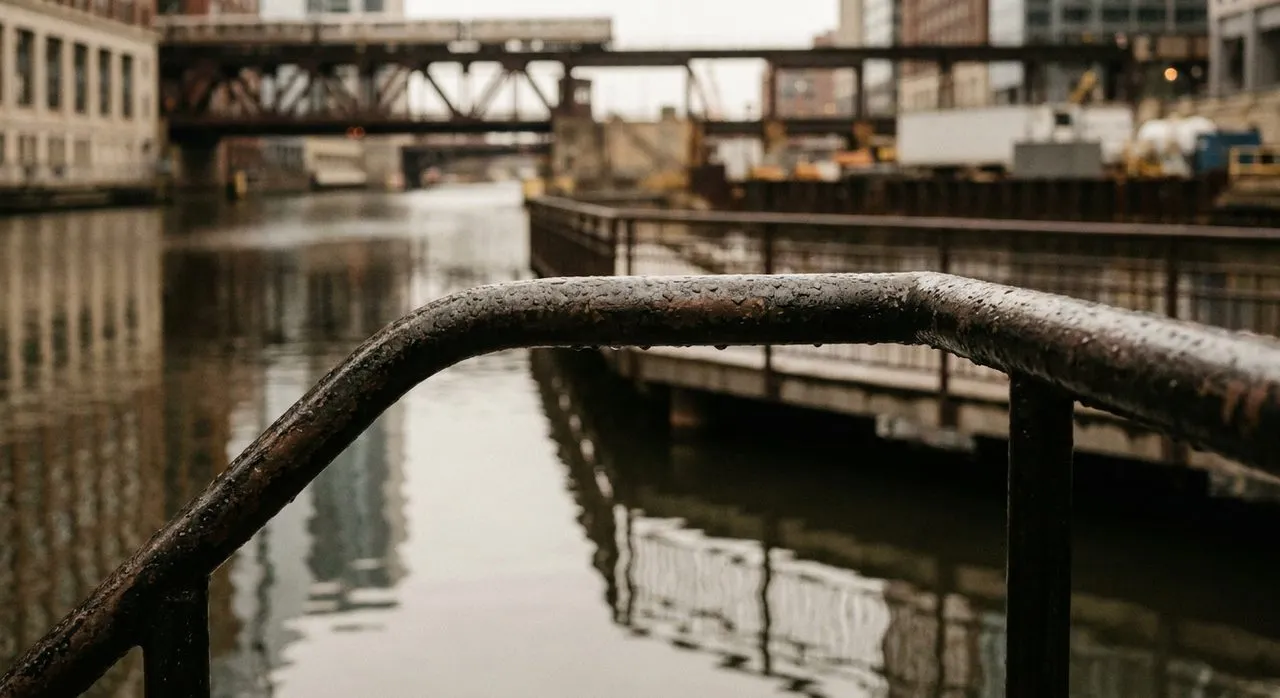
Past the Monroe bridge, the river bends southwest and widens. The main stem becomes the South Branch, and the Riverwalk follows it faithfully. The change is immediate: fewer restaurants, fewer tourists, more cyclists commuting with purpose. The pavement is the same smooth concrete, but the buildings pull back. On the east bank, old printing plants and loft conversions; on the west, the occasional parking lot or construction fence. You're still in the thick of the city, but the energy is different—less performance, more transit.
The light changes too. With the channel wider and the towers no longer boxing you in, the sky opens. Late-afternoon sun hits the water at a lower angle, turning the surface bronze or pewter depending on cloud cover. Gulls wheel above the occasional barge. The industrial heritage that built Chicago stops being abstraction and starts showing up in the bones of the landscape—railroad bridges, repurposed warehouses, the faint smell of rust and old timber pilings when the wind is right.
The quiet stretch
Benches along the South Branch stretch between Roosevelt and 18th Street are significantly less crowded than the Loop section, especially on weekday afternoons. If you're looking for a place to sit with a book or just watch the water without negotiating for elbow room, this is the zone. The path is almost meditative here—long, straight, bordered by chain-link or newer railings depending on which parcel the city upgraded most recently. Occasionally a heron stalks the shallows near the bank. Occasionally a freight train rumbles across the Amtrak corridor to the west.
There's an odd beauty to this middle section, the kind that doesn't photograph as well as the downtown bridges but lingers longer in memory. The textures are rougher: graffitied concrete abutments, weathered brick, wildflowers colonizing the edges of empty lots. It's the Chicago that doesn't make the tourism brochures but anchors the city's identity—working, shifting, never quite finished. You're alone with your thoughts here, or nearly so. A jogger passes. A cyclist nods. The skyline recedes behind you but never quite disappears.
Arrival at Ping Tom
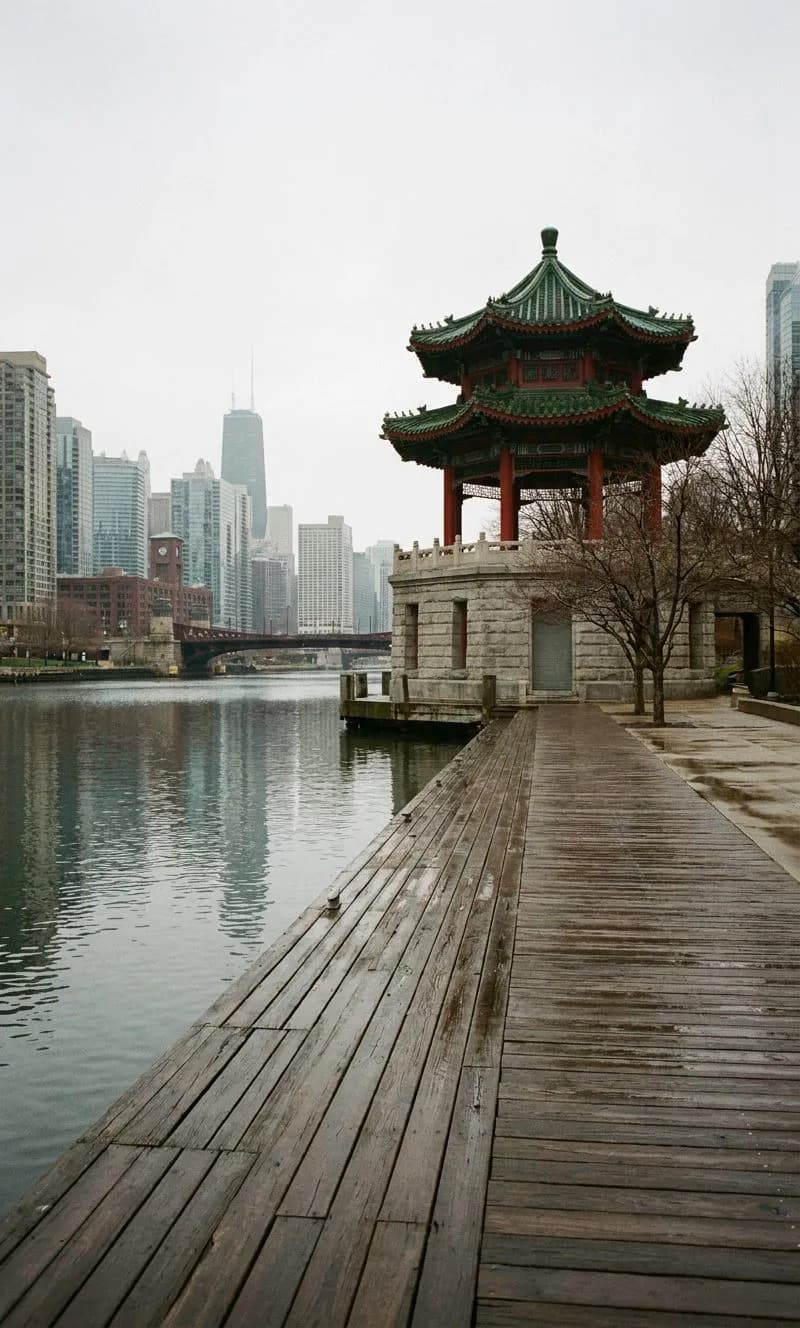
The full walk from the Lake Street Riverwalk entrance to Ping Tom Memorial Park is closer to about 2 miles, depending on routing and takes forty to fifty minutes, depending on pace and how often you stop to lean on the railing and stare at the water. The park announces itself with a red pagoda rising above the river's edge, a piece of architectural punctuation that signals you've entered Chinatown's sphere of influence. The fieldhouse is modern, brick and glass, with restrooms available—a practical consideration after an hour of walking—and a lawn that slopes gently toward the water.
What makes Ping Tom remarkable as a terminus isn't just the pagoda or the playground equipment or the community garden plots. It's the way the skyline reappears here, framed now by railyard cranes and the skeletal geometry of switching yards to the south. You're two miles from where you started, and the city looks different from this angle—more sprawl, less density, the towers clustered like a distant mountain range rather than walls pressing in. The river is wide here, almost placid, and the light in spring—especially late afternoon—turns everything amber. Families fish off the dock. Tai chi practitioners move through forms on the lawn. It's a neighborhood park that happens to offer one of the city's better views, if you know to look for it.
What the walk teaches
Urban walks like this one resist easy summary. They're not scenic in the way a lakefront path is scenic, all uninterrupted water and recreational joggers. The Riverwalk from Lake Street to Ping Tom is more honest than that—a cross-section of how the city actually works, not just how it poses for visitors. You pass under infrastructure, through industrial corridors, past the blank walls of buildings that turn their fronts to other streets. You see where the money concentrates and where it thins out. You watch the river change from ornament to working waterway and back to community amenity.
By the time you reach the pagoda, you've walked through three or four different Chicagos, all connected by the same thread of water and the same strip of pavement. It's a reminder that cities are built in layers, and that the best way to understand them is often just to walk from one end of something to the other, paying attention. The extended Riverwalk offers that opportunity without requiring a car, a ticket, or anything more than decent shoes and a willingness to keep moving. That's not nothing.
Practical notes
The Lake Street Riverwalk entrance is accessible via the CTA Lake stop (Brown, Orange, Purple, Pink lines); the southern terminus at Ping Tom Memorial Park is at 300 W. 19th St. in Chinatown, near the Cermak-Chinatown station on the CTA Red Line The path is generally open daily, but specific hours and closures can vary; spring and fall offer the most comfortable walking temperatures. The route is fully paved and ADA-accessible. Bring water—there are no fountains along the South Branch stretch—and sunscreen; shade is sparse south of Roosevelt. Restrooms are available at Ping Tom's fieldhouse. Street parking is limited near both endpoints; public transit is strongly recommended. Verify seasonal hours and any construction closures via the city's Riverwalk page before setting out.
Tags: #ChicagoRiverwalk #TheLongWayHome #ChicagoWalking #SouthBranch #PingTomPark #Chinatown #UrbanHiking #CityWalks #ChicagoSpring2026 #RiverViews #LoopToChinatown #ChicagoPublicSpace #WalkableChicago #FreeChicago #RiverwalkExtension
Sources consulted: Chicago Riverwalk · Ping Tom Memorial Park · City of Chicago - Riverwalk · Chicago Park District · Time Out Chicago
All trademarks are the property of their respective owners.