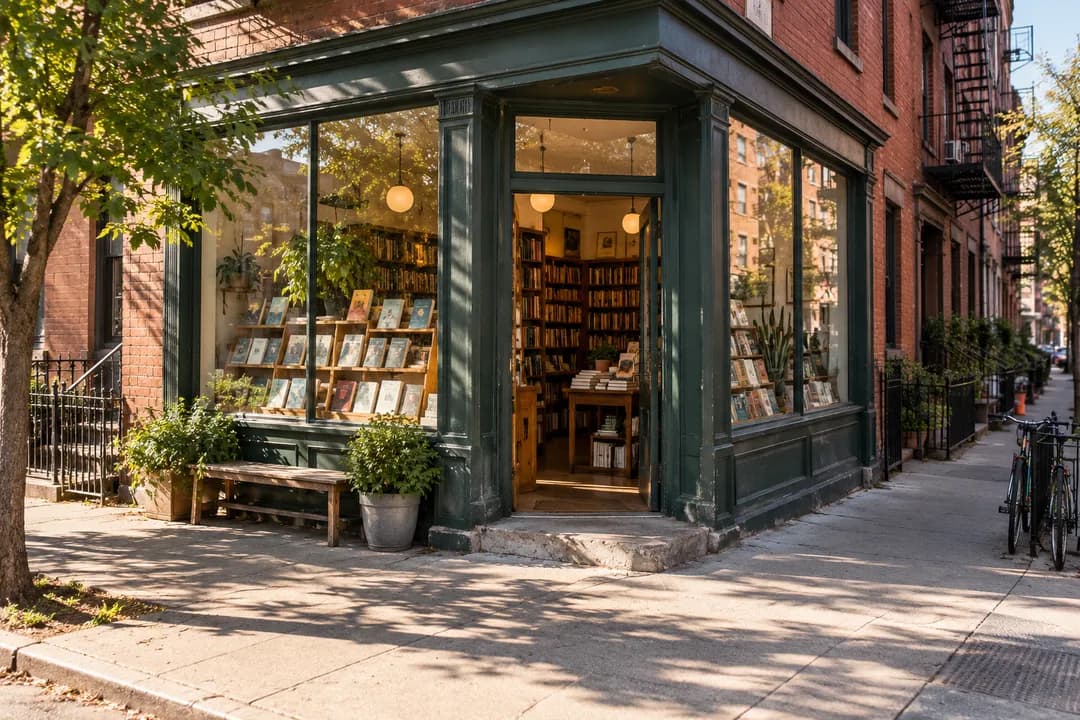
 WORD Bookstore in Greenpoint Remains a Community-Focused Indie Bookstore Near Me
Hidden Gems & Odd Finds
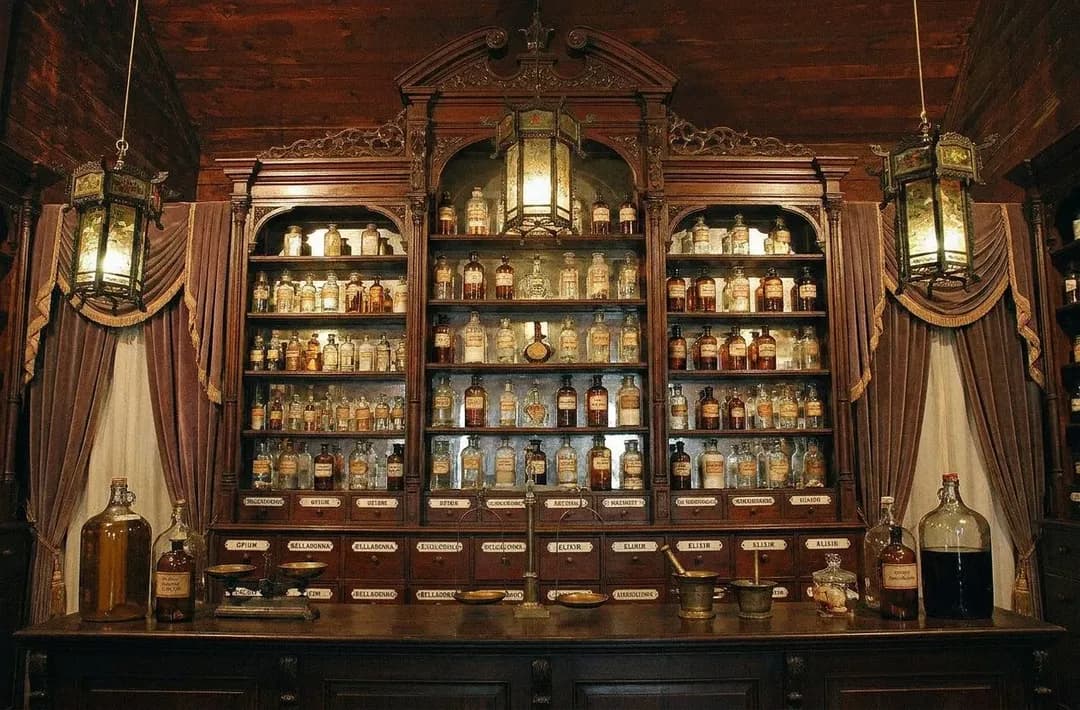
c.o. bigelow apothecary's vintage pharmacy cases when the village morning regulars pick up prescriptions
Greenwich Village's oldest working apothecary preserves Victorian-era fixtures and hand-painted labels behind its prescription counter, where early-morning regulars create a brief window of neighborhood conversation before the retail browsers arrive.
The brass bell above the door announces every arrival at C.O. Bigelow Apothecaries, where the scent of rosewater and lanolin mingles with something sharper—the faint chemical trace of a working pharmacy. Tourists photograph the storefront's vintage signage throughout the day, but the shop reveals a different character entirely in the hours when locals queue at the prescription counter, leaning against mahogany fixtures that predate the neighborhood's transformation into a global landmark. This is not a recreated heritage experience. The tin ceiling is original, as are the numbered wooden drawers and glass-fronted cabinets that line the walls, their contents shifted from functional to decorative over more than a century of continuous operation.
The morning prescription window
Between nine and eleven in the morning, the apothecary belongs to the neighborhood. Regulars collect monthly prescriptions, exchange updates about building management and street construction, and navigate the narrow aisles with practiced efficiency. The rhythm shifts entirely after eleven-thirty, when the retail traffic intensifies and the space fills with browsers examining imported skincare lines and the house-brand products displayed in vintage-style packaging. But in those early hours, the pharmacist's voice carries clearly from behind the raised counter, and it's possible to examine the architectural details without stepping aside every thirty seconds.
The demographic skews older—longtime Village residents who remember when the surrounding blocks housed artists' studios rather than luxury condominiums, when these fixtures were simply the working furniture of a neighborhood drugstore rather than Instagram backdrops. Their presence creates an unspoken buffer, a brief window when the shop functions primarily as pharmacy rather than retail attraction, though both roles coexist throughout the operating day.
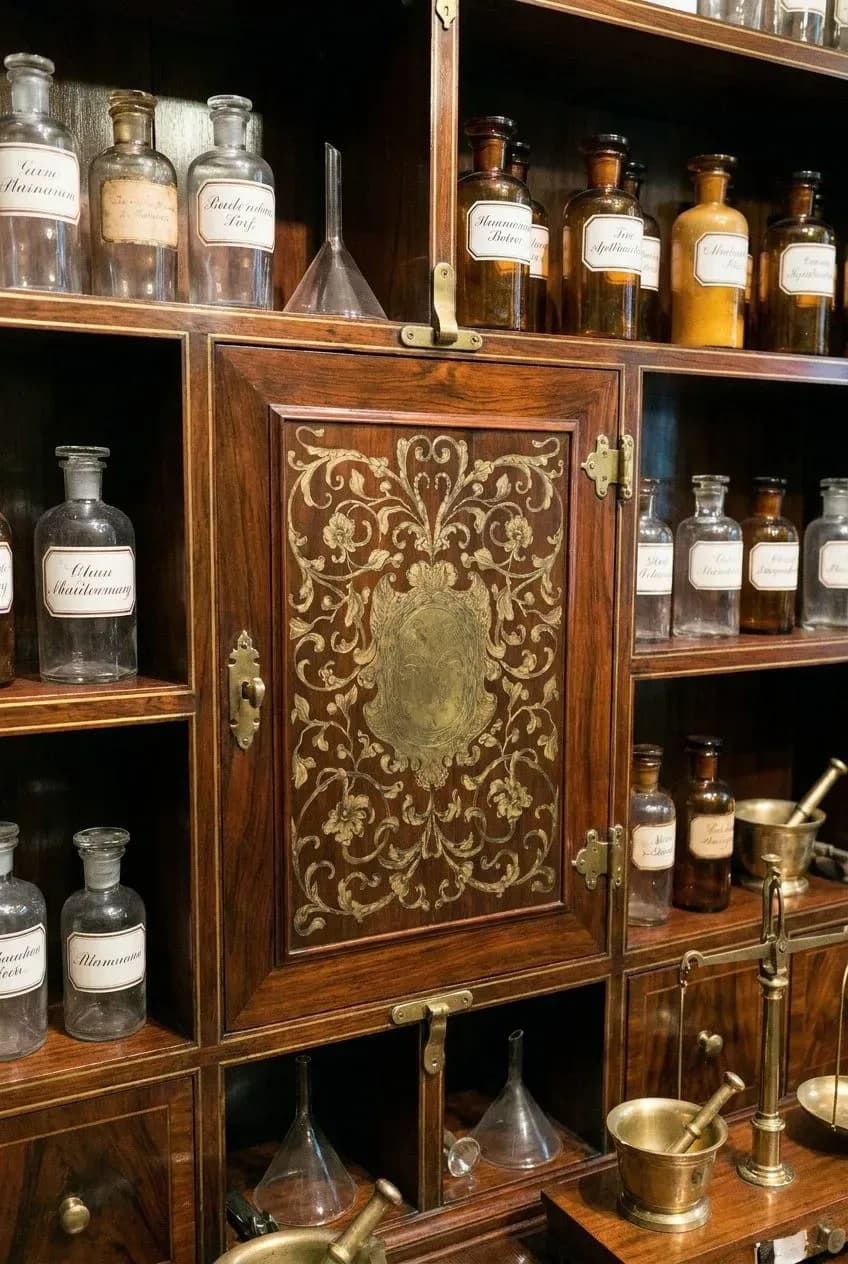
Victorian pharmacy architecture in active use
The apothecary cases rise floor-to-ceiling behind the prescription counter, their glass panels reflecting the winter light that filters through the Sixth Avenue windows. Victorian-era medicine bottles occupy the upper shelves—cobalt blue glass, amber vessels with ground-glass stoppers, ceramic jars bearing faded apothecary symbols. These are display pieces now, their contents long since disposed of or consolidated, but the mahogany framework remains structurally sound and beautiful in the way only well-maintained nineteenth-century joinery can be.
More compelling are the numbered wooden drawers that once held raw pharmaceutical ingredients, each bearing hand-painted labels in serif script: resins, powders, botanical extracts listed by their Latin names. The numbering system runs into the triple digits, a reminder of how many discrete compounds a working apothecary once stocked. The drawers themselves are shallow, sized for bulk materials that would be weighed and measured to order. They're preserved now as architectural elements, their contents removed, but the brass pulls are still warm from decades of handling, worn smooth at the centers where generations of pharmacists reached for cinchona bark or dried chamomile flowers.
Contemporary compounding behind historic fixtures
The apothecary still compounds specialized formulations on-site, continuing a practice that disappeared from most American pharmacies decades ago. The preparation area is visible behind the historic counter, where modern equipment shares space with the Victorian casework. Mortars and pestles of graduated sizes line a marble slab; pharmaceutical-grade scales measure to the milligram. This isn't a demonstration kitchen or a heritage craft exhibit—the pharmacist works here daily, preparing custom-strength topical medications, flavored pediatric suspensions, and specialized compounds that mass production cannot economically serve.
The juxtaposition is striking: contemporary pharmaceutical precision framed by mahogany and etched glass, the old and current practice overlapping in the same narrow workspace. It's a functional arrangement rather than a designed one, the result of continuous operation through multiple technological eras. The shop never closed for renovation, never stripped its interior to modernize, simply added each generation's tools alongside what already worked.
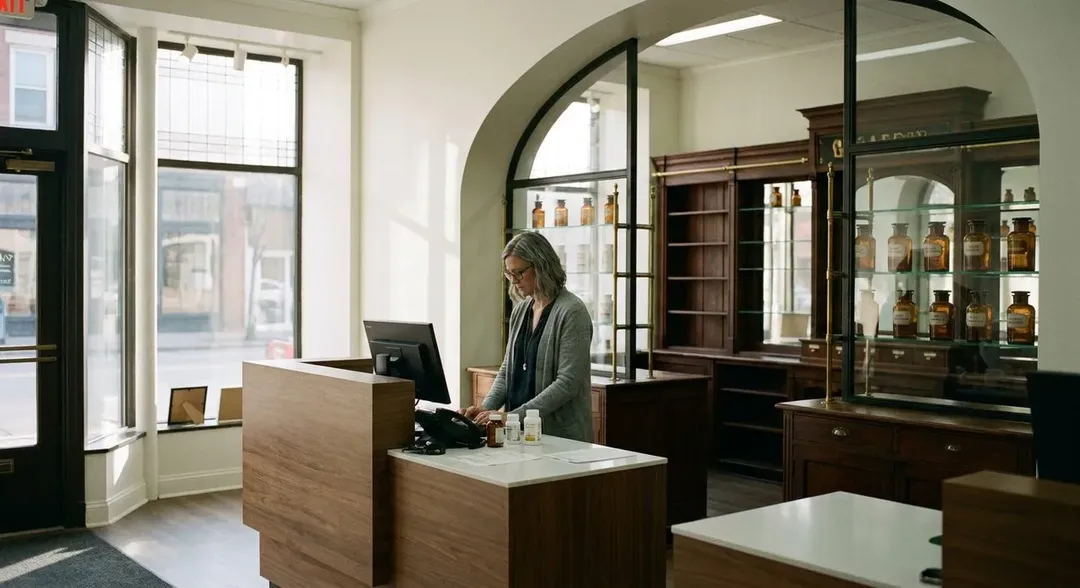
Navigating the narrow footprint
The shop retains much of its original configuration, which means the aisles accommodate perhaps two people passing carefully. Original tin ceiling panels press close overhead, stamped in patterns that catch the overhead lighting. During peak retail hours, particularly weekend afternoons when this stretch of Sixth Avenue fills with browsers working through a West Village city guide itinerary, movement slows to a shuffle. Examining the architectural details requires patience and spatial awareness.
Winter light improves the visibility considerably, particularly on overcast late-2026 mornings when the flat illumination eliminates glare on the glass-fronted cases. The prescription counter occupies the rear portion of the shop, raised slightly above floor level, with the compounding area and vintage fixtures visible behind it. Standing near the counter provides the best vantage for observing the preserved interior, though it also places you in the working pharmacy zone where customers queue for service. The balance requires reading the room—stepping aside when the line lengthens, returning when traffic clears.
House formulations and imported lines
The retail inventory spans contemporary skincare—European imports not widely distributed in the U.S., established American brands, the shop's own house line packaged in glass bottles and tins that echo the vintage aesthetic. The house products include cold creams, rose salves, and glycerin-based formulations that track closely to nineteenth-century recipes, updated for modern stability and safety standards. These sell steadily to regulars who've repurchased the same items for years, alongside tourists attracted by the heritage packaging.
The retail merchandising occupies freestanding fixtures and wall-mounted shelving separate from the pharmacy cases, preserving the architectural features while maximizing product display in the limited square footage. It's a practical arrangement that acknowledges both functions: the working pharmacy with its specialized services, and the retail operation that funds preservation of the historic interior. Neither subordinates the other; both coexist in productive tension within the narrow footprint.
The Village context in late 2026
C.O. Bigelow occupies a retail landscape dramatically different from the one in which it has operated since 1902, surrounded now by national chains and high-turnover storefronts where independent businesses once clustered. The apothecary's persistence—maintaining both pharmacy operations and architectural preservation—represents an increasingly rare business model in Manhattan neighborhoods where rising rents pressure owners toward higher-margin retail or sale. That it continues compounding custom formulations rather than converting fully to gift-shop operations speaks to an institutional commitment that transcends immediate profitability.
The neighborhood regulars who arrive during morning prescription hours understand this implicitly. Their presence supports the pharmacy function that justifies the business's continued operation, creating economic space for preservation of the Victorian fixtures and specialized services that pure retail could not sustain. It's an ecosystem, fragile and pragmatic, playing out daily in a mahogany-paneled shop with a stamped-tin ceiling and numbered drawers bearing century-old painted labels.
Practical notes
C.O. Bigelow Apothecaries, 414 Sixth Avenue near West Eighth Street, Greenwich Village. Nearest subway: West Fourth Street–Washington Square (A/C/E/B/D/F/M lines), nearby. Limited metered street parking; garage parking available on LaGuardia Place. Pharmacy and retail hours vary; verify directly before visiting. The shop is street-level accessible, though narrow aisles may present challenges for wheelchair users or anyone requiring significant maneuvering space. Arrive during morning hours for the quietest retail experience and clearest view of architectural details. Bring cash or card; all major payment methods accepted. Winter visits benefit from natural light that improves visibility of the glass-fronted cases.
Tags: #COBigelow #GreenwichVillage #VintagePharmacy #NYCApothecary #TheOddEdit #VictorianArchitecture #WorkingPharmacy #WestVillage #NYCHistory #NeighborhoodRegulars #HistoricInteriors #CompoundingPharmacy #WinterInNYC #VillageLife #NYCLocal
Sources consulted: C.O. Bigelow Apothecaries · Greenwich Village · Official Bigelow Site · NY Times New York · NYC Landmarks Preservation
All trademarks are the property of their respective owners.
Ask Karpo for more information.
Keep reading
- WORD Bookstore in Greenpoint Remains a Community-Focused Indie Bookstore Near Me
 The Corner Bookstore on Madison Avenue Is Carnegie Hill's Indie Bookstore Near Me
 192 Books in Chelsea Brings Art and Fiction to Indie Bookstore Near Me