 WORD Bookstore in Greenpoint Remains a Community-Focused Indie Bookstore Near Me
Hidden Gems & Odd Finds

A Hat Maker in the Garment District Still Using 1940s Blocks
Third-floor walk-up on 37th; she shapes beaver felt with steam and memory
You climb three flights of narrow stairs on West 37th Street, past a fabric wholesaler and a pattern-making studio, until you reach a door marked only with a peeling number 3. Inside, Miriam Schaefer shapes hats the way her grandmother taught her in 1982, using wooden blocks carved before Pearl Harbor and beaver felt that arrives in stiff cones from a mill in Connecticut. The steam hissing from her vintage kettle sounds like the building's radiators, and the whole operation smells like wet wool and the particular mustiness of old wood that's absorbed decades of humidity.
The Blocks Live in Numbered Cubbies Along the East Wall
Miriam keeps roughly two hundred hat blocks organized by size and era, each one labeled with masking tape and pencil marks that have faded to ghost writing. The 1940s blocks—her most-used collection—occupy the middle shelves where she can reach them without the step stool. You'll see her run her hand over a block's crown before she selects it, reading the wood grain like braille. Some blocks show thumb-worn smooth spots where countless hat makers before her pressed and shaped. She bought most of them at an estate sale in 2003 when a millinery supplier on 38th Street finally closed, paying eight hundred dollars for the entire lot. The oldest block she owns dates to 1936 and gets used exactly twice a year for a private client who orders the same fedora style every autumn and spring. Watch her pull a block and you'll notice she never looks at the labels—her hands know the shapes by weight and texture.
She Starts Every Hat with Twenty Minutes of Steam
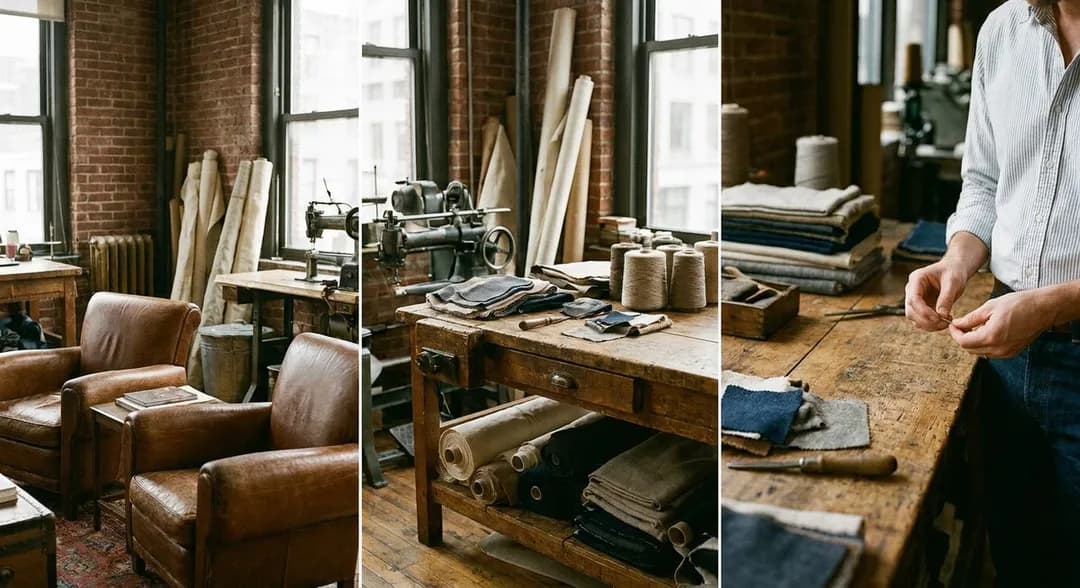
The beaver felt arrives stiff as cardboard, shaped like traffic cones in natural gray-brown. Miriam's steam kettle—a restaurant-supply model from the 1970s—sits on a rolling cart she wheels between her work table and the single industrial sink. She holds each felt cone over the steam for what looks like too long, rotating it slowly while the fibers relax and darken with moisture. The felt goes soft enough to drape, and that's when she stretches it over the chosen block, working from crown to brim with her palms flat and fingers spread wide. You can hear the felt squeak against the wood as she smooths out air pockets and coaxes the material into its new shape. She pins the brim edge with T-pins that belonged to her grandmother, the metal heads worn thin and slightly bent. The whole studio reaches a specific humidity level by mid-morning—you'll feel it the moment you walk in, that thickness in the air that makes your coat feel heavier.
Tuesday Afternoons She Works on Custom Orders Only
Miriam blocks off Tuesdays from one to five for appointments with clients who want hats shaped specifically for their head measurements and style preferences. You need to book at least three weeks out, and she'll ask you to come in for a fifteen-minute fitting where she measures your head in four places using a cloth tape that's marked in both inches and the old hat-size system. She keeps fitting notes in a three-ring binder organized alphabetically, each client's page showing head tracings and penciled notes about crown preferences and brim angles. A regular customer named James comes in every October for the same porkpie shape in charcoal felt—Miriam knows his measurements by heart now but still pulls his page to check her notes. During these appointments she'll make you coffee in a French press, the good beans from the roaster on Ninth Avenue, and she'll talk through the process while she works. The studio gets the best light on Tuesday afternoons when the sun angles through the west-facing windows and turns the floating felt fibers into visible constellations.
The Ribbon Drawer Contains Grosgrain from 1955 to Last Month

Miriam finishes each hat with a grosgrain ribbon band, and her ribbon collection spans seven decades of millinery supply. The vintage ribbons—stored flat in a wide drawer that used to hold architectural plans—come from the same 38th Street estate sale as the blocks. You can spot the older ribbons by their slightly different weave pattern and the way the black has faded to charcoal at the edges. She uses modern ribbon for most orders because clients prefer the crisp finish, but she'll offer vintage ribbon to anyone who asks about it specifically. The vintage grosgrain costs an extra forty dollars per hat, and about one in ten customers chooses it. She hand-stitches every ribbon band with a curved needle, her stitches so small they're almost invisible even when you know where to look. The thread color never quite matches the ribbon—she goes one shade darker deliberately, a technique her grandmother insisted on for durability.
She Learned the Trade During a Summer Internship That Became a Career
Miriam started coming to this building in 1982 as a Parsons student looking for summer work. Her grandmother's friend ran a millinery studio two floors down, and Miriam spent three months learning to read hat blocks and work with steam. She planned to go into costume design but kept coming back to the studio on weekends, then after graduation, then full-time by 1985. She took over this third-floor space in 1991 when a button manufacturer moved to New Jersey, and she's been here through three landlord changes and the complete transformation of the neighborhood around her. The building still has its original 1920s freight elevator, though it only works about half the time. Most days she takes the stairs.
Walk-Ins Can Buy Ready-Made Hats from the Sample Rack
Miriam keeps fifteen to twenty finished hats on a wooden rack near the window—samples and experimental shapes she's made between commissions. These run between one hundred eighty and two hundred forty dollars depending on the felt quality and ribbon choice. She adds new ones irregularly, whenever she has extra felt and wants to try a crown shape she's been thinking about. The rack turns over slowly—sometimes a hat sits there for months, sometimes someone buys three in one visit. She doesn't maintain any online presence, so the only people who find these ready-made hats are the ones who climb the stairs. On Fridays she's usually working on her own designs rather than commissions, and that's when you'll see the most experimental shapes taking form on the blocks.
Practical Notes
The studio operates Tuesday through Friday, roughly ten to six, though Miriam sometimes works earlier or later depending on deadlines. No website, no Instagram—call 212-947-3840 to schedule a fitting or ask about ready-made inventory. Custom hats start at three hundred twenty dollars and take four to six weeks, longer during autumn when everyone suddenly remembers they want a hat for winter. The studio is cash or check only, with an ATM two blocks south on 37th and Seventh. Take the B, D, F, or M to 34th Street-Herald Square and walk north, or the N, Q, R, W to Times Square-42nd and walk south. The building entrance is between a fabric store and a locked door that leads to offices upstairs—look for the brass intercom panel and press button three, though Miriam doesn't always hear it if the steam kettle is running. Bring measurements if you have them. Expect the studio to be warm.
Tags: #TheOddEdit #GarmentDistrict #NYCHats #MillineryStudio #BeaverFelt #VintageBlocks #MadeInNYC #TraditionalCrafts #HatMaker #ManhattanWorkshops #West37thStreet #CustomHats #HandmadeHats #NYCCraftspeople #HiddenNYC
Sources consulted: atlasobscura.com · timeout.com · nytimes.com
All trademarks are the property of their respective owners.
Ask Karpo for more information.
Keep reading
- WORD Bookstore in Greenpoint Remains a Community-Focused Indie Bookstore Near Me
 The Corner Bookstore on Madison Avenue Is Carnegie Hill's Indie Bookstore Near Me
 192 Books in Chelsea Brings Art and Fiction to Indie Bookstore Near Me