There's a particular quality to Washington Square Park in the days before the fountain returns. The circular basin sits empty, its tiered concrete catching the April light at odd angles, pigeons pecking at grit where water will soon churn. Then, typically in mid-April, the city flips the switch. The fountain reactivates for the season, its jets launching skyward around 11:00am daily, and the park's sonic and social geography shifts overnight. The low roar of recirculating water replaces the hollow echo of sneakers on dry concrete. Benches that were merely benches become prime viewing real estate. It's one of the city's most reliable seasonal transitions, and it happens without fanfare—except for those who know to show up.
The seasonal switch and when to expect it
The fountain typically activates for the season in mid-April, weather dependent, and operates seasonally; verify current hours with NYC Parks before publishing. NYC Parks announces the exact start date one week prior, usually via a quiet bulletin buried on their event calendar or through neighborhood message boards. There's no ribbon-cutting, no formal ceremony—just a maintenance crew running final checks and, at the appointed hour, water.
That first morning draws a small crowd of regulars: dog-walkers who've been timing their route past the dormant basin all winter, NYU students emerging from library torpor, retirees who've marked the date on their mental calendars. The sound arrives before the visual spectacle—a mechanical groan, a shudder through the plumbing, then the hiss and spray. By noon the park has recalibrated around it, the fountain once again the kinetic center of the square.
Three water patterns on a 12-minute loop
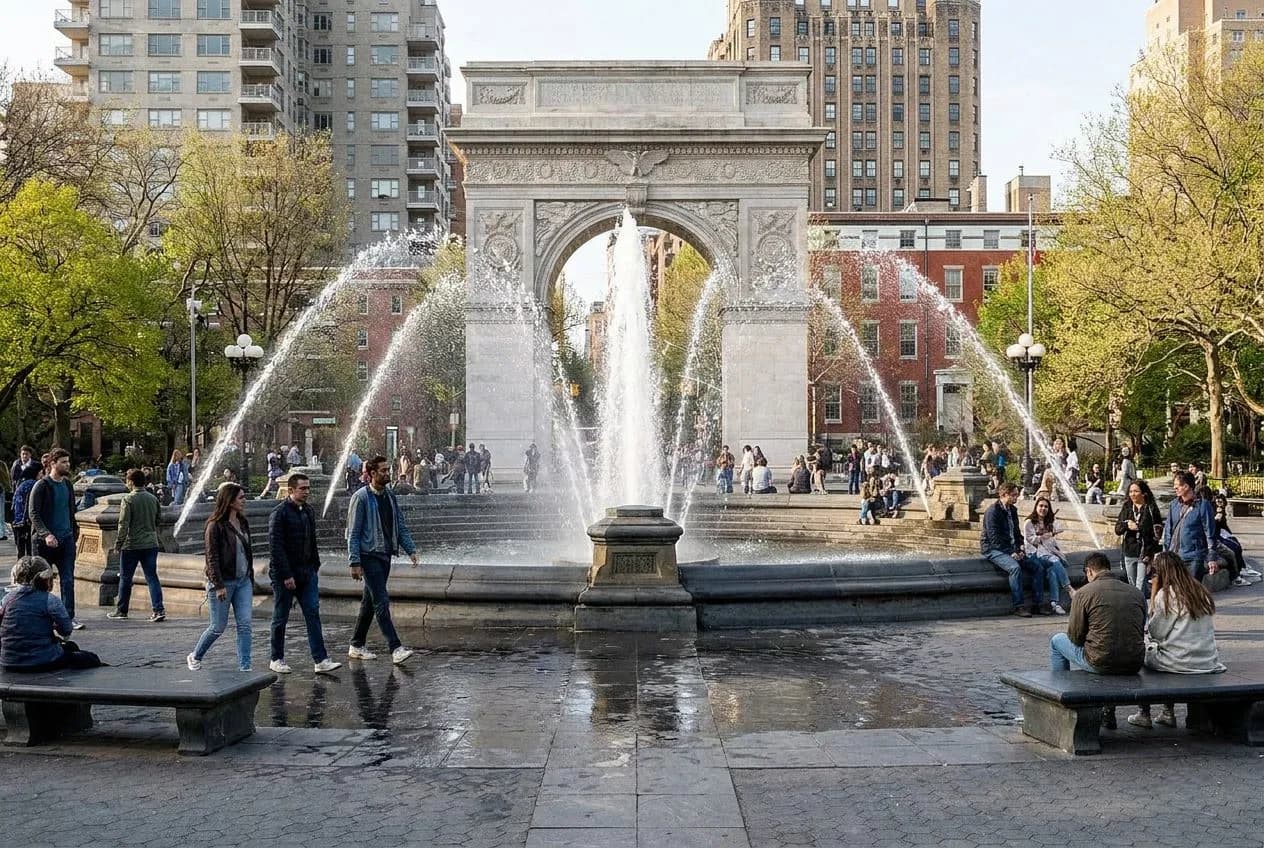
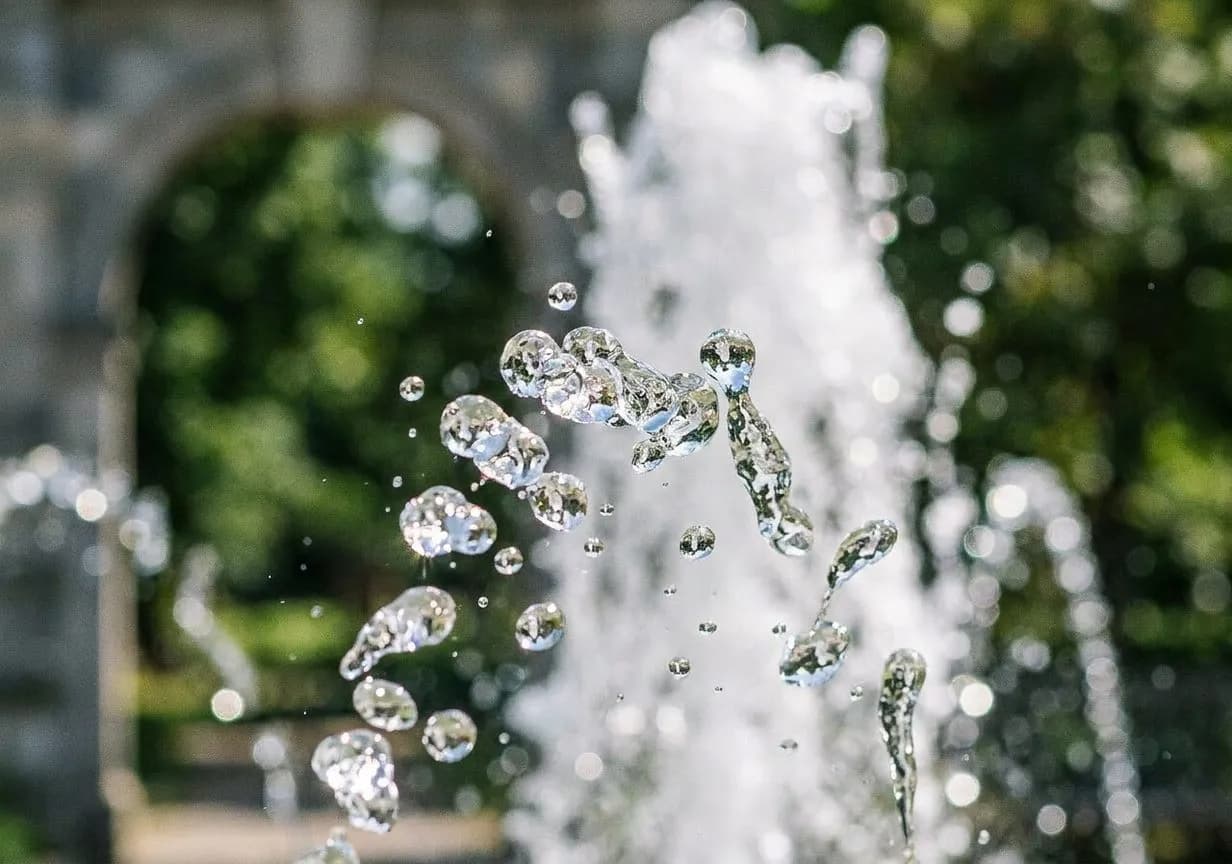
The fountain's water jets cycle through three distinct patterns every 12 minutes: a low perimeter ring that hugs the outer tier, a central geyser burst that launches a single column skyward, and a full-pattern spray reaching 15 feet that activates the entire grid of nozzles. If you're standing at the fountain's edge when the full pattern engages, you'll feel the mist shift—a cool veil that drifts south or west depending on the breeze. The geyser phase is the most photogenic, a thick white plume that catches the light and momentarily drowns out street noise.
The 12-minute rhythm becomes intuitive after a few visits. Regulars time their approach: photographers wait out the low phase, parents with toddlers wade in during the perimeter ring when the splash zone is predictable. The sound varies too—the low ring is a gentle burble, the geyser a percussive roar, the full spray a layered white noise that softens the edges of nearby conversation. It's a metronome for the park's late-morning energy, and it subtly dictates how people move through the space.
Where to sit for the best light and sightlines
The benches near the fountain and Garibaldi statue receive the most consistent midday sun from April through September and offer unobstructed fountain views. These benches fill early—by 11:30am on weekends, they're claimed by readers, sketch artists, and anyone nursing a takeout coffee with no agenda beyond absorbing warmth and watching water. The sun angle is particularly kind here in late April and May, when the light is strong but not yet punishing, and the plane trees overhead haven't filled out enough to cast heavy shade.
The north benches, by contrast, stay cool most of the day—ideal for July but less appealing in spring when you're still shaking off winter. The east and west flanks get dappled light, pleasant but inconsistent. If you're planning to linger, the south side is the move. Bring a paperback or a sketchpad; the fountain's repetition is hypnotic, and an hour can pass without effort. It's easily one of the best free things to do in the park once the weather turns.
The 11am activation and late-morning park rhythms
The 11:00am start time shapes the park's social cadence. Before activation, the plaza belongs to commuters cutting through, early dog runs, tai chi practitioners claiming the eastern quadrant. Once the fountain roars to life, the demographic thickens: families with strollers, tourists orienting themselves, students between classes, musicians setting up near the arch. By noon the park has hit its daytime cruising altitude—crowded but not claustrophobic, animated but not frantic.
The fountain becomes the gravitational center. People arrange themselves in concentric rings: kids wading in the spray zone, a middle band of sitters and photo-takers on the fountain's rim, the benches forming an outer ring of observers. Street performers gravitate toward the southern edge, their acts framed by the arch in one direction and the fountain's spray in the other. The late-morning slot is prime for people-watching without the weekend throngs; it's an ideal window for anyone piecing together low-key weekend plans that don't require an admission fee.
Seasonal atmosphere and October shutdown
The fountain's season runs cleanly from mid-April through October, bracketing the city's warmest months. By late September the late-afternoon light turns golden and slanted, the water catching it at new angles. October brings a bittersweet quality—everyone knows the shutdown is imminent, and there's a faint urgency to the last weeks of operation. You'll see fewer kids splashing, more solo contemplatives soaking up the final days of the water's white noise.
When the fountain finally powers down for the winter, the park exhales. The basin drains, the jets go silent, and the circular plaza returns to its stark geometry. The contrast is sharper than you'd expect—proof of how thoroughly the fountain rewrites the park's sensory landscape when it's active. By November the memory of spray and mist feels impossibly distant, which makes the April reactivation all the more satisfying.
What to bring and when to visit
Arrive mid-morning if you want the benches and a seat in the sun. Bring sunglasses—the glare off the water is real—and something to read or sketch. A light jacket in April is wise; the mist adds a chill even on warm days. If you're planning to wade, know that the fountain's basin isn't sanitized between cycles, and the stone can be slippery. Sneakers or sandals you don't mind getting wet are the move. The park itself is flat and accessible, though the fountain's rim involves a step up.
Practical notes
Washington Square Park is bounded by Waverly Place, University Place, West 4th Street, and MacDougal Street in Greenwich Village. Nearest subway: West 4th Street–Washington Square (A/C/E/B/D/F/M). Street parking is scarce; meter rates apply until 7:00pm most days. The fountain operates daily from approximately 11:00am to 7:00pm, mid-April through October, weather permitting. Restrooms available at the park's northwest corner. The plaza is wheelchair accessible; the fountain rim requires a small step. Verify seasonal hours and activation dates via NYC Parks.
Tags: #WashingtonSquarePark #RightOnTime #NYCParks #GreenwichVillage #FountainSeason #SpringInNYC #FreeThingsToDo #WeekendPlans #ManhattanParks #NYCSpring #CityRituals #UrbanNature #ParkBenches #NYCGuide #CarpoFindssNYC
Sources consulted: Washington Square Park - Wikipedia · Washington Square Park - NYC Parks · NYC Parks Fountains · Manhattan Community Engagement - NYC.gov · New York - The New York Times
All trademarks are the property of their respective owners.