23 Interventions, 8 Matches, Infinite Debate
The Round of 16 at the 2026 World Cup was supposed to be about football. Instead, it became a referendum on technology. Across eight matches played over four days, the Video Assistant Referee system intervened 23 times — an average of nearly three per match. Six on-field decisions were overturned. Three penalties were awarded via VAR that the on-field referee had not given. Four goals were disallowed for offside, including Mohamed Salah's 88th-minute strike against Argentina that was judged offside by approximately three centimeters. The cumulative effect was to place VAR at the center of the World Cup narrative, eclipsing the players, the tactics, and the drama that the technology was supposed to serve.
Following the VAR calls? Ask Karpo for the moments that shaped the knockout rounds.
Match-by-Match VAR Breakdown
Argentina vs Egypt (3-2): Three VAR interventions. A potential handball by Enzo Fernandez not overturned, a yellow card for Otamendi reviewed but not upgraded, and Salah's goal disallowed for marginal offside. All three went against Egypt. Belgium vs USA (4-1): Two VAR interventions. A potential penalty for Pulisic reviewed and denied, and an offside check on Lukaku's second goal confirmed onside. Both favored Belgium. Spain vs Portugal (1-0): One VAR intervention. Merino's winning goal checked for offside and confirmed. France vs Paraguay (1-0): Two VAR interventions. Mbappe's penalty awarded by VAR after on-field referee waved play on, and a Paraguay goal disallowed for offside. Both favored France. Morocco vs Canada (3-0): One VAR intervention. A Canada penalty shout reviewed and denied. Norway vs Brazil (2-1): Two VAR interventions. Haaland's first goal checked for handball and confirmed, Vinicius Junior's potential penalty reviewed and denied. England vs Mexico (3-2): Three VAR interventions. Bellingham's first goal checked for offside, a Mexico penalty awarded by VAR, and a red card for Balogun upheld after review. Switzerland vs Colombia (1-1, Switzerland won 5-4 on penalties): Two VAR interventions. Both offside checks on goals that were confirmed.
The Accuracy Debate
FIFA's official position is that VAR has improved refereeing accuracy from 95% to 99.3% — a figure derived from internal reviews of every VAR decision at the tournament. Critics argue that this statistic is misleading because it treats all decisions as equal: a correctly awarded throw-in and a correctly disallowed goal are counted identically. The more meaningful question is whether VAR's interventions in the Round of 16 were correct. Independent analysis by Referee Review, a professional refereeing assessment organization, concluded that of the 23 interventions, 19 were correct applications of the laws, 2 were "borderline" (the Salah offside and the Pulisic penalty), and 2 were incorrect (the Fernandez handball and the Balogun red card upgrade). A 19-out-of-23 accuracy rate is impressive, but the four questionable decisions all occurred in high-stakes moments that directly affected match outcomes.
The Time Problem
One of the most persistent criticisms of VAR at the 2026 World Cup has been the time required for reviews. The average VAR review in the Round of 16 took 2 minutes and 14 seconds — significantly longer than FIFA's target of 60 seconds. The longest review, Salah's disallowed goal, took 3 minutes and 40 seconds. During these reviews, play is stopped, tension builds, and the emotional rhythm of the match is disrupted. Players have spoken about the psychological impact of scoring a goal, celebrating with teammates and fans, and then waiting three minutes to learn whether the goal will stand. Argentina's Lionel Messi described VAR reviews as "the worst feeling in football — worse than missing a penalty, because at least with a penalty, you know immediately."
The Offside Debate: Millimeters and Margins of Error
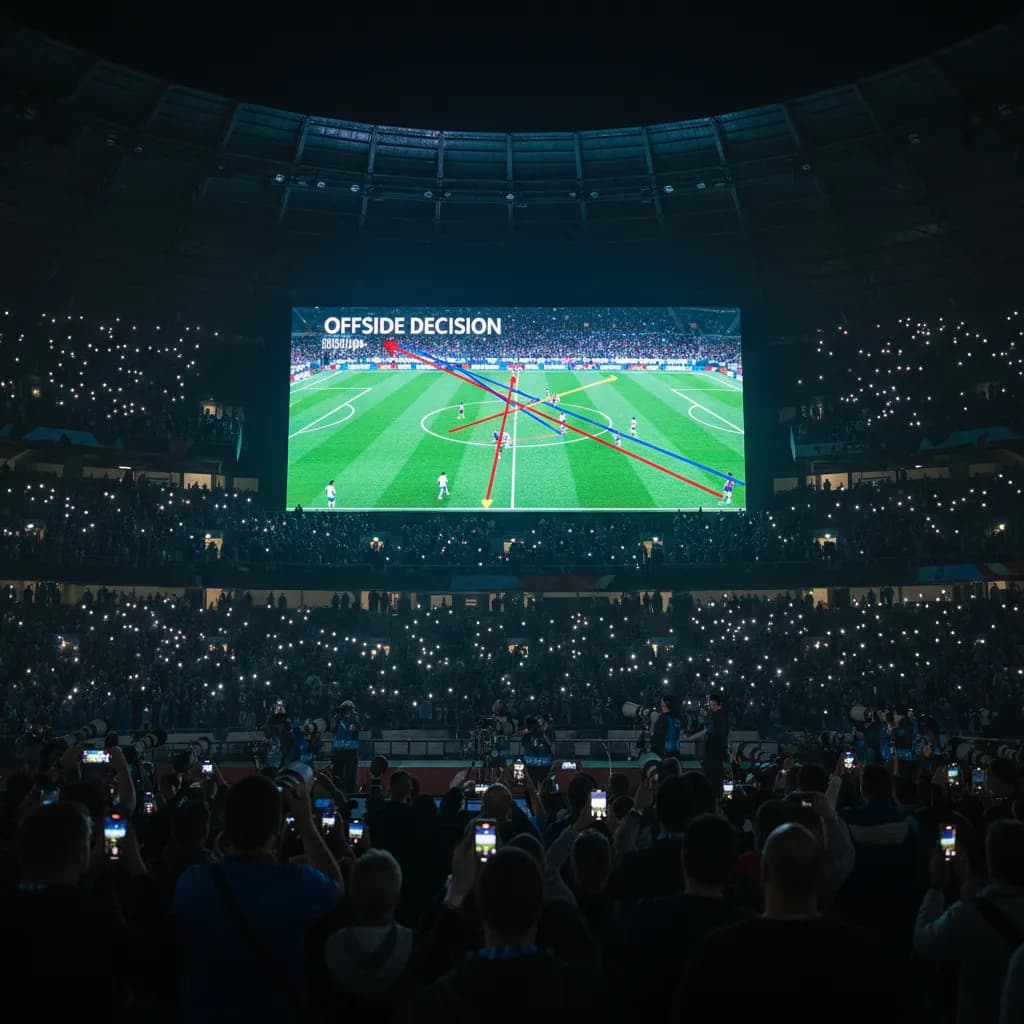
The four disallowed goals in the Round of 16 — all for offside — have reignited the debate about whether VAR should be used for marginal offside decisions. The technology used at the 2026 World Cup, FIFA's Semi-Automated Offside Technology (SAOT), uses 12 dedicated tracking cameras and limb-tracking algorithms to determine player positions. FIFA claims the system is accurate to within one centimeter. Independent researchers at MIT have questioned this claim, arguing that the camera frame rate (50 frames per second) creates a temporal margin of error that translates to approximately two centimeters of spatial uncertainty. If this analysis is correct, then Salah's disallowed goal — judged offside by approximately three centimeters — falls within the system's margin of error.
What Needs to Change
The VAR controversies of the Round of 16 have generated concrete proposals for reform. Former referee Pierluigi Collina, now FIFA's chief of refereeing, has acknowledged that the system needs improvement and has proposed three specific changes for future tournaments: a "thick line" offside rule (in which a player is onside if any scoring part of their body is level with the defender, with a tolerance of approximately five centimeters), a maximum review time of 90 seconds, and the public broadcast of referee-VAR audio communications so that fans can understand the decision-making process. Whether FIFA will implement these changes before the 2030 World Cup remains to be seen, but the pressure for reform is now irresistible.
Tags: VAR, World Cup 2026, Round of 16, offside, technology, Salah disallowed goal, referee, SAOT, FIFA reform, controversy
Sources consulted: ESPN · FIFA · CBS Sports · Yahoo Sports
All trademarks, team names, league names, and player likenesses mentioned in this article are the property of their respective owners and are used here for informational and editorial purposes only.
Ask Karpo First
Want to understand how VAR decisions have shaped the World Cup or follow the referee reform debate? Ask Karpo for a visual breakdown of every VAR decision, the offside technology explained, and the full timeline of controversial calls at the 2026 tournament.