 Where to Eat Near Penn Station That Isn't a Chain
US Open 2026

US Open Tiebreak Rules Casual Fans Should Learn
This simple guide explains US Open singles tiebreak scoring so decisive late-set moments are easier to follow.
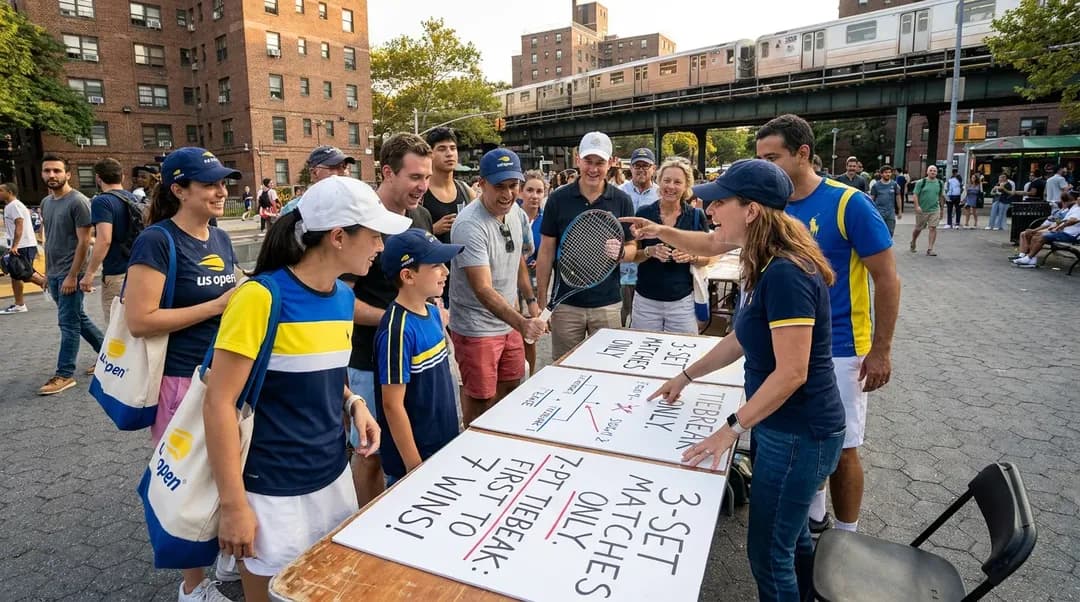
A US Open singles set can feel perfectly clear until the scoreboard reaches 6-6. Then the rhythm changes: the players stop playing regular games, the score starts climbing by individual points, and the server switches after one point, then every two points. That can make a tense finish look more complicated than it is. A tiebreak is simply a shorter race used to decide a tied set. The drama comes from three rules: a player must reach the target number, must lead by two points, and must manage a serving pattern that creates small swings called mini-breaks. Once you know those pieces, the final minutes of a close set become much easier to read.
Text Karpo for a current, low-friction plan for us open tiebreak rules casual fans should learn—including timing, route checks, and practical options that fit your day.
The Basic Tiebreak Math
In a standard singles set, a tiebreak is played when the set score reaches 6-6. In non-deciding sets, it is a 7-point tiebreak. That name means the first player to reach at least seven points wins the tiebreak, but only with a two-point lead. A 7-5 score is finished. A 7-6 score is not finished, because the margin is only one. The players continue until someone leads by two, such as 8-6, 9-7, or 12-10.
The tiebreak counts as one game on the set scoreboard. If a player wins the breaker after the set reaches 6-6, the set is recorded as 7-6. The point score inside the tiebreak may appear beside the set score or be mentioned by commentators, but the main set score still shows one player winning the set seven games to six. That is why a set can be described as “seven-six” even if the tiebreak itself ended 7-3 or 10-8.
The two-point requirement is what keeps the ending from becoming automatic. At 6-4 in a 7-point tiebreak, the leader has two set points. At 6-6, neither player has won the tiebreak, and the pressure resets into a point-by-point duel. There is no deuce call and no advantage scoring. The count simply keeps rising until one player creates the required gap.
Serving Order Without Confusion
Tiebreak serving order feels unusual because it does not copy a normal service game. The player who was due to serve next starts the tiebreak with one service point. After that, the opponent serves two points. Then the players keep alternating in pairs of service points until the tiebreak ends. The easiest memory aid is: one serve to open, then two serves at a time.
- Point 1: the player due to serve starts the tiebreak.
- Points 2 and 3: the other player serves.
- Points 4 and 5: the first player serves again.
- The two-serve pattern continues until the tiebreak is won by two.
Because service changes so often, broadcasters often talk about a mini-break. A mini-break means a player has won a point on the opponent’s serve during the tiebreak. It is not a full break of serve in the normal-game sense, but it matters because the server is usually expected to have some advantage. If a player wins a return point and then protects the next service points, the scoreboard can quickly feel tilted.

Players change ends after every six points in a tiebreak. For example, they may switch sides at 4-2, 3-3, 6-6, or 9-9. The tiebreak itself continues; only the court positions change. Outdoors, that can matter because sun, wind, shadows, and backdrop may feel different from one end. For fans, the change of ends is a good moment to check the score and confirm who serves next.
Deciding Sets Raise Stakes
The deciding set uses a longer version of the same idea. In Grand Slam singles, when the deciding set reaches 6-6, the match is settled by a 10-point tiebreak, with a two-point margin still required. In women’s singles, the deciding set is the third set. In men’s singles, it is the fifth set. The longer target gives the final stage of the match more room before one point swings everything.
A deciding-set 10-point tiebreak is often called a match tiebreak because it decides the winner of the match. The first player to reach at least 10 points, while leading by two, wins. Scores such as 10-8, 11-9, and 14-12 are possible. At 9-7, the leader has match points. At 9-9, the match is still alive because nobody has created the two-point margin.
This changes how a viewer should read momentum. In a 7-point tiebreak, a 4-1 deficit can feel severe because the finish line is close. In a 10-point deciding breaker, 4-1 is still dangerous, but there is more time to recover. A player can regain one mini-break, settle into the serving pattern, and force the opponent to keep making finishing shots under pressure.
Reading The Pressure Points
Tiebreaks do not require different strokes, but they change the cost of each choice. A bold second serve at 2-1 may look confident. The same choice at 6-6 can look risky if the player has been missing. Returners may become more patient on second serves, trying to make the server hit one extra ball. Others may step in and attack because one strong return can create a mini-break.
Watch what happens immediately after the serve. A player landing first serves can start points on offense and protect the two-point serving turns. A player missing first serves may invite aggressive returns even when the score is level. On return, depth matters: a deep block can neutralize a strong serve, while a short return can let the server control the next shot.
- From 0-0 to 3-3, look for first-serve percentage and return depth.
- At 4-4 or 5-5, notice whether players choose safer targets or still attack lines.
- On set point or match point, watch the receiver’s starting position before the serve.
- After a mini-break, see whether the leader can protect the next service points.
The phrase “confirm the mini-break” is useful. If a player wins a point on the opponent’s serve and then wins the next point or two on serve, the advantage becomes stronger. For example, moving from 3-3 to 5-3 can feel larger than a two-point lead because the player has both stolen a service point and defended the gain. If the mini-break is given straight back, the emotional edge can disappear quickly.
Body language can help, but the scoreboard structure tells the clearer story. A player may look calm while facing a dangerous return point. Another may celebrate loudly while still needing to survive the opponent’s next two serves. The best habit is to ask three questions: who serves next, how many points are needed, and whether the leader is actually ahead by the required margin.
Practical Notes
For “US Open Tiebreak Rules Casual Fans Should Learn,” the useful 2026 calendar anchor is August 23 through September 13, with singles main-draw play beginning August 30. If you plan to watch on site, recheck the official schedule before travel because tennis timing can shift. For following tiebreaks in the stadium, choose sightlines that let you see the scoreboard clearly, then note who serves the first point of the breaker. That one detail makes the later two-serve pattern easier to follow. Before acting on “US Open Tiebreak Rules Casual Fans Should Learn,” recheck the official security page; its current limit is one searchable bag per guest, no larger than 12 by 12 by 16 inches.
Tags: #USOpen2026 #Tennis #NewYork #Queens #FlushingMeadows #USOpenGuide #TennisFans #SportsTravel #NYCEvents #HardCourt #KarpoFinds #Karpo
Sources consulted: usopen.org — Official reference · usopen.org — Official reference · usopen.org — Official reference
All trademarks are the property of their respective owners.
Ask Karpo first
Want to know what is confirmed, when to show up, and what is actually open to the public? Ask Karpo for the latest US Open updates and a practical New York plan for us open tiebreak rules casual fans should learn.
Ask Karpo for more information.
Keep reading
- Where to Eat Near Penn Station That Isn't a Chain
 Andytown Coffee in the Outer Sunset: The Snowy Plover Explained
- Best Things to Do in Chicago: What the City Gives Away