 Where to Eat Near Penn Station That Isn't a Chain
US Open 2026
US Open History Hidden Around Flushing Meadows
A walk through Flushing Meadows reveals how US Open tennis grew from old fairgrounds into a landmark shaped by transit, parks, and New York sports.
Before you pick a gate, a seat, or a subway exit, decide what kind of US Open day you want: a pure tennis sprint, a New York history walk, or a little of both. The USTA Billie Jean King National Tennis Center sits in Flushing Meadows Corona Park, but it is not just a sports complex placed in Queens. The ground around it carries layers of world’s fair ambition, mid-century city planning, transit engineering, and stadium memory. If you slow down between matches, the site starts to read like an outdoor museum where tennis is the newest, loudest chapter. That is what makes this tournament setting different: the trip to the court passes through the remains of older New York dreams.
Text Karpo for a current, low-friction plan for us open history hidden around flushing meadows—including timing, route checks, and practical options that fit your day.
A Fairground Becomes Tennis Ground
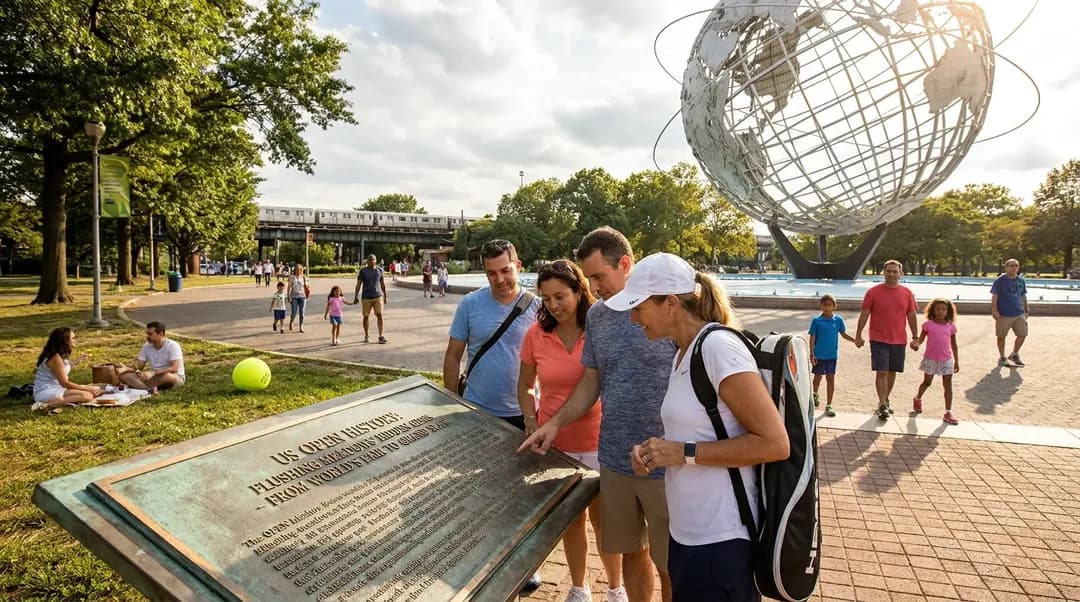
Flushing Meadows became famous to many Americans as a place built for spectacle. The park hosted the 1939-40 New York World’s Fair and, a generation later, the 1964-65 fair. Those events were about technology, transportation, global culture, and the promise that cities could organize modern life on a grand scale. The remaining icons around the park, especially the Unisphere, help explain why the US Open feels different from country-club tennis. The tournament is surrounded by big public space, wide paths, highways, rail lines, and civic monuments rather than quiet lawns.
That setting changes the fan experience. You arrive in a place designed for crowds, movement, and visual drama. The fairground legacy also makes the tennis center feel connected to New York’s habit of reinventing land for new audiences. What was once a stage for nations, pavilions, and corporate optimism became a stage for athletes, night sessions, television, and global visitors. The sport did not erase the fairground; it learned how to use its scale.
City Planning Under Every Footstep
The walk from transit toward the tennis center is part of the story. Flushing Meadows Corona Park was shaped by the idea that a huge urban park could serve many communities at once, not only the nearby blocks. Roads, rails, stadiums, museums, lakes, and open fields all compete for space. That is why the US Open site can feel both highly organized and slightly overwhelming. You are crossing infrastructure, not just entering a venue. The elevated train, the Long Island Rail Road connection, the pedestrian ramps, and the park paths are clues to how New York moves large crowds through a shared landscape.
- Look for the Unisphere as an orientation marker, not just a photo stop.
- Use the broad park paths to understand how the site was built for mass movement.
- Notice how transit, baseball, tennis, and parkland sit within a short walk of one another.
For fans, that means planning should be spatial, not only chronological. A match schedule can tell you when tennis is scheduled, but the park shapes how long it may take to move, meet friends, clear entry, or reset between sessions. The most satisfying route is often the one that reduces backtracking and leaves room to notice the setting. A short pause in the park can make the complex feel less like an isolated arena and more like one piece of a much larger Queens landscape.
From Forest Hills To Flushing
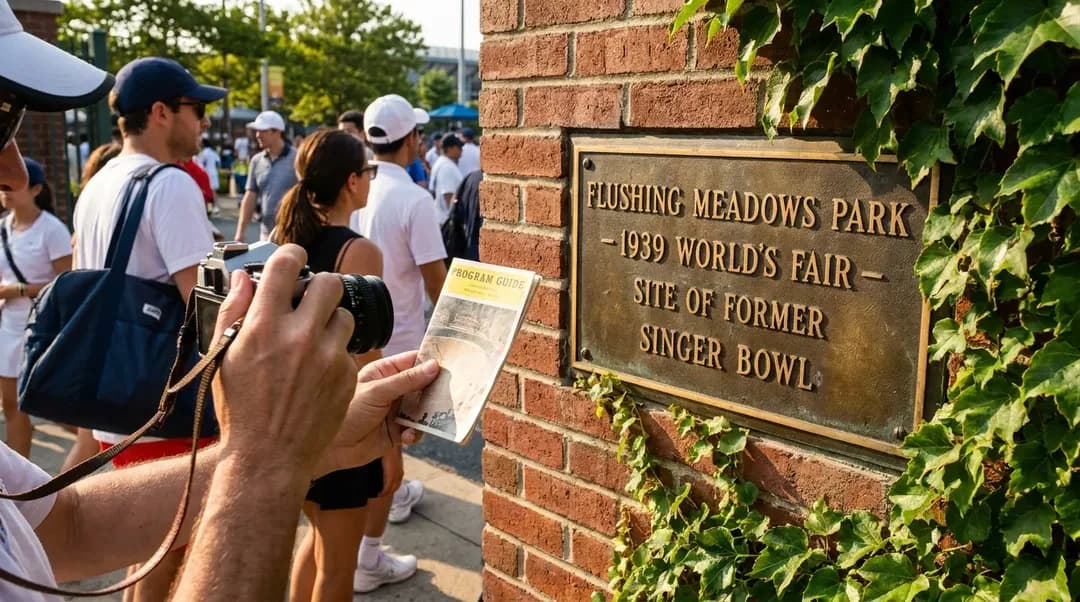
The US Open did not begin in Queens. The tournament’s official history traces the men’s national championship to 1881 in Newport, Rhode Island, and the event later became closely associated with the West Side Tennis Club in Forest Hills. That older chapter matters because Forest Hills represented a different tennis world: smaller, club-based, and more intimate. The move to Flushing Meadows in 1978 changed the tournament’s scale and personality. It placed top-level tennis inside a public park with room for larger courts, heavier crowds, and a more visibly urban identity.
The modern site also tells a story through names. The USTA Billie Jean King National Tennis Center honors one of the sport’s central advocates for equality. Arthur Ashe Stadium, which opened in 1997, brings civil rights, public dignity, and tennis excellence into the venue’s daily geography. Those names are not decoration. They frame how visitors encounter the sport’s history before a ball is struck. In a former fairground, where public symbols were always part of the design, the named courts turn tennis history into a map.
New York Sports In Stereo
Few tennis venues sit so close to another major sports landmark. Citi Field stands beside the tennis center, and the memory of Shea Stadium still belongs to the same neighborhood map. That proximity gives the US Open a New York rhythm: baseball crowds, tennis crowds, commuters, park users, and visitors can overlap in the same late-summer corridor. It also explains why the area can feel like a sports district even though it remains part of a public park. Queens does not separate these identities neatly; it stacks them in view of one another.
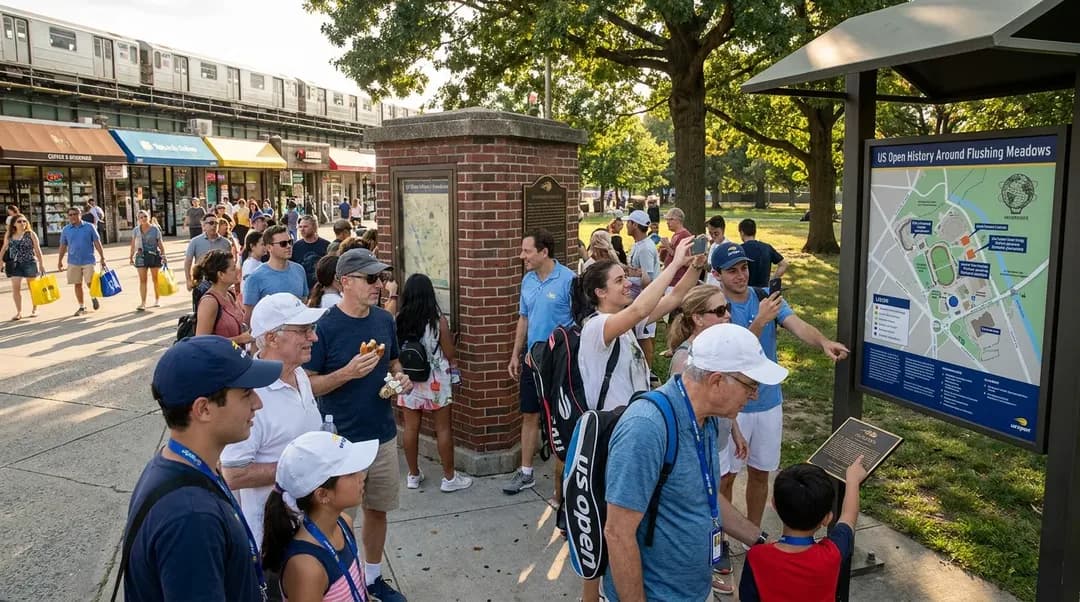
This is useful context for first-time visitors because the sensory mix is part of the place. The roar you hear may not all come from tennis. The traffic pattern may reflect more than one event. The skyline around you may include stadium lights, fair remnants, apartment towers, and planes overhead. Instead of treating that as clutter, treat it as the local texture that makes this Grand Slam distinct. The US Open’s setting is not a neutral backdrop; it is one of the tournament’s signatures.
Practical Notes
For “US Open History Hidden Around Flushing Meadows,” the useful 2026 calendar anchor is August 23 through September 13, with singles main-draw play beginning August 30. Treat those dates as planning anchors, not as a promise of any specific player, match time, price, business hour, transit condition, or available seat. Advice: before travel, recheck the official event schedule and plan-your-visit information for the latest session details, gate guidance, transportation notes, and venue rules. Before acting on “US Open History Hidden Around Flushing Meadows,” recheck the official security page; its current limit is one searchable bag per guest, no larger than 12 by 12 by 16 inches. If you want the history layer, build in enough margin to walk toward the Unisphere, look back at the tennis center from the park, and see how the fairground, the transit lines, and the stadium district fit together.
Tags: #USOpen2026 #Tennis #NewYork #Queens #FlushingMeadows #USOpenGuide #TennisFans #SportsTravel #NYCEvents #HardCourt #KarpoFinds #Karpo
Sources consulted: usopen.org — Official reference · usopen.org — Official reference · usopen.org — Official reference
All trademarks are the property of their respective owners.
Ask Karpo first
Want to know what is confirmed, when to show up, and what is actually open to the public? Ask Karpo for the latest US Open updates and a practical New York plan for us open history hidden around flushing meadows.
Ask Karpo for more information.
Keep reading
- Where to Eat Near Penn Station That Isn't a Chain
 Andytown Coffee in the Outer Sunset: The Snowy Plover Explained
- Best Things to Do in Chicago: What the City Gives Away