 Soap Making Workshop Near Me in Edogawa: Eight Wakuwaku
Weekend Plans
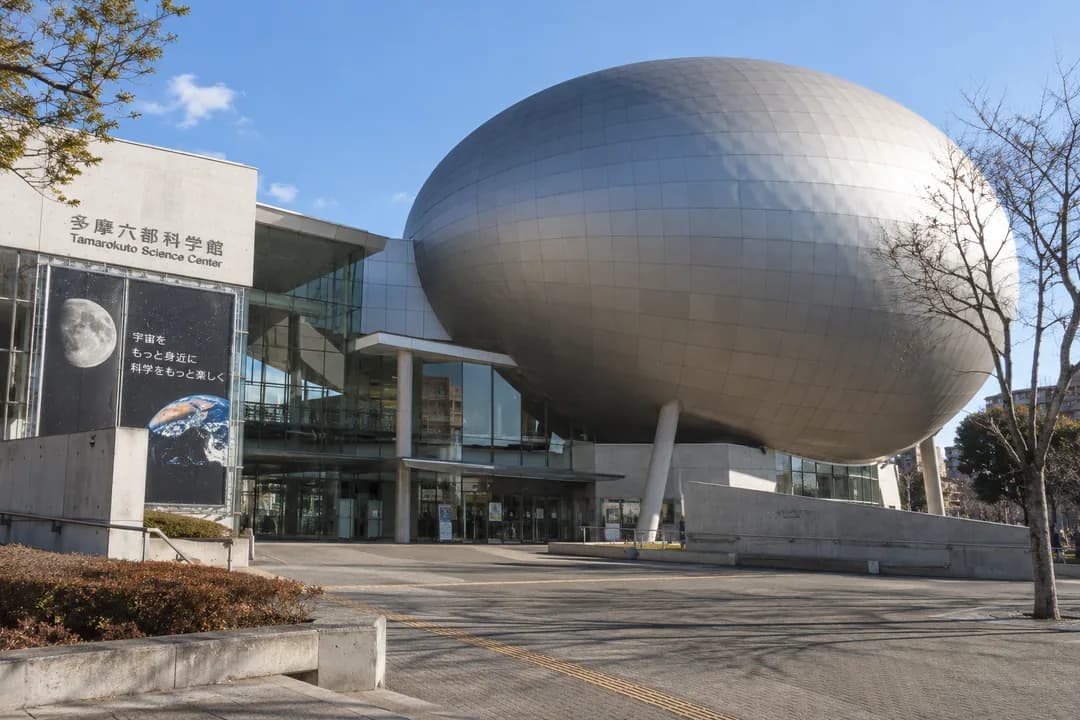
Science Museum Near Me in Nishitokyo: Tamarokuto Planetarium and Labs
Explore Tamarokuto Science Center in Nishitokyo featuring a world-record Guinness planetarium dome and five interactive laboratory galleries.
Located on the gentle wooded plateau of western Tokyo at 5-10-64 Shibakubocho, Nishitokyo, Tokyo 188-0014, Tamarokuto Science Center is one of Japan's most celebrated regional science discovery museums. Renowned for housing a Guinness World Record holding tilted planetarium dome alongside five expansive hands-on laboratory zones, the institution provides an immersive educational bridge between foundational natural laws and modern space science. Visitors encounter interactive exhibits that explore astrophysics, biomechanics, electrical engineering, and regional geology through engaging physical experiments. General exhibition entry is priced at ¥520 for adults and ¥210 for children and students ages 4 to 18, making this expansive museum an exceptionally accessible destination for curious travelers exploring the Tokyo metropolitan area.
Guinness World Record Planetarium and the Science Egg Dome
The architectural centerpiece of Tamarokuto Science Center is the distinctive spherical pavilion known as the Science Egg, which shelters a massive 27.5-meter tilted dome theater. Recognized by Guinness World Records for its extraordinary celestial fidelity, the dome utilizes the custom-built CHIRON II opto-mechanical projector capable of casting more than 140 million pinpoint stars onto the curved ceiling. The optical star projector is synchronized with high-resolution digital projectors to simulate realistic atmospheric perspectives, deep-sky nebulae, planetary flybys, and the rotational dynamics of distant galactic clusters.
Unlike automated planetarium venues that rely entirely on pre-recorded audio tracks, Tamarokuto's astronomy presentations are narrated live by expert resident educators. Each forty-five-minute session begins with an introduction to the actual constellations and wandering planets visible above Tokyo's night sky during the current week, teaching viewers how to identify seasonal asterisms despite suburban light pollution. The astronomers then guide audiences across cosmic epochs, moving smoothly from ancient stellar navigation mythology to the latest gravitational wave discoveries.
The spacious seating inside the Science Egg features tiered, reclining seats engineered to preserve natural neck angles and panoramic viewing comfort across the entire visual arc. Special monthly evening screenings focus on specialized astronomical themes, such as the lifecycles of massive supergiants, the orbital dynamics of near-Earth comets, and exoplanet atmospheric spectroscopy. Acoustic baffles embedded behind the perforated dome panels ensure warm, balanced acoustic dispersion throughout every presentation.
Five Discovery Laboratories Spanning Physics, Biology, and Mechanics
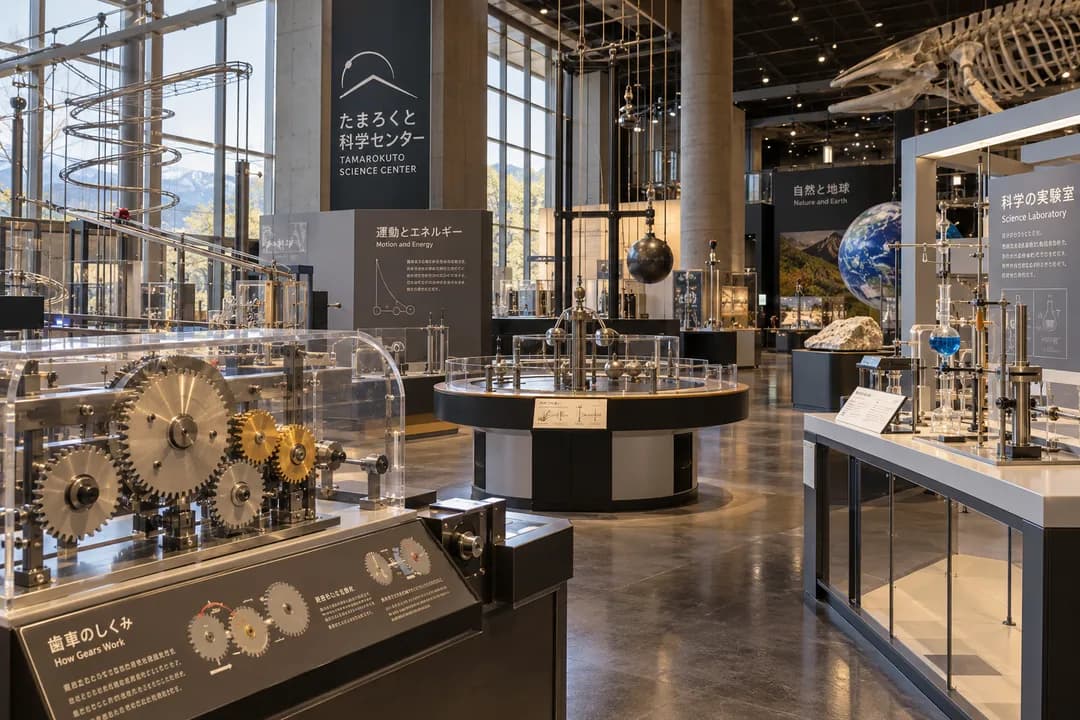
Beyond the planetarium dome, the center's primary exhibition hall is structured into five permanent laboratories arranged around a central sunlit court. The Challenge Lab invites guests to explore foundational physical forces, centering on the Moon Walker apparatus that physically counterweights participants to simulate one-sixth lunar gravity. Visitors strap into safety harnesses and experience the bouncy, floating strides characteristic of Apollo astronauts exploring the lunar surface, directly feeling the relationship between mass, inertia, and gravitational acceleration.
In the adjacent Body Lab, hands-on apparatuses decode human sensory biology and physiological mechanics. Interactive sensor stations measure personal reaction speeds in milliseconds, analyze cardiac rhythms across variable physical exertion, and demonstrate the acoustic limits of human hearing through frequency modulation dials. Visual perception modules showcase dynamic optical illusions, explaining how human retinal cones and neural processing pathways interpret complementary colors, depth gradients, and continuous motion.
The Mechanism Lab focuses on mechanical engineering principles, fluid dynamics, and electrical energy transfer. Visitors turn heavy brass hand-cranks to engage complex planetary gear trains, cam drives, and compound pulley assemblies, observing mechanical advantage and torque amplification in real time. Transparent wind tunnels allow guests to test different airfoil cross-sections against laminar smoke streams, revealing how aerodynamic lift and vortex drag shape everything from bullet train nose cones to high-speed wind turbines.
Ecosystems of Musashino and Earth Science of the Tama Region
The Nature Lab turns attention toward the immediate biological landscape of the surrounding Musashino plateau and Tokyo's western river valleys. Dioramas and living terrariums exhibit native pond life, woodland beetles, burrowing cicada larvae, and migratory waterfowl commonly found along the nearby Shakujii and Tama rivers. Magnified digital stereomicroscopes allow guests to examine the micro-textures of tree bark, delicate butterfly scales, and photosynthetic leaf structures gathered directly from the museum's outdoor biodiversity gardens.
In the Earth Lab, the exhibits trace the geological foundations and seismic history of the Kanto Plain. Visitors inspect real vertical core samples showing layered tephra volcanic ash deposits laid down over millennia by prehistoric eruptions of Mount Fuji and Mount Asama. Detailed tactile fossil displays showcase ancient marine mollusks, prehistoric mammal teeth, and petrified wood fragments uncovered during civil excavation projects throughout suburban Tokyo.
Seismological monitors linked to Japan's regional earthquake warning networks provide continuous readouts of subterranean plate movements and local seismic micro-tremors. Interactive hydraulic tables demonstrate liquefaction phenomena in loose sandy subsoils, illustrating why municipal infrastructure engineers in Tokyo utilize deep concrete foundation pilings to secure buildings against seismic shear stress.
Joint Municipal Origins and Regional Educational Mission Since 1994
Tamarokuto Science Center was formally inaugurated in March 1994 as a pioneering cooperative enterprise managed by the Tamarokuto Science Center Association. The association was founded through a joint inter-municipal partnership uniting five western Tokyo cities: Kodaira, Higashimurayama, Tanashi, Hoya, and Kiyose, with Higashikurume joining the association shortly after. When Tanashi and Hoya merged in 2001 to form the city of Nishitokyo, the institution maintained its beloved multi-city governance model, serving as a shared cultural hub for the region.
The museum's foundational charter, developed in the early 1990s, emphasized tactile inquiry over passive glass-case curation. Rather than reading dense explanatory plaques, visitors are encouraged to touch moving levers, adjust physical rheostats, and conduct repeatable experiments under the guidance of roaming museum docents and volunteer university science scholars. This interactive pedagogical philosophy has made the center an essential field-trip destination for public elementary schools across western Tokyo.
Throughout the year, the center hosts weekend citizen science symposiums, amateur telescope construction workshops, and botanical taxonomy seminars in its dedicated laboratory classrooms. The facility maintains close collaboration with surrounding academic institutions, including Tokyo University of Agriculture and Technology and Hitotsubashi University, routinely hosting visiting researchers who present their active fieldwork to multi-generational family audiences.
Visitor Information, Ticket Pricing, and Transport Connections
Tamarokuto Science Center welcomes visitors Tuesday through Sunday from 9:30 AM to 5:00 PM, with final building admission permitted until 4:00 PM. The museum is closed on Mondays, except when a national holiday falls on Monday, in which case the facility operates as normal and observes closure on the following Tuesday. Ticket pricing offers excellent flexibility: adult entry is ¥520 for permanent exhibitions alone or ¥1,040 for a combined exhibition and planetarium ticket. For children ages 4 through high school students, exhibition admission is ¥210, while the combined planetarium package is ¥420. Toddlers under age 4 enter free of charge.
Reaching the museum via Tokyo's public transit network is straightforward from central Tokyo terminals. From Seibu-Shinjuku Station, board the Seibu Shinjuku Line express train to Hana-Koganei Station, which takes approximately twenty-five minutes. From Hana-Koganei Station's North Exit, board Seibu Bus route Hana 09 or Hana 10 and disembark directly at the Tamarokuto Kagakukan bus stop. Alternatively, the museum is an easy eighteen-minute stroll northward through quiet residential streets lined with residential gardens and suburban greenbelts. For inquiries, the information desk can be reached by phone at +81-42-469-6100.
Before or after visiting Tamarokuto Science Center, travelers can easily combine their excursion with nearby outdoor attractions in western Tokyo. Directly south of Hana-Koganei Station lies the vast expanse of Koganei Park, famous for its springtime cherry blossom groves and the Edo-Tokyo Open Air Architectural Museum, where historic Meiji and Taisho-era residences and traditional bathhouses have been meticulously preserved in a tranquil wooded setting.
Ask Karpo for more information.
Keep reading
- Soap Making Workshop Near Me in Edogawa: Eight Wakuwaku
 Soap Making Workshop Near Me in Nakameguro: Luxum
 Soap Making Workshop Near Me in Ikebukuro: And S