 Soap Making Workshop Near Me in Edogawa: Eight Wakuwaku
Weekend Plans
Science Museum Near Me in Kitanomaru: Tokyo Science Museum Labs
Discover the Science Museum at 2-1 Kitanomaru-koen for interactive mechanics, giant gear physics, automotive cutaways, and full-dome astronomy.
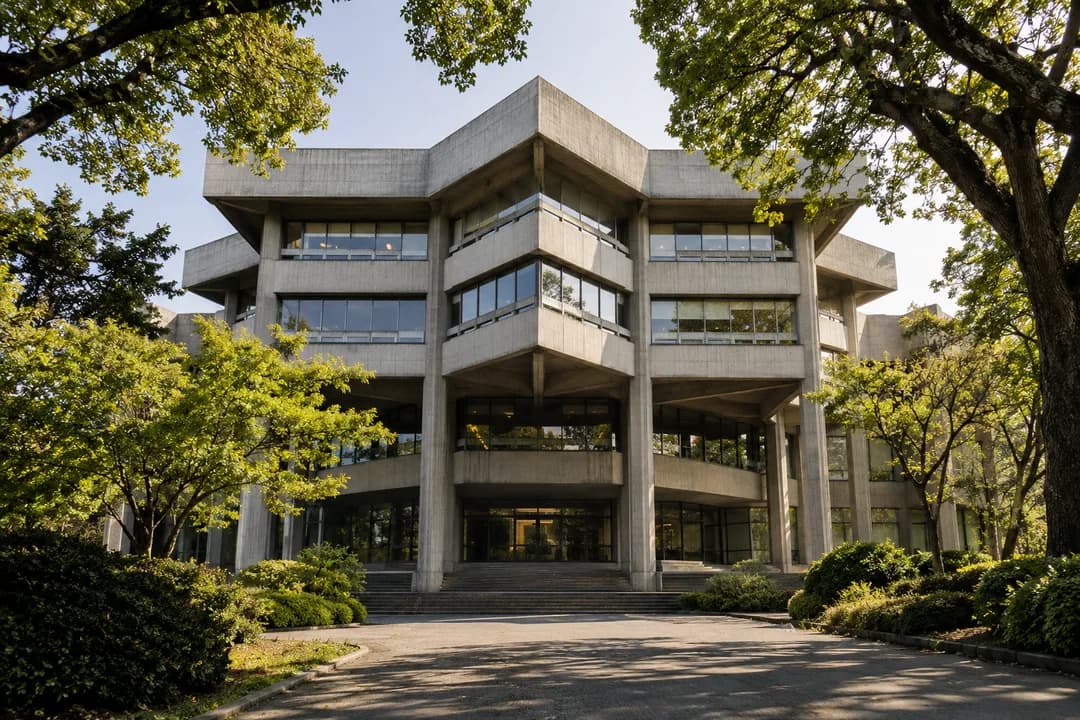
Nestled inside the moated imperial parkland of Kitanomaru Park at 2-1 Kitanomaru-koen, Chiyoda-ku, Tokyo 102-0091, the Science Museum, Tokyo (known in Japanese as Kagaku Gijutsukan) is an interactive, experimental technology museum designed specifically for tactile, participatory learning. Housed in an iconic five-story star-shaped modernist concrete building near the Nippon Budokan, the museum was created by the Japan Science Foundation to cultivate practical engineering literacy among youth and adults. Across four sprawling upper floors, hundreds of hands-on physical installations invite visitors to pull pulleys, rotate giant mechanical gears, steer driving simulators, and experiment with optical lasers and electromagnetic induction. Standard general admission costs ¥950 for adults, ¥600 for junior high and high school students, and ¥500 for children aged four and older.
Hands-on Mechanical Engineering and Kinetic Energy Exhibits
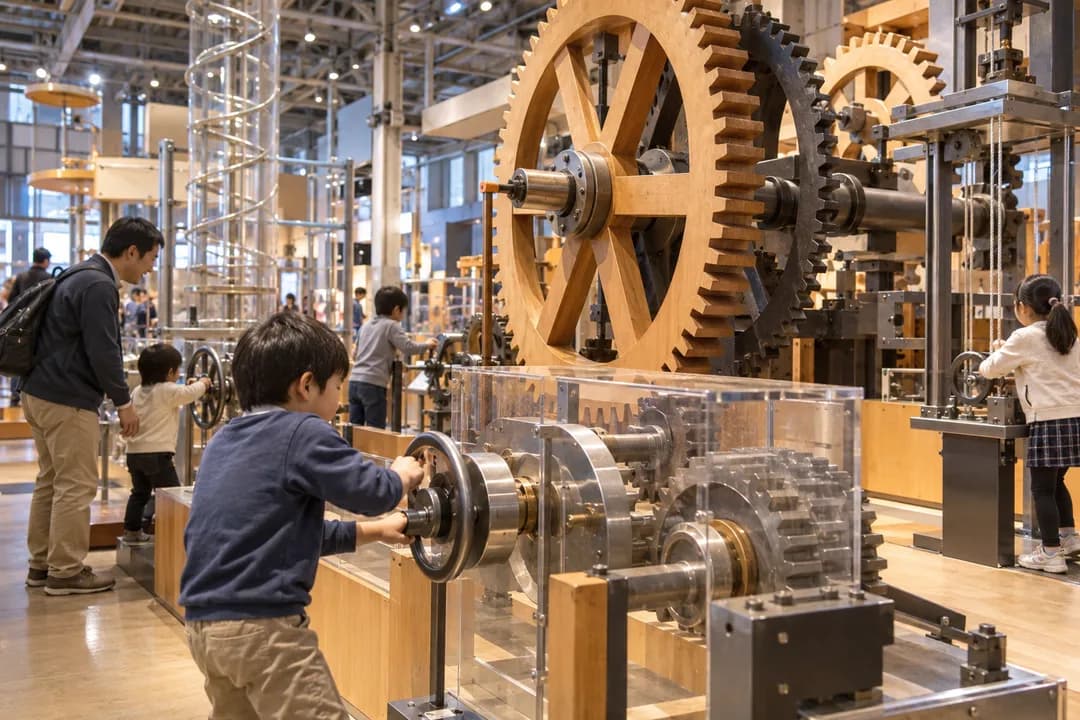
The second floor introduces visitors to fundamental mechanical engineering through the popular 'Mechanics' gallery. Here, visitors encounter a labyrinth of oversized wooden and steel gear trains, ratchets, camshafts, and mechanical linkages. By turning large cast-iron handwheels, guests directly observe how gear reduction converts rapid spinning motions into high-torque lifting forces, hauling heavy weighted steel balls through spiral Archimedes screws and gravity tracks.
A neighboring section demonstrates the physics of levers, pulleys, and friction. Children and adults sit in suspended harness chairs and pull on different block-and-tackle rope configurations, discovering how compound pulley systems reduce the physical effort needed to hoist their own body weight into the air. Nearby, air-cushion puck tables and kinetic pendulum installations let guests test Newton's laws of motion through direct physical experimentation.
The mechanical engineering area also features interactive torque scales and balance beams. Visitors adjust counterweights and pivot fulcrums along calibrated steel girders to discover the mathematical relationship between lever arm distance and equilibrium, providing tangible physical insights into bridge construction and crane design.
Automotive Transmissions, Electric Motors, and Optical Physics
On the fourth floor, the automotive and transport technology pavilion features full-scale vehicle cutaways revealing the inner workings of modern internal combustion engines and hybrid electric drivetrains. Transparent transmission casings with color-coded gears show how automatic clutches and planetary gear sets shift ratios in real time. Visitors can sit in authentic driver's cabs to operate computerized driving simulators that model regenerative braking and anti-lock brake systems (ABS).
The optical science and illusion laboratory on the same floor explores the electromagnetic spectrum through lenses, mirrors, and prisms. Visitors experiment with polarized light filters that reveal stress fractures in transparent plastics, navigate a maze of distortion mirrors, and align helium-neon laser beams across mirror arrays to trigger photodiode sensors. Interactive light tables let guests mix red, green, and blue light beams to study additive color theory versus pigment subtractive mixing.
A dedicated acoustics room allows guests to experiment with sound wave resonance and standing waves. Visitors speak into coiled acoustic delay pipes to hear their own voice echo back seconds later, or use parabolic sound mirrors positioned across the room to whisper messages across long distances with pinpoint acoustic clarity.
Electromagnetic Laboratories and Synra Dome Projections
Ascending to the fifth floor, visitors discover extensive interactive zones dedicated to electricity, magnetism, and material sciences. Hands-on Van de Graaff electrostatic generators allow guests to observe static electric discharge arcs and hair-raising charge accumulation. Electromagnetic induction tables demonstrate how fluctuating magnetic fields generate electric currents inside copper rings, causing aluminum discs to levitate through magnetic repulsion.
The fifth floor also houses the Synra Dome, a high-definition digital planetarium and full-dome immersive theater. Equipped with multi-channel digital projection systems, the dome screens educational astronomical journeys that transport audiences from the Earth's upper ionosphere through the solar system and across the Milky Way. Surrounding exhibits explore nuclear energy generation, photovoltaic silicon solar cells, and energy conservation systems used in smart residential power grids.
In the materials science corner, guests test the tensile strength, elasticity, and thermal conductivity of metals, polymers, and carbon-fiber textiles. Interactive hydraulic crushers demonstrate compressive failure modes, while shape-memory alloy wires snap back into preformed shapes when exposed to hot air streams.
A 1964 Olympic Era Star Shaped Landmark in Kitanomaru Park
The Science Museum, Tokyo was officially established in April 1964 by the Japan Science Foundation, opening its doors just months before the 1964 Tokyo Summer Olympics. The distinctive architectural structure features a five-pointed star footprint with perforated concrete lattice exterior screens that filter natural sunlight while keeping indoor gallery spaces cool and energy-efficient.
Over its six decades of operation, the museum has continuously updated its technical galleries in close collaboration with leading Japanese engineering firms and universities. Historical showcases celebrate key postwar Japanese innovations, from early transistor radios and quartz timing circuits to high-speed Shinkansen railway bogies and carbon-fiber composite materials, reflecting Japan's remarkable rise as a global manufacturing powerhouse.
The building itself stands as an important monument of mid-century Japanese structural engineering. Designed by architect Mamoru Yamada, who also designed the neighboring Nippon Budokan, the building uses reinforced concrete shear walls to withstand major seismic tremors while maintaining unobstructed open-plan exhibition floors.
Practical Visiting Notes for Kudanshita and Tayasumon Gate
The Science Museum is open to visitors from 9:30 AM to 4:50 PM, with last entry permitted at 4:00 PM. The museum is closed on Wednesdays, but remains open during Japanese public holidays and school vacation periods. General admission is ¥950 for adults, ¥600 for junior high and high school students, and ¥500 for children aged four to elementary school age, while children three and younger enter free. The main administrative telephone number for visitor assistance is +81 3-3212-8544.
The museum is conveniently situated inside Kitanomaru Park, accessible from Kudanshita Station (Tokyo Metro Tozai, Hanzomon, and Toei Shinjuku Lines). Taking Exit 2, visitors enter the park through the historic 17th-century Tayasumon Gate, a registered National Important Cultural Property, and walk seven minutes along the tree-lined avenue. Alternatively, Takebashi Station (Tozai Line, Exit 1b) is a seven-minute walk past the National Museum of Modern Art. After touring the science exhibits, visitors can walk to the neighboring Nippon Budokan, explore the outer moats of the Imperial Palace, or relax in the tranquil green lawns of Kitanomaru Park.
Most families and visitors spend roughly two hours engaging with the hands-on science exhibits across the second through fifth floors. The museum features a basement cafeteria serving hearty noodle and curry dishes, as well as a spacious museum shop on the first floor selling mechanical puzzle sets, optical prisms, and model rocket assembly kits.
Ask Karpo for more information.
Keep reading
- Soap Making Workshop Near Me in Edogawa: Eight Wakuwaku
 Soap Making Workshop Near Me in Nakameguro: Luxum
 Soap Making Workshop Near Me in Ikebukuro: And S