 Soap Making Workshop Near Me in Edogawa: Eight Wakuwaku
Weekend Plans
Science Museum Near Me in Odaiba: Miraikan National Emerging Innovation
Explore Miraikan at 2-3-6 Aomi in Odaiba for the giant Geo-Cosmos OLED sphere, advanced humanoid robotics, and space exploration laboratories.
Located on the reclaimed waterfront district of Odaiba at 2-3-6 Aomi, Koto-ku, Tokyo 135-0064, Miraikan—the National Museum of Emerging Science and Innovation—is Japan's premier public institution dedicated to frontier scientific research, robotics, and astrophysics. Built with soaring glass curtain walls and an airy central atrium, the museum was engineered by the Japan Science and Technology Agency to demystify complex research emerging from universities and national laboratories. Visitors explore interactive science exhibits ranging from real-time planetary monitoring and artificial intelligence to subatomic physics detectors and deep-space habitats. General admission for the permanent exhibition costs ¥630 for adults, ¥210 for children and students 18 and under, while preschool children enter for free.
The Geo-Cosmos OLED Globe and Real Time Planetary Science
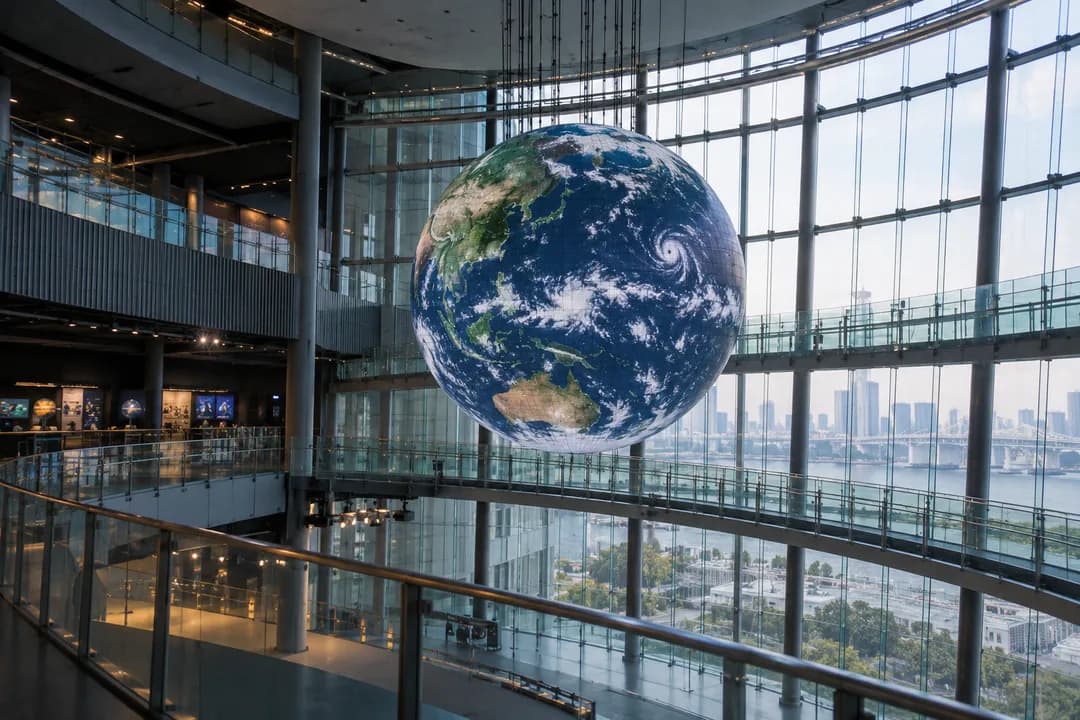
The iconic visual centerpiece of Miraikan is the Geo-Cosmos, a spherical display globe measuring six meters in diameter suspended dramatically from the sixth-floor ceiling. Composed of ten thousand three hundred and sixty-two organic light-emitting diode (OLED) panels, the sphere boasts a resolution exceeding ten million pixels. The display rotates continuously, projecting real-time satellite imagery of Earth's cloud movements, ocean surface temperatures, and atmospheric weather patterns recorded daily by weather satellites.
Visitors lie on circular reclining couches directly beneath the sphere or walk along the suspended spiral ramp to view the globe from varying elevations. Interactive touchscreen kiosks lining the ramp allow users to overlay distinct scientific datasets onto the sphere, illustrating global maritime shipping corridors, human population density, earthquake epicenters, and ozone concentration levels. The exhibit turns raw geophysical satellite data into a mesmerizing visual study of planetary health.
The sphere connects directly to Miraikan's Tsunagari global data system, which integrates satellite observations from international space agencies. High-definition projections periodically show atmospheric carbon emissions dispersing over the continents across seasonal shifts, illustrating the interconnected nature of global environmental dynamics. Audio narrations softly guide viewers through planetary cycles while ambient music plays across the sunlit atrium.
Humanoid Robotics, Android Research, and Artificial Intelligence
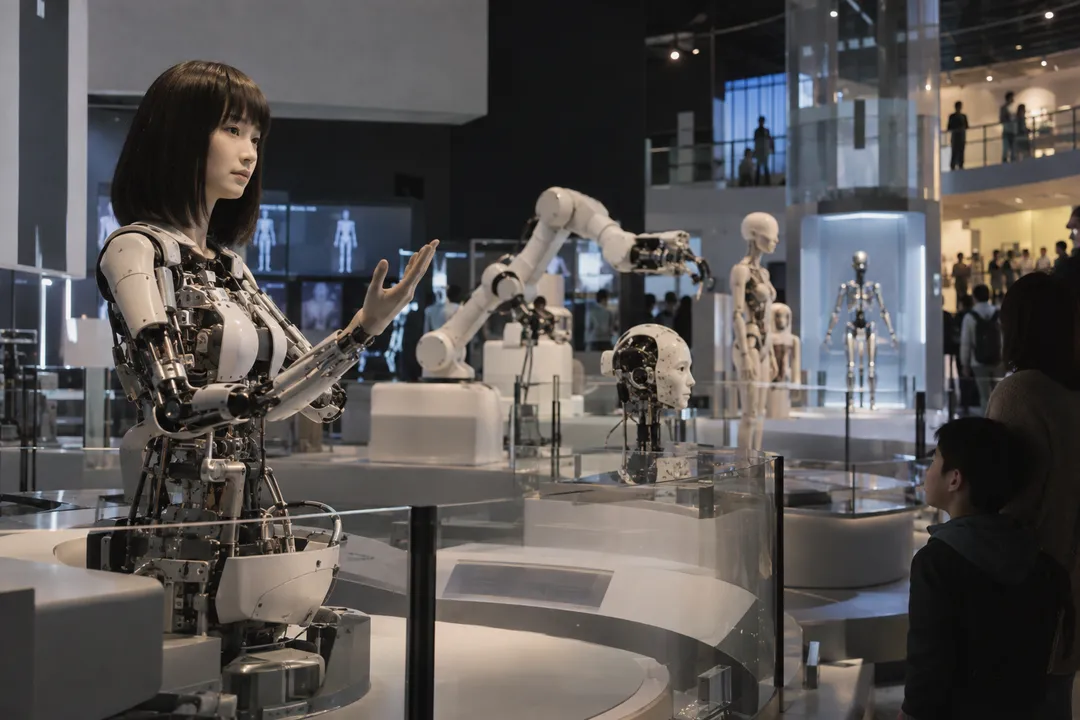
On the third floor, Miraikan's robotics and android galleries present the cutting edge of human-machine interaction, featuring ongoing research from roboticist Hiroshi Ishiguro. Visitors meet Otonaroid, a lifelike female android equipped with silicone skin, pneumatic actuators, and realistic eye micro-movements capable of autonomous conversation. Nearby stands Alter, a complex robotic torso featuring exposed pneumatic cylinders and neural network algorithms that generate spontaneous, organic-looking gestures.
The gallery also traces the historical milestones of bipedal locomotion pioneered by ASIMO and modern industrial collaborative robots. Interactive exhibits invite visitors to test their reflexes against machine-vision cameras and explore the ethical dilemmas of artificial intelligence integration. Young visitors and adults alike can interact with robotic therapy seals and companion bots, examining how mechanical tactile sensors and responsive motors evoke genuine emotional reactions from humans.
Scheduled live robotic demonstrations take place several times daily in the central arena. Visitors watch researchers test multi-jointed walking algorithms and object-recognition neural networks on uneven terrain. Informational panels explain how inverse kinematics and gyroscopic stabilization allow humanoid machines to maintain equilibrium during unexpected physical disturbances.
Quantum Computing Laboratories and Life Science Breakthroughs
The fifth-floor permanent exhibition focuses on the frontier of fundamental physics and genetic biology. In the physics zone, visitors walk through an atmospheric spark chamber that visualizes cosmic rays: when high-energy subatomic particles from outer space strike the gas chamber, glowing electrical sparks instantly ignite along their trajectories. Displays also introduce the engineering principles behind the Super-Kamiokande neutrino observatory, complete with genuine photomultiplier tubes salvaged from deep underground neutrino detectors.
The cellular biology pavilion explores CRISPR-Cas9 genome editing, stem cell therapies, and synthetic biology through hands-on mechanical models and digital puzzles. Transparent laboratory chambers demonstrate how researchers culture induced pluripotent stem (iPS) cells and reconstruct human organ tissue. Visitors manipulate oversized double-helix DNA puzzles to understand the biochemical mechanics of transcription, translation, and genetic mutations in living organisms.
An interactive quantum computing zone explains quantum superposition and entanglement using polarized optical photon experiments. Guests can manipulate physical dials to observe how quantum bits can represent zero and one simultaneously, and study how cryogenic dilution refrigerators keep superconducting quantum circuits cooled to near absolute zero.
Mamoru Mohri and the 2001 Founding of JST's Flagship Museum
Miraikan was established in July 2001 under the leadership of Japanese astronaut Mamoru Mohri, who served as the museum's founding Chief Executive Director after flying aboard NASA Space Shuttle missions STS-47 and STS-99. Dr. Mohri envisioned Miraikan not as a static repository of past inventions, but as a dynamic open forum where active research scientists, engineers, and everyday citizens could debate the future direction of scientific progress.
The space exploration pavilion reflects Mohri's personal astronaut legacy, featuring a full-scale walk-through replica of the International Space Station's Columbus and Kibo laboratory modules. Visitors peer into zero-gravity astronaut sleeping quarters, inspect space-grade food packets, and study water recycling loops used aboard orbiting space stations, learning how orbital life-support systems manage oxygen generation and carbon dioxide removal.
The museum also showcases deep-sea exploration technology, including a titanium pressure sphere replica from the Shinkai 6500 manned research submersible. Exhibits present hydrothermal vent ecosystems thriving under extreme hydrostatic pressures, demonstrating how chemosynthetic bacteria survive without sunlight at the ocean floor.
Practical Notes for Odaiba and Telecom Center Station
Miraikan is open to the public from 10:00 AM to 5:00 PM Wednesday through Monday, remaining closed on Tuesdays except during national holidays and Japanese school vacation weeks. General admission tickets cost ¥630 for adults and ¥210 for visitors eighteen and under. Admission to the Dome Theater Gaia, which screens 3D spherical planetarium films, requires a small additional fee of ¥310 for adults and ¥100 for children. For visitor services and general inquiries, the museum telephone line is +81 3-3570-9151.
The museum is readily accessible via Tokyo's waterfront transit network. Commuters take the automated Yurikamome elevated train to Telecom Center Station (a 4-minute walk) or Tokyo International Cruise Terminal Station (a 5-minute walk). Alternatively, visitors can take the Rinkai Line to Tokyo Teleport Station, located a pleasant 15-minute walk through the waterfront parks. Nearby attractions in Odaiba include the life-sized Unicorn Gundam statue at DiverCity, teamLab Planets in Toyosu, and the scenic Odaiba Seaside Park promenade overlooking Tokyo Bay and the Rainbow Bridge.
Visitors planning to see Dome Theater Gaia screenings should reserve ticket time slots upon morning arrival, as popular shows frequently sell out by midday. The museum features a top-floor observation restaurant offering panoramic views toward the Tokyo skyline, as well as a ground-floor museum shop stocking robotics kits, space food packages, and science experiment books.
Ask Karpo for more information.
Keep reading
- Soap Making Workshop Near Me in Edogawa: Eight Wakuwaku
 Soap Making Workshop Near Me in Nakameguro: Luxum
 Soap Making Workshop Near Me in Ikebukuro: And S