 Soap Making Workshop Near Me in Edogawa: Eight Wakuwaku
Weekend Plans
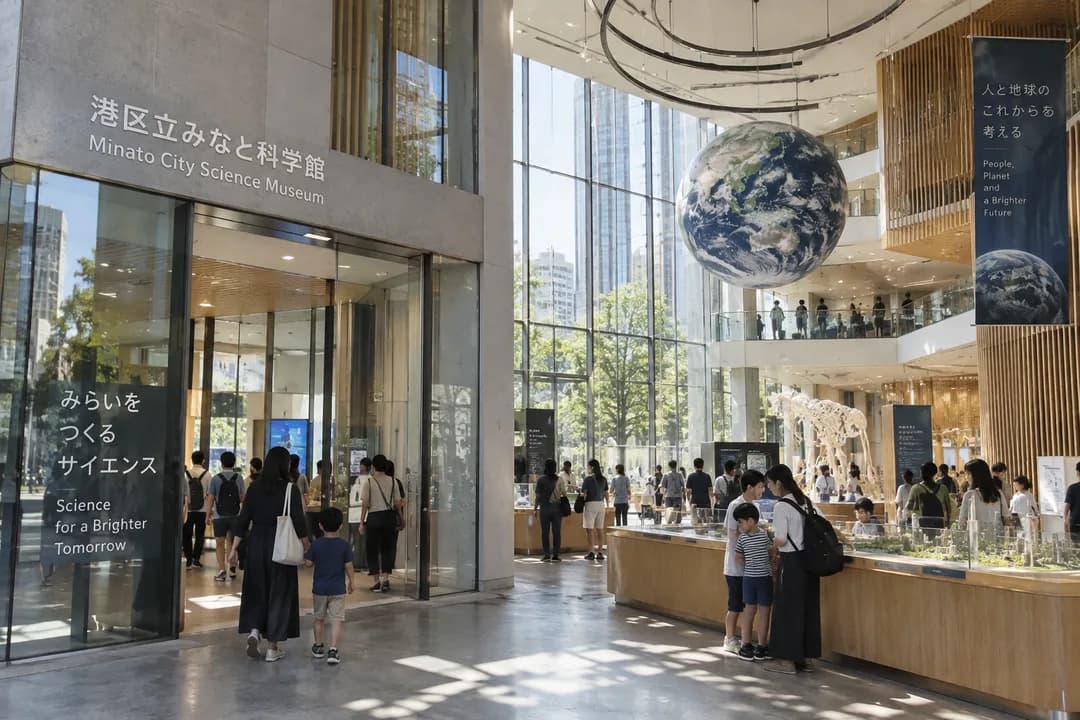
Science Museum Near Me in Toranomon: Minato City Interactive Galleries
Discover Minato City Science Museum in Toranomon with free interactive urban technology exhibits and an optical-digital hybrid 4K planetarium.
Nestled in the bustling central business district of Toranomon at 3-6-9 Toranomon, Minato-ku, Tokyo 105-0001, Minato City Science Museum is an innovative urban institution dedicated to exploring the unseen scientific systems underpinning Tokyo. Co-located with the Japan Meteorological Agency's Weather Science Museum inside the Minato City Education Center, the museum opened to reveal how physics, meteorology, urban engineering, and marine biology converge in everyday city life. Visitors of all ages explore tactile digital installations, seismic simulators, and a cutting-edge hybrid 4K planetarium dome. Permanent gallery admission is completely free of charge, offering visitors exceptional cultural value within walking distance of Toranomon Hills.
Urban Technology and Everyday City Science Exhibits
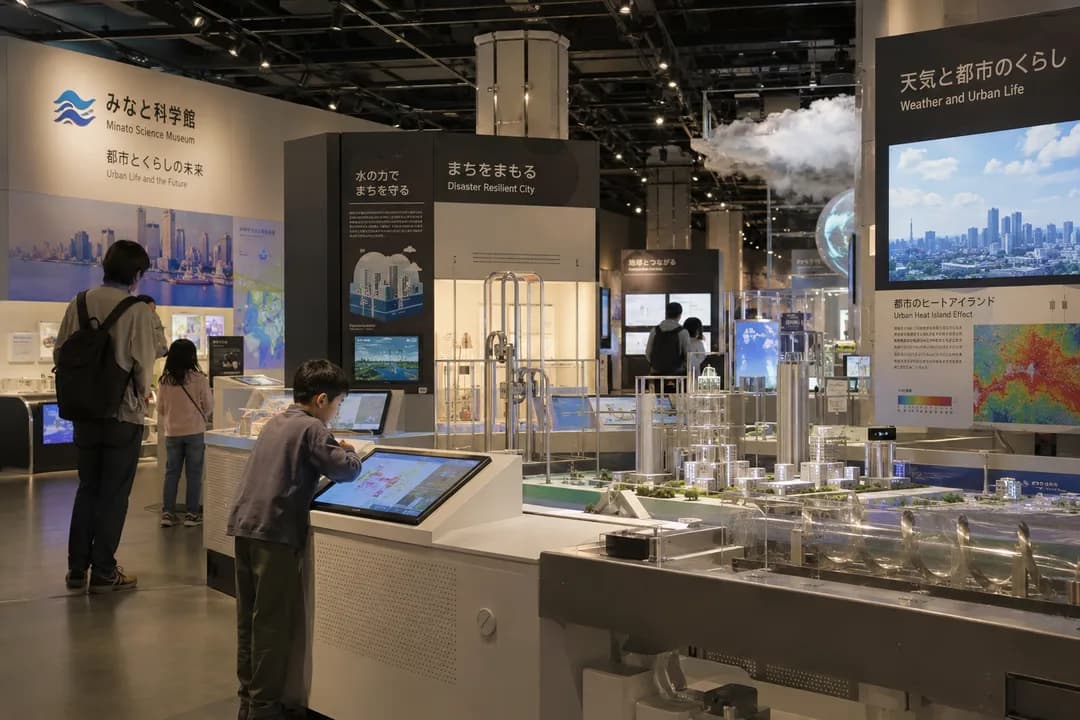
The first-floor permanent exhibition hall is structured around the unifying theme of city science, presenting how modern civil infrastructure allows millions of residents to thrive safely in a dense metropolitan environment. The City zone showcases the sophisticated structural engineering incorporated into Tokyo's contemporary skyscrapers. Interactive cutaway architectural models explain tuned mass dampers, flexible base-isolation rubber bearings, and hydraulic shock absorbers that counteract severe seismic vibrations during major earthquakes.
Guests can manipulate physical cross-section piping displays to trace how clean drinking water is pumped from the Tone and Tama river basins through subterranean distribution networks into high-rise domestic taps. Another hands-on station illustrates Tokyo's vast underground flood diversion systems, demonstrating how stormwater runoff is channeled into deep subterranean retention tunnels during torrential seasonal typhoons to protect low-lying wards from river overflow.
The transit engineering station introduces magnetic sensor grids, automated subway train control mechanisms, and regenerative braking loops that power Tokyo's rail networks. Children and adults use touch-sensitive control consoles to manage power distribution across simulated urban power grids, balancing renewable solar energy generation against peak daytime electrical consumption.
Atmospheric Physics and Natural Systems of Tokyo Bay
In the Nature and Sea zones, the museum highlights the complex microclimates and aquatic ecosystems that exist alongside Tokyo's coastal developments. Miniature wind tunnels allow visitors to position scale-model high-rise towers and observe how aerodynamic wind channels create urban heat island effects or localized wind corridors through city streets. Thermal imaging cameras display how reflective building facades and green rooftop gardens modify ambient street temperatures.
The marine science exhibits examine the oceanographic dynamics and biodiversity of Tokyo Bay. An interactive sonar table lets visitors explore marine sound propagation, demonstrating how harbor dolphins and coastal fish species communicate beneath maritime shipping channels. Water density tanks explain thermohaline circulation, illustrating how seasonal temperature shifts and freshwater discharge from rivers influence bay currents and nutrient mixing.
Nearby, the Life zone delves into biomechanics and environmental adaptation. Interactive sensor stations examine human visual persistence, reflex timing, and muscular energy expenditure. Magnified digital displays introduce microscopic organisms inhabiting municipal park soils and tidal flats, emphasizing how urban biodiversity contributes to soil filtration and ecological balance in dense city centers.
The Optical Digital Hybrid Planetarium and Dome Screenings
On the second floor, Minato Science Museum houses a state-of-the-art planetarium featuring an eight-meter tilted dome with eighty ergonomically contoured reclining seats. The theater utilizes an advanced optical-digital hybrid projection system engineered by Goto Inc., pairing a high-precision optical starball with multiple synchronized 4K digital video projectors. This dual configuration allows the dome to reproduce over eight million distinct pinpoint stars with true deep-space contrast while superimposing seamless computer-generated astronomical imagery.
The planetarium programming balances educational children's shows with sophisticated astronomical documentaries for adult audiences. Resident commentators narrate seasonal stargazing guides, demonstrating which celestial constellations can be spotted from central Tokyo despite city ambient light. Visitors gaze at realistic projections of the Milky Way, zoom toward distant extrasolar planetary systems, and witness the gravitational mechanics governing black holes.
Special evening screenings include ambient acoustic concerts and astronomical storytelling sessions combining classical musical scores with planetary flythroughs. Planetarium tickets are exceptionally affordable: adult admission is priced at ¥600, while elementary and junior high school students pay just ¥100 per show. Preschool children enter free of charge when accompanied by a ticketed guardian.
Meteorological Science Museum Partnership and 2020 Founding History
Minato City Science Museum was officially opened in June 2020 as part of a comprehensive civic development project replacing the former municipal Toranomon Education Center. The municipal government entered into a unique cooperative alliance with the Japan Meteorological Agency, which relocated its historic Weather Science Museum from Otemachi into the new Toranomon complex. This seamless integration gives visitors access to two world-class science education facilities under a single roof.
The JMA exhibition area features genuine meteorological observation instruments used across Japan, including Automated Meteorological Data Acquisition System (AMeDAS) weather stations and oceanographic observation buoys. A highlight is the earthquake shaking simulator, where visitors stand on a secure hydraulic platform that realistically replicates the lateral and vertical ground accelerations of seismic intensity scales.
A dynamic vortex storm chamber demonstrates the rotational fluid mechanics that generate destructive tornadoes and typhoons. Visitors manipulate air intake controls and steam injectors to observe atmospheric updrafts and cloud formation processes. Certified meteorologists and emergency management specialists frequently host interactive weekend talks detailing disaster preparedness strategies for urban dwellers.
Hours, Admission Guidelines, and Access Near Toranomon Hills
Minato Science Museum is open daily from 9:00 AM to 8:00 PM, with final admission permitted until 7:30 PM. The museum is closed on the second Monday of each month, as well as during the annual year-end maintenance period from December 29 through January 3. When a scheduled Monday closure coincides with a Japanese national holiday, the facility opens as normal and observes its closure on the subsequent Tuesday. Entry to all permanent exhibition galleries on the first and second floors is completely free of charge (¥0), with tickets required only for planetarium screenings.
The museum enjoys convenient transit connectivity across central Tokyo's subway network. It is situated a short four-minute walk from Toranomon Hills Station (Exit B1) on the Tokyo Metro Hibiya Line, or a five-minute walk from Kamiyacho Station (Exit 4b) on the same line. Visitors arriving via the Tokyo Metro Ginza Line can disembark at Toranomon Station (Exit 2) and walk southward along Sakurada-dori for approximately eight minutes. For visitor assistance and planetarium group reservations, the administrative reception desk can be contacted at +81-3-6381-5926.
The surrounding Toranomon neighborhood offers rich historical and architectural contrasts for visitors exploring the district on foot. Just two blocks north rises the iconic Toranomon Hills Mori Tower complex, known for its sky-high public observation terraces and modern art installations. Immediately to the east, visitors can climb the steep eighty-six stone steps of Atago Shrine atop Atago Mountain, Tokyo's highest natural elevation in the central twenty-three wards.
Ask Karpo for more information.
Keep reading
- Soap Making Workshop Near Me in Edogawa: Eight Wakuwaku
 Soap Making Workshop Near Me in Nakameguro: Luxum
 Soap Making Workshop Near Me in Ikebukuro: And S