 Fine Dining Near Me in Kitashinagawa: Quintessence and Its Blank Black Menu
Restaurants
Fine Dining Near Me in Minami-Aoyama: NARISAWA's Bread That Rises at Your Table
NARISAWA, on the ground floor of Minami-Aoyama Garden Court at 2-6-15 Minami-Aoyama, is Yoshihiro Narisawa's two-Michelin-star home of Innovative Satoyama Cuisine, ranked No. 37 on Asia's 50 Best Restaurants 2026. The Chef's Tasting Course starts at ¥68,000 tax included plus a service fee, booked only through OMAKASE.
NARISAWA serves one menu, the Chef's Tasting Course, priced from ¥68,000 per guest with tax included and a separate service fee on top, and it takes bookings only through OMAKASE, never by phone. The dining room sits on the ground floor of Minami-Aoyama Garden Court, 2-6-15 Minami-Aoyama, Minato-ku, Tokyo 107-0062, a three-minute walk from Aoyama-itchome Station. The 2026 MICHELIN Guide Japan lists it with two stars, and Asia's 50 Best Restaurants ranks it No. 37 for 2026. Searching fine dining near me between Akasaka and Omotesando leads here.
Three Minutes From Aoyama-itchome to the Garden Court
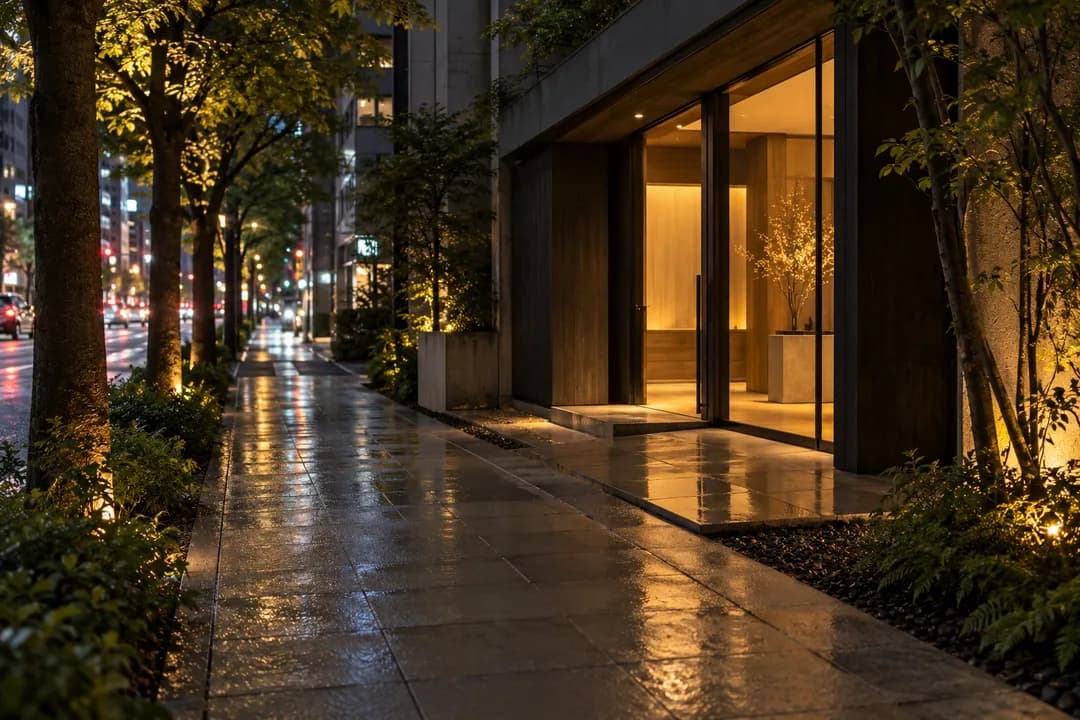
Retty lists the walk from Aoyama-itchome Station on the Tokyo Metro Ginza Line as three minutes, or about 230m, and Gaienmae Station on the same line as five minutes and roughly 370m. OMAKASE names Aoyama-itchome as the nearest station. TableAll describes the approach well: the broad Aoyama boulevard gives way to small side streets, and a few steps off the traffic you reach a quiet ground-floor entrance shaded by trees.
Dinner guests enter between 5:30pm and 6pm, the last order time on the official site, and the room closes at 8pm. Lunch seats from 12pm, with last entry at 12:30pm and close at 2:30pm. Leave a margin for the walk, because OMAKASE warns that late arrivals or anyone leaving early may miss part of the course. Smoking is banned inside and at the entrance, including electronic cigarettes and vapes.
From a Tokoname Sweet Shop to Odawara and Aoyama
Yoshihiro Narisawa was born in 1969 in Tokoname, Aichi Prefecture, into a family whose sweets business was started by his grandfather, according to TableAll. He was a promising windsurfer before heading to Europe after high school, and spent eight years in French, Swiss and Italian kitchens, including two years at Girardet and time with Joel Robuchon, before flying home in 1995.
He first opened La Napoule, a small portside restaurant in Odawara, Kanagawa Prefecture, that drew celebrities down from Tokyo. In 2003 he moved to Minami-Aoyama as Les Créations de NARISAWA, renamed NARISAWA in 2011. The restaurant topped the inaugural Asia's 50 Best list in 2013, marked its 20th anniversary in 2023 with a renovation, and came in at No. 21 on The World's 50 Best Restaurants in 2025, per the 50 Best page.
The philosophy page on the official English site explains the name of the style. Forests cover almost 70% of Japan, and the satoyama is the cultivated edge where villages, fields, woods and sea meet. Narisawa filters that rural culture into what he calls Innovative Satoyama Cuisine, and his Michelin quote says the theme is coexisting with forests, which is why the team visits depopulated mountain villages every year to plant trees and clean up.
Satoyama Scenery, Sumi and the Bread That Rises at Your Table
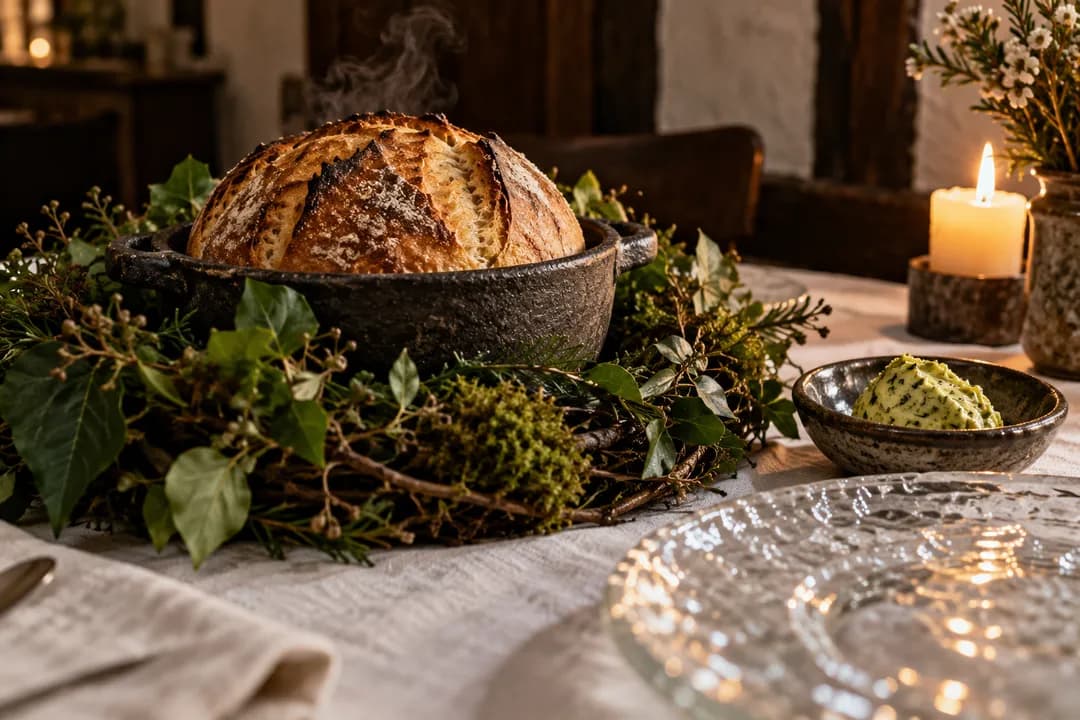
The menu changes daily with the ingredients, but several dishes have run for years. Bread of the Forest, served since 2010, starts as raw dough made with natural yeast from the forests of Shirakami-Sanchi, a UNESCO World Heritage Site. It arrives nestled in a wreath of seasonal greenery and keeps fermenting in front of you, then a piping-hot stone oven is set up at the table and the loaf bakes on the spot, per the Japan National Tourism Organization.
Satoyama Scenery, first plated in 2010, sits on a timber plank with a bamboo cup of chilled clear soup drawn from cedar and oak. TableAll describes soil made from charcoal, sherry vinegar and dried onion, moss built from okara, chlorophyll, perilla and green tea, and deep-fried burdock standing in for trees. The wild grasses come from Kaga in Ishikawa Prefecture, a landscape the chef wants each diner to picture.
Sumi, introduced in 2008, is a chargrilled block of lean Kobe beef rump coated in charred Shimonita green onion powder and served on ubame oak charcoal, so the slices show a bright red centre against black ash. The 2026 Asia's 50 Best citation singles out Temari, root vegetable strips wrapped around a crab and scallop dumpling like a traditional toy ball. Vegetarian and vegan menus are available on request.
What ¥68,000 Buys and How the Pairings Work
OMAKASE lists the Chef's Tasting Course at ¥68,000 per guest, tax included, as a starting price, with a separate service fee charged on the night. Each booking also carries a ¥390 per-seat OMAKASE reservation fee. Through the concierge service TableAll the same full course shows as ¥89,500 per person, a price that includes TableAll's own ¥8,000 booking fee, so booking direct on OMAKASE is the cheaper route for most diners.
Special menus appear around the calendar. The 2025 to 2026 Year-end and New Year Special Course ran from December 17 to January 10 at ¥78,000, tax included. From June 16 to August 29, 2026, lunch featured a ¥70,000 Toyama pairing that matched the course with Masuizumi sake from Ryuichiro Masuda and SAYS FARM wine from Yoshinori Tsuri, with a NARISAWA non-alcoholic drink option alongside.
Outside those events, TableAll lists pairings of sake only, sake with wine, or overseas wines only, plus non-alcoholic pairings that combine cocktails and tea. The opening toast is poured in the hiki sakazuki tea ceremony style, using Aramasa Sato Uhei NARISAWA, a bag-filtered sake made for the restaurant by the brewery Aramasa. BYOB is not allowed, and the restaurant takes cash and credit cards.
The 10am Monthly Release, Two-Guest Minimum and No Perfume
Seats for each month open at 10am Japan time on the first business day of the previous month. The August 2026 OMAKASE page, for example, showed bookings running to September 30 with the next round opening on September 1 at 10am. Each account may book once per month. NARISAWA takes parties of two or more only, nobody under 18 may enter, and bookings made on behalf of others by third parties are refused.
The cancellation rule is strict. Contact OMAKASE six days ahead; from five days before you pay 50% of the menu price, and from two days before you pay 100%. Date, time and party size are locked once the booking goes through. Guests are asked to skip perfume and cologne and to pass that rule on to companions. Extensive allergies may lead the restaurant to decline a booking, and a celebration message plate can be requested in advance.
Here is the honest judgement: skip NARISAWA if you are travelling solo, bringing a teenager, or want to choose your own dishes, because the room accepts none of those. It also suits a slow evening better than a pre-theatre dash, since the 6pm last entry and fixed course leave no shortcut. Food lovers who care about sake, sustainability and Japanese craft get the most from the bill.
Glass Plates, Sake Cellars and a Kitchen Behind Glass
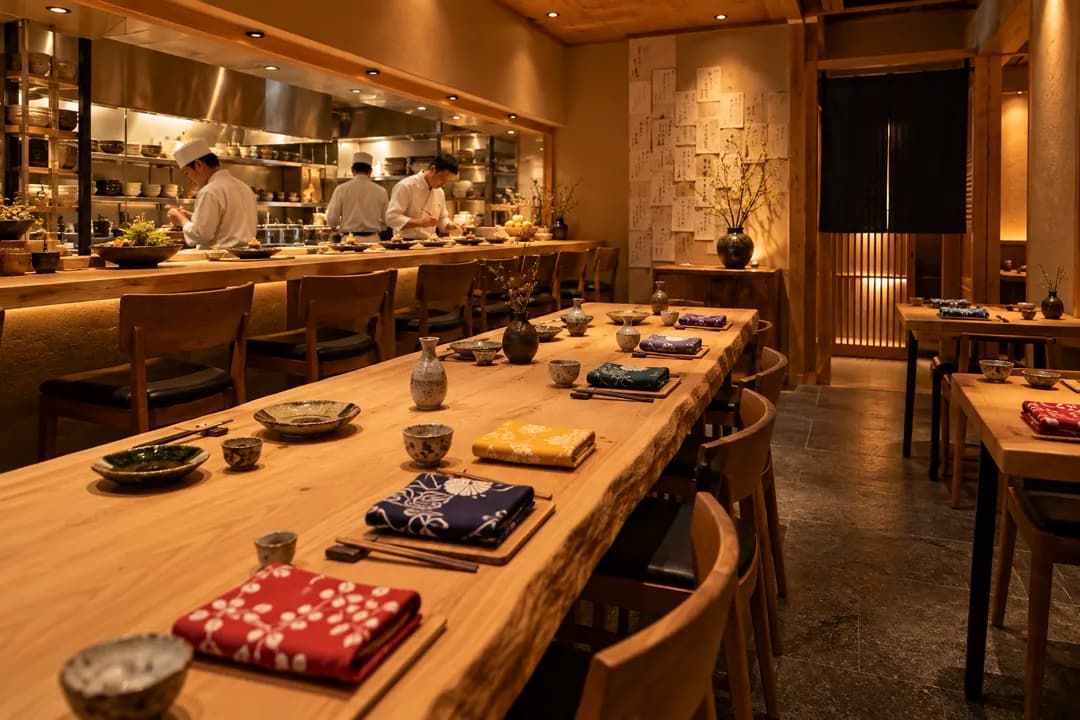
TableAll describes white walls against dark timber, no paintings, no background music and no scents, so attention stays on the plates. Each linen-covered table starts bare except for a heavy glass plate engraved with NARISAWA, which stands in for a sushi counter, and no glass or cutlery appears until the meal begins. Two sake cellars built to show off large isshobin bottles hold a mostly unpasteurised collection.
The kitchen runs behind a glass wall that keeps the aromas out of the dining room, with stations for hot dishes, cold plates and pastry above an underground stock room holding tanks for live fish and langoustine. Knives come from Takamura in Fukui, with a ripple-pattern blade and the bee logo on the handle, and lacquerware is re-lacquered rather than replaced. OMAKASE currently lists 15 seats.
The team itself is international, with cooks from Thailand, Vietnam, South Korea, Indonesia, the United States, Italy and Brazil, according to TableAll. Narisawa was named Most Influential Chef at Madrid Fusion in 2010, won the first 50 Best Sustainable Restaurant Award in 2013 and cooked the heads of state banquet at the 2019 G20 Osaka Summit, so expect many diners who have flown in for this table.
Noguchi's Stone Garden, the Ginkgo Avenue and Den as Plan B
Before a weekday lunch, walk over to Sogetsu Kaikan at 7-2-21 Akasaka, where Isamu Noguchi designed Heaven, an indoor stone garden of stones and water completed in 1978 at the request of Sogetsu ikebana founder Sofu Teshigahara. The Sogetsu school has used it for ikebana shows, performances and fashion presentations. Around the corner from NARISAWA, the chef's BEES BAR opened in April 2018 for a drink before or after dinner.
In late autumn, the Meiji Jingu Gaien ginkgo avenue is five minutes from Aoyama-itchome: 146 trees planted in 1923 line a 300m road from Aoyama-dori to the Memorial Picture Gallery. Peak gold usually lands in late November, and the Icho Namiki Matsuri runs from mid-November to early December with oden and roasted chestnuts. If NARISAWA is full, Plan B is Zaiyu Hasegawa's Jimbocho Den at 2-3-18 Jingumae, Shibuya-ku, booked only by phone on 03-6455-5433 from 12pm to 5pm, Monday to Saturday.
Practical Notes
NARISAWA, 1F Minami-Aoyama Garden Court, 2-6-15 Minami-Aoyama, Minato-ku, Tokyo 107-0062. Phone 03-5785-0799, though bookings are taken only through OMAKASE. Lunch 12pm to 2:30pm, last entry 12:30pm. Dinner 5:30pm to 8pm, last entry 6pm. Closed Sunday and Monday. Chef's Tasting Course from ¥68,000 per guest, tax included, plus service fee and a ¥390 OMAKASE seat fee. Cancellation 50% from five days before, 100% from two days. Ages 18 and over, parties of two or more. Aoyama-itchome Station, Tokyo Metro Ginza Line, three minutes on foot.
Ask Karpo for more information.
Keep reading
- Fine Dining Near Me in Kitashinagawa: Quintessence and Its Blank Black Menu
 Fine Dining Near Me in Marunouchi: Sézanne Under New Chef Stephen Lancaster
 Fine Dining Near Me in Jingumae: Den's Dentucky Fried Chicken Kaiseki