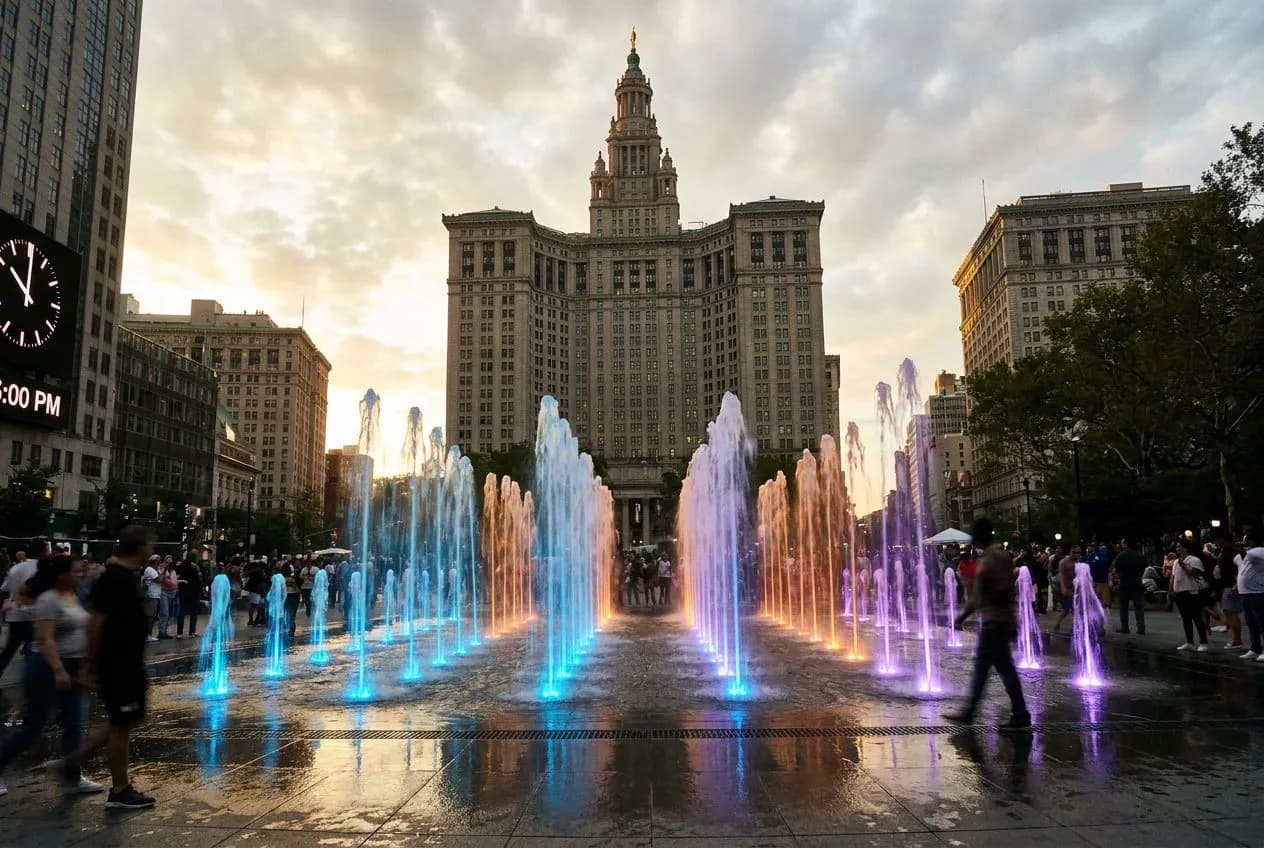
City Hall Park at five o'clock on a Wednesday in summer has a peculiar energy. Office workers loosen their collars and cut diagonal paths toward the subway. Tourists angle for photos of the neoclassical façade. And then, precisely at the top of the hour, the 1999 fountain erupts into a twenty-minute ballet of water and light that stops foot traffic in its tracks. It's one of those weekly programming rhythms that defines a season if you're paying attention—and if you know where to stand, it's better than most things you'll pay fifty dollars to see indoors.
The geometry of a good view
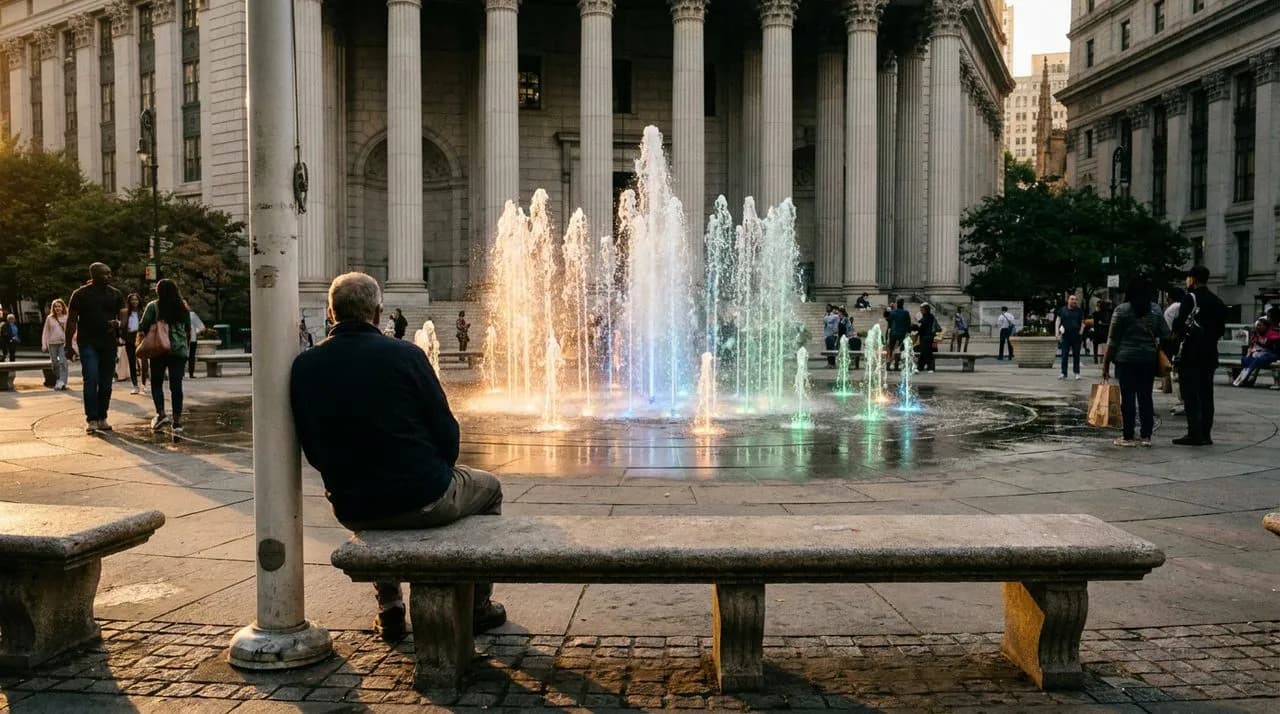
Not all benches are created equal. The south bench nearest the flagpole sits at the fountain's designed sightline axis, a deliberate choice made during the 1999 restoration when landscape architects mapped out the optimal viewing cone. From that spot, the radial spray patterns align, the LED uplights catch the water at the engineered angle, and the whole composition makes geometric sense. Fifteen feet to either side and you're watching a pretty fountain. Here, you're watching the fountain as intended.
The bench fills quickly by 4:50pm on clear evenings, a silent acknowledgment among regulars that real estate matters. Claim your spot early. Bring a newspaper or pretend to check your phone. The people who arrive at 4:58pm and hover at the periphery are the same ones who wonder why their photos look flat. The regulars know better—they've learned through trial and error that this particular piece of cast iron and wooden slats offers something the other seating doesn't: a front-row seat to municipal theater that actually respects its audience.
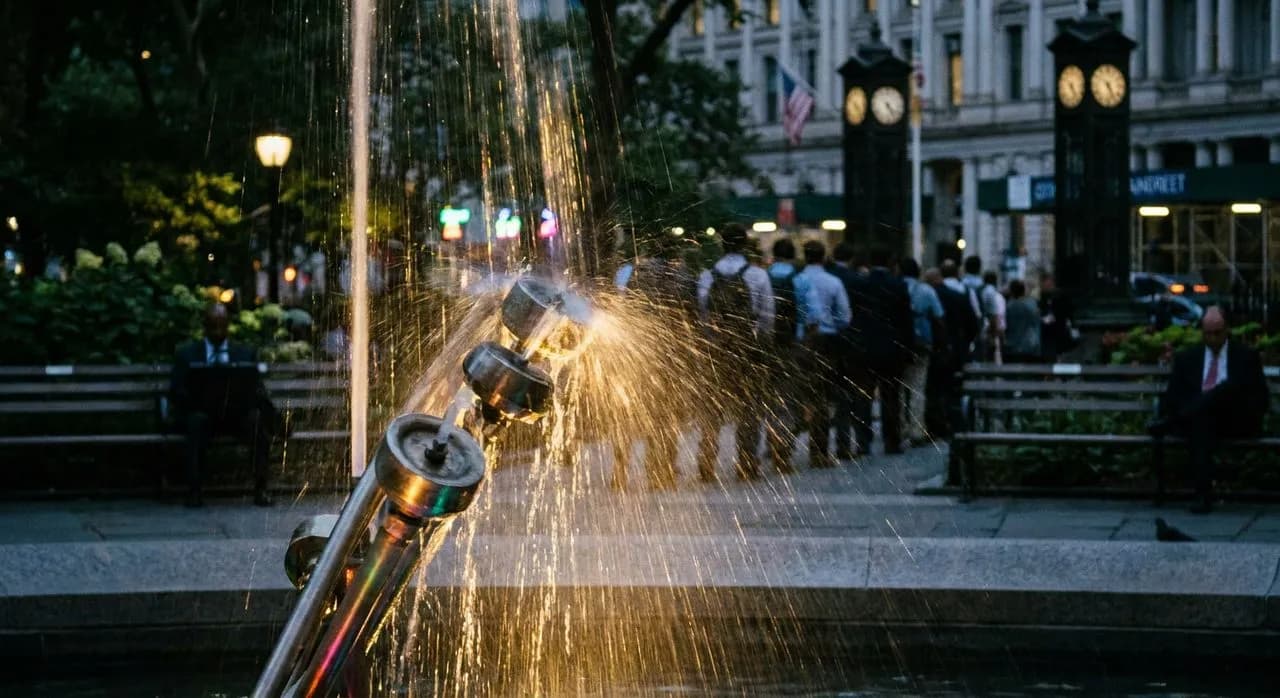
Nineteen minutes, forty seconds
The fountain show is scheduled for Wednesday afternoons, weather permitting. Not 5:01pm. Not "around five." The opening sequence is a radial burst pattern that unfolds like a geometric proof, each jet triggered in sequence from the center outward, and late arrivals miss it entirely. By the time you're shouldering through the crowd at 5:03pm, you've missed the thesis statement and you're watching the footnotes.
The precision is part of the point. This is civic ritual dressed in engineering clothes—a municipal promise that something beautiful will happen at the appointed hour, no ticket required. The fountain's control system is synced to an atomic clock, because in a city where the subway runs on vibes and optimism, it's quietly radical for a public amenity to simply work, on time, every single week.
The Wednesday reset
Parks staff call it "the Wednesday reset." The sequence appears to be a seasonal public fountain display for visitors and park users. cutting through the park, a municipal nod to the fact that Wednesdays occupy a particular psychological space—not the beginning, not quite the end, but the hinge point where the week either coheres or collapses. The fountain show offers a twenty-minute intermission, a chance to sit on a bench and watch water do complicated things while your inbox waits.
There's something generous about that intent. Most urban design assumes you're moving through space at commuter velocity. This fountain assumes you might want to stop, that you might have nineteen minutes and forty seconds to spare on a Wednesday in June, and that a choreographed display of water and light might be exactly the interruption you need. It's not wellness programming or algorithmic self-care. It's just a fountain that does its dance whether you show up or not.
What you're actually watching
The sequence cycles through seven distinct patterns, each named internally by the maintenance crew: Radial, Spiral, Cascade, Crossfire, Pulse, Lattice, and the closing Bloom. The LED uplights shift through a temperature range from cool blue to warm amber, timed to complement the spray height and velocity. On humid evenings the mist catches the light and creates an unintentional halo effect that photographers love and that the designers definitely did not plan for but have learned to accept as a happy accident.
The sound design is accidental but effective. There's no music, just the layered percussion of water hitting stone at varying intervals, a rhythmic white noise that drowns out traffic and phone conversations. By minute twelve, the ambient sound has reprogrammed your nervous system. By minute sixteen, you've forgotten what you were annoyed about on the R train.
The sensory shift at dusk
The fountain show plays differently depending on when summer happens to set its sun. Early season Wednesdays in May catch full daylight, the water glittering sharp and clean against blue sky. By late June, the five o'clock hour straddles that perfect transitional light—still bright enough to see without assistance, but soft enough that the LED uplights start to register as more than decorative accents. Come August, the show begins in golden hour and ends in near-dusk, the programmed lights doing the heavy lifting as natural light fades. The transformation is gradual but total: what starts as a water feature becomes a light sculpture with water as its medium.
Temperature matters too. On cooler May evenings, the mist stays low and tight to the fountain basin. In the thick humidity of July and August, it drifts and disperses, carrying the smell of wet stone and treated water into the surrounding benches. If you're sitting close, you'll feel the occasional kiss of spray on your forearms when the wind shifts. It's not enough to drench you, just enough to remind you that this is a living system, not a video loop. The fountain breathes. The air around it changes. By the time the closing Bloom sequence fires all jets simultaneously in one last coordinated burst, you've been through a sensory cycle that has nothing to do with screens.
Summer 2026 context
The fountain has been operating in its restored form since the late 1990s., long enough that a generation of downtown workers has come to rely on it without ever thinking about the infrastructure underneath. The pumps were overhauled in winter 2025, and the LED system was upgraded to a more efficient spec that draws less power but produces sharper color saturation. The show itself remains unchanged—proof that good design doesn't need annual reinvention.
Late summer brings the best conditions. The air is thick, the light is golden after five, and the park empties just enough that the fountain becomes the main event rather than background scenery. September Wednesdays have a bittersweet edge, the knowledge that the season is ending and the fountain will soon go dormant until May. Regulars start showing up more reliably in the final weeks, unwilling to miss the last few performances.
Practical notes
City Hall Park is bounded by Broadway, Park Row, and Chambers Street in lower Manhattan. Nearest subways: Brooklyn Bridge–City Hall (4/5/6), Chambers Street (J/Z), Park Place (2/3). The fountain show runs Wednesdays at 5:00pm sharp, May through September, weather permitting. The south bench by the flagpole offers optimal viewing; arrive by 4:50pm for a seat. The park is fully accessible. Bring sunglasses for late-afternoon glare and a light jacket if you're staying through dusk. No admission fee. The show runs rain or shine unless lightning is present.
Tags: #CityHallPark #NYCFountains #WednesdayRitual #LowerManhattan #PublicArt #RightOnTime #NYCSummer #FreeNYC #DowntownNYC #CivicSpace #SummerInTheCity #NYCParks #UrbanMoments #FountainShow #MidweekMagic
Sources consulted: City Hall Park - Wikipedia · City Hall Park - NYC Parks · Official NYC Website · Time Out New York · New York Times - NY Region
All trademarks are the property of their respective owners.