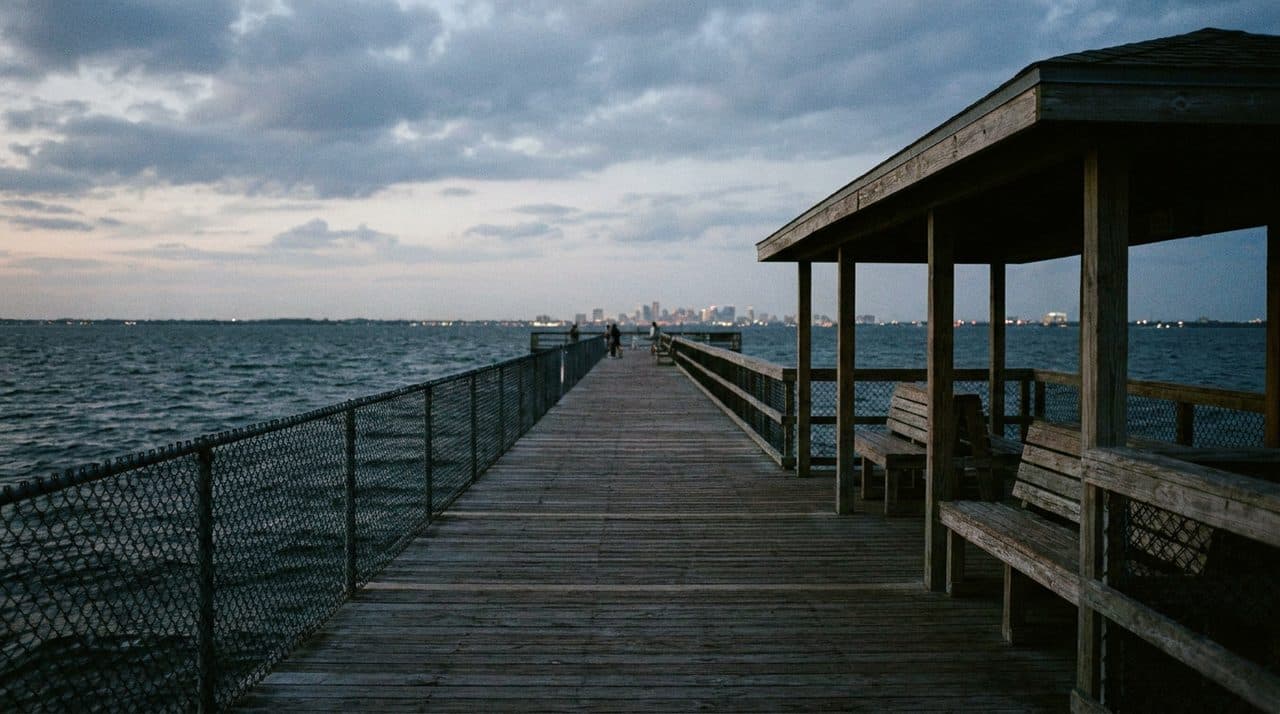
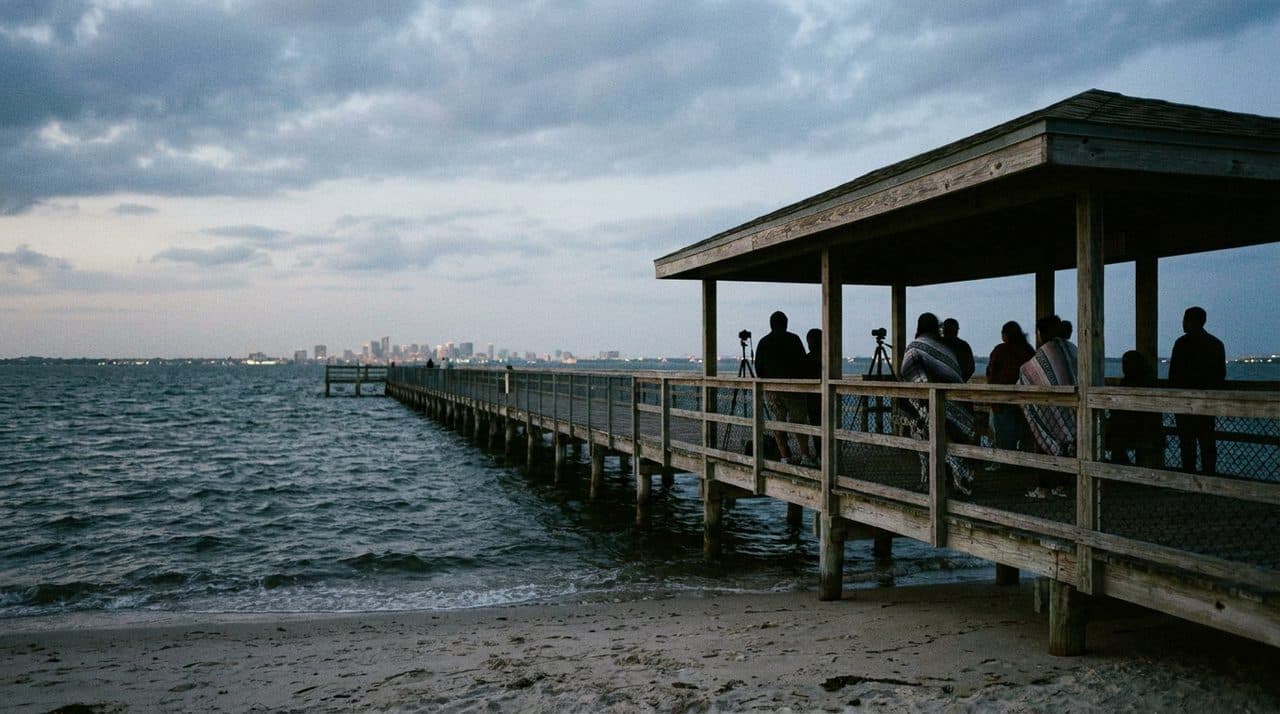
You walk to the end of Pier 41 in Red Hook just as the sun drops behind the Statue of Liberty, and there's a group of people staring at handheld devices like they're divining rods. They're not looking for fish or checking their phones—they're tracking fluctuations in Earth's magnetic field, and on nights when solar activity spikes, this weathered platform becomes an impromptu observatory where amateurs gather to watch the sky do things it rarely does this far south.
The Platform That Measures What You Can't See
The structure itself is industrial leftovers—concrete poured decades ago when this waterfront meant shipping containers and longshoremen, not kayak rentals and artisan distilleries. Someone bolted a wooden bench to the southern edge years back, and now it's worn smooth in the center where people sit facing the harbor. The real action happens around a makeshift weather station cobbled together from salvaged equipment: a magnetometer jury-rigged to a solar panel, a wind gauge that squeaks when gusts come off the Upper Bay, and a whiteboard where regulars chalk up KP-index readings like they're posting surf conditions. On calm nights the board stays empty. When geomagnetic storms roll in, it fills with numbers and arrival time predictions.
The Regulars Who Show Up With Radios

You'll recognize the core group by their equipment. One guy—always in a Carhartt jacket regardless of season—brings a shortwave radio and tunes it to frequencies that crackle and pop when solar radiation hits the ionosphere. Another regular sets up a DSLR on a tripod pointed north, long-exposure settings already dialed in, even though auroras rarely push this far south. They're optimists or obsessives, possibly both. The conversations run technical: coronal mass ejections, Bz components, flux density. But there's also this undercurrent of hope, like they're waiting for a band that might not show. Between the jargon, someone usually brings thermoses of coffee that taste like they were brewed at dawn, and the steam rises into the cold air mixing with cigarette smoke and the salt smell coming off the water.
When the Sky Cooperates and When It Doesn't
Most nights you get nothing. The magnetometer needle barely twitches, the radio stays quiet, and people pack up after an hour feeling like they drove to a concert that got canceled. But twice, maybe three times a year, conditions align—a solar flare erupts, plasma hurtles toward Earth, and the magnetic field compresses like a drumhead getting tuned. That's when the radio starts hissing with static bursts, when the magnetometer needle swings hard, and when everyone on the pier goes quiet and looks north. You won't see the full curtains of green and red that show up in Alaska or Iceland, but sometimes there's a glow on the horizon, a pale wash of color that could be light pollution or could be protons colliding with oxygen molecules. The ambiguity doesn't diminish the moment—it sharpens it.
What the Magnetometer Actually Tells You
The device itself looks like a science fair project that got left in the rain. It measures magnetic field strength in nanoteslas, and the readings scroll across a small LED display that's hard to read when the sun's still up. Baseline in Red Hook hovers around forty-eight thousand nanoteslas, give or take. During geomagnetic storms, you'll see spikes and dips—sometimes swings of a few hundred nanoteslas within minutes. The regulars have learned to read these fluctuations like a language. A sudden drop often precedes the main event. Rapid oscillations mean the storm's at peak intensity. The numbers themselves matter less than the pattern, the rhythm of disturbance rippling through invisible fields that surround the planet. Someone usually explains this to newcomers, and the explanation always ends with: "You're watching the sun punch the Earth's magnetic shield in real time."
The Unexpected Social Fabric of Storm Chasers
You'd think a hobby this niche would attract loners, but the pier-end crowd skews surprisingly social. There's a retired physics teacher who brings printed NOAA forecasts and hands them out like party invitations. A graphic designer who works night shifts and stops by on her way home, still smelling faintly of printer toner. A couple who met at a planetarium lecture and now treat storm watches like date nights, sharing a blanket and a bag of chips. When activity is low, conversations drift: someone's basement renovation, a documentary about Skylab, complaints about the L train. When the magnetometer spikes, everyone shuts up and watches the numbers. It's the only hobby where silence is both the goal and the reward.
Getting There and What to Bring
The pier sits at the western end of the neighborhood, past the shipping terminals and the old graving docks. You're walking distance from the bus stop on Van Brunt if you don't mind a fifteen-minute trek through streets that still feel more industrial than residential. The platform's accessible all hours—there's no gate, no admission, just concrete and sky. Bring layers even in summer; wind off the water cuts through sweatshirts like they're tissue paper. A red-light flashlight helps if you're checking notes or adjusting equipment without ruining your night vision. Check space weather forecasts before you go—sites that track solar wind speed and density, apps that send alerts when storms are inbound. And lower your expectations. The odds of seeing auroras from New York City are slim, but the odds of feeling like you're connected to something bigger than the five boroughs—those are pretty much guaranteed.
Practical Notes
The pier's open year-round with no formal hours or fees. Sunset to midnight is prime time, though serious watchers arrive earlier to set up. Public transit means the B61 bus to Van Brunt, then a walk west toward the water—follow the industrial buildings until you run out of land. No reservations, no bookings, just show up. Bring your own seating and something warm to drink. Cell service is decent if you need to pull up real-time data. The magnetometer's usually there, but it's community-maintained, so no guarantees. Peak geomagnetic activity tends to cluster around equinoxes, but solar storms don't follow a schedule. Your best bet is monitoring forecasts and being ready to drop everything when conditions look promising.
Tags: #RedHook #NYCHiddenSpots #SpaceWeather #AmateurAstronomy #MagneticFields #UrbanObservatory #SolarStorms #PierLife #GeekNYC #BrooklynWaterfront #NightSky #ScienceOutdoors #TheOddEdit #UnusualNewYork #NYCAfterDark
Sources consulted: atlasobscura.com · timeout.com · nytimes.com
All trademarks are the property of their respective owners.