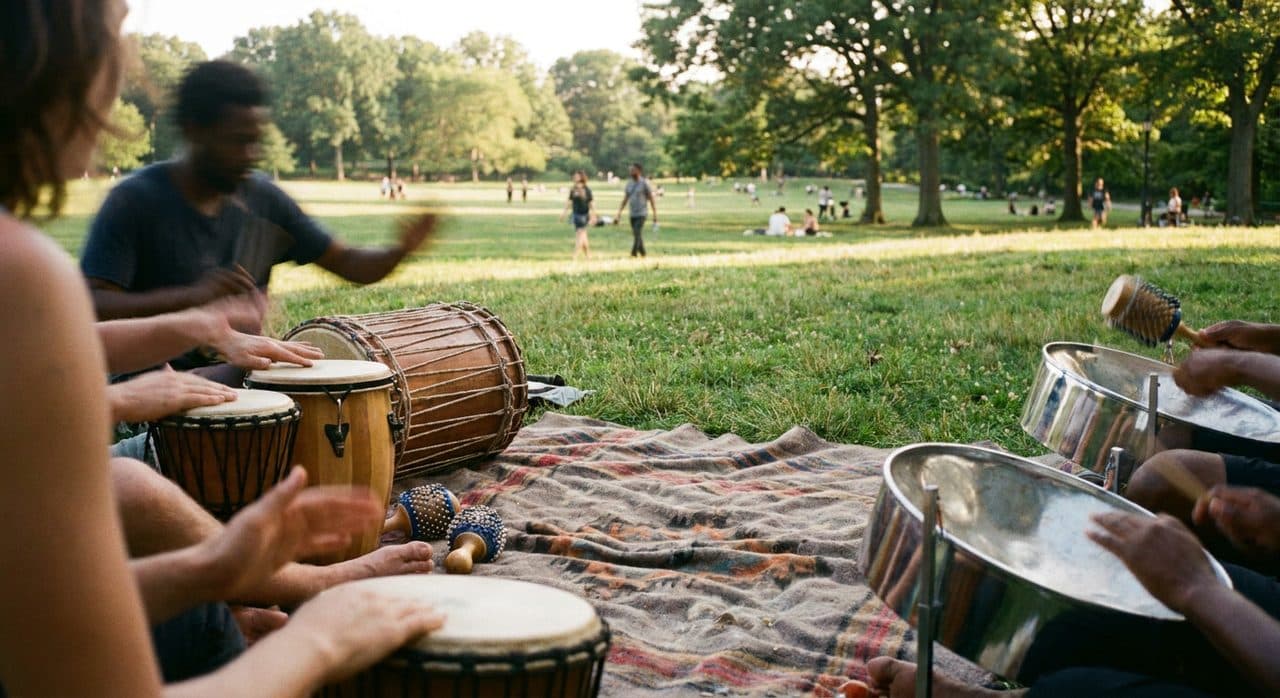
You arrive at the north end of Long Meadow around 7PM on a Thursday in June and hear it before you see it — a scattered rhythm that hasn't quite found itself yet, djembes and congas testing the air, someone tapping a cowbell against their palm. By 7:15, twenty people have formed a loose circle on the grass near the Third Street entrance, and the sound has locked into something that pulls your shoulders back and makes you forget you were checking your phone.
The Gathering Has No Founder
Nobody organized this. There's no Facebook event, no permit, no designated leader. The circle started sometime in 2019 when a few drummers from the Crown Heights scene began meeting after work to play through the long summer light. It dissolved during the pandemic, reformed in spring 2022, and now runs every Thursday from April through October when the weather cooperates. You'll find it roughly 150 yards southwest of the Third Street park entrance, where the meadow opens widest and the ground stays driest after rain. The core group — three women who work in healthcare and a sound engineer named Marcus who always brings the heaviest bass drum — arrive between 6:45 and 7:00 to claim the spot. Everyone else just shows up.
The unspoken rule is this: if you brought an instrument, you're in the circle. If you didn't, you sit outside it. The distinction matters because the circle needs to breathe, needs sightlines between players, needs space for the rhythm to travel across faces and hands. You can sit five feet back on your blanket and feel every beat in your sternum. Closer than that and you're in the way.
What Actually Happens Between 7PM and Sunset
The first twenty minutes are chaos pretending to be music. Someone starts a pattern, three others follow, two more try to layer something on top that doesn't quite fit. It falls apart. They laugh. Someone else begins. This is the negotiation phase, the feeling-out, the democracy of percussion where the loudest voice doesn't win — the clearest one does. By 7:30, when the circle has grown to thirty or forty people, something clicks. The rhythm simplifies, finds its pocket, and suddenly everyone's locked in. A woman with silver rings on every finger plays a cajón with her eyes closed. Two teenagers share a single djembe, trading off every eight bars. Marcus anchors everything with a bass pattern that sounds like a heartbeat slowed to half speed.
You don't need to know music theory. You need to feel where the spaces are and resist filling all of them. The best players leave gaps, trust silence, let the pattern breathe. Around 8PM, when the light goes golden and horizontal across the grass, the circle hits its peak. This is when people start dancing — not in the circle, but around it, a second ring of bodies moving however the rhythm tells them to move.
The Regulars You'll Recognize After Three Visits
Marcus with the bass drum is the unofficial timekeeper, the one who signals transitions with a sudden roll or a dropped beat. He works in post-production for a studio in Gowanus and treats these sessions like unpaid therapy. The three healthcare workers — you'll hear people call them "the sisters" though they're not related — play matching djembes and wear their scrubs sometimes if they've come straight from shift work. There's an older man, maybe seventy, who brings a tambourine and plays it with more precision than anyone plays anything else. He never stays past 8:30. Someone told me he used to tour with a funk band in the eighties, but he's never confirmed it.
Then there are the floaters: the guy who brings a trumpet and plays long tones over the drums until someone glares at him and he stops. The woman with the shekere who only shows up on full moons, literally. The college kids from Pratt who bring hand drums that cost forty dollars and play them like they cost four hundred. Everyone's welcome. Everyone's tolerated. The circle self-corrects — if you're too loud, too off, too desperate for attention, the rhythm simply moves around you until you adjust or leave.
What to Bring and What to Leave Home
A blanket, water, maybe a sweatshirt for when the sun drops and the temperature follows. That's it. Don't bring a drum unless you know what you're doing — there are always a few spare instruments circulating, shakers and small hand drums that people pass to newcomers who want to try. Don't bring a speaker. Don't bring your own music. The whole point is the thing that happens when forty strangers negotiate a shared rhythm without words, and you can't replicate that with a Bluetooth connection and a playlist.
Food is fine but keep it simple. This isn't a picnic. You'll see people with takeout containers from the taco spot on Flatbush or bags of chips from the bodega on Lincoln. Nobody's grilling. Nobody's setting up a spread. You're here for the sound, and everything else is secondary.
When the Circle Breaks and Why It Matters
Around 9PM, sometimes earlier if the energy flags, the rhythm starts to fracture. Someone speeds up, someone else slows down, the center doesn't hold. People pack their drums, shake hands, drift toward the park exits in small groups. The whole thing dissolves as informally as it began. There's no finale, no applause, no moment when everyone acknowledges what just happened. You walk back toward Flatbush or Grand Army Plaza with the rhythm still echoing in your chest, and the city sounds different — the traffic has a backbeat, the subway rumble has a pattern, everything's percussion if you're listening right.
This is why the circle matters. Not because it's particularly skilled or because you'll hear something you couldn't hear in a concert hall, but because it's proof that people can still make something together without an app, without a plan, without someone charging admission at the door. You show up, you listen, you find your place in the pattern. That's it. That's everything.
Practical Notes
The circle runs Thursdays from roughly 7PM to 9PM, April through October, weather permitting. If it's raining or below 60 degrees, don't bother. Enter Prospect Park at the Third Street entrance (between Prospect Park West and the park drive) and walk southwest into Long Meadow. You'll hear it. The nearest subway is Grand Army Plaza (2/3 trains) or 7th Avenue (F/G trains), both about a ten-minute walk. No reservations, no tickets, no cover charge. Bring cash if you want to grab food beforehand — the taco truck on Flatbush and Lincoln takes cards but the line moves faster if you have bills. Park bathrooms close at dusk, so plan accordingly. If you want to bring an instrument, bring something you can carry easily and play sitting down. Nobody's standing in this circle.
Tags: #ProspectPark #BrooklynMusic #DrumCircle #LongMeadow #NYCHiddenGems #ThursdayNights #LiveMusic #CommunityMusic #UrbanRituals #BrooklynNights #ProspectParkWest #GrandArmyPlaza #NYCPercussion #OutdoorMusic #SummerInBrooklyn
Sources consulted: timeout.com · secretnyc.co · thrillist.com
All trademarks are the property of their respective owners.