 Haaland Has Seven Goals and Norway Runs Entirely Through Him
⚽️2026 FIFA WORLD CUP
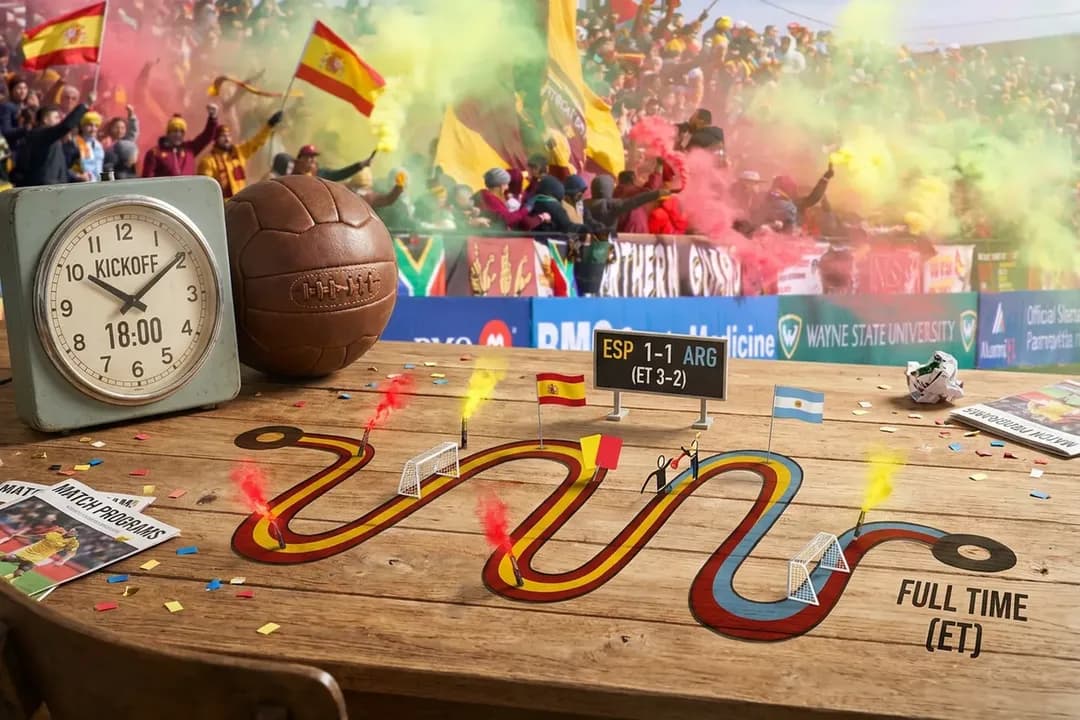
Spain Argentina Final Timeline From Kickoff Through Extra Time
Spain beat Argentina 1-0 after extra time in the 2026 World Cup final at New York New Jersey Stadium. This timeline follows only the confirmed turning points from kickoff through Ferran Torres’s decisive 106th-minute goal.
East Rutherford became the center of world football on July 19, 2026, when Spain and Argentina met in the final at New York New Jersey Stadium. The match kicked off at 3 p.m. ET and moved through regulation without a goal, leaving the score level after 90 minutes. Extra time then supplied the decisive confirmed sequence: Enzo Fernandez was dismissed after a second yellow card, Ferran Torres scored in the 106th minute, and Spain closed out a 1-0 victory. This recap keeps the timeline tight, verified, and focused on the moments that changed the final.
Want this final turned into a custom plan for your night? Text Karpo for a personalized Spain-Argentina recap, celebration route, food idea, watch-party reset, or New York City-area game-day memory guide.
Kickoff Set The Final In Motion At 3 p.m. ET
The confirmed timeline begins at 3 p.m. ET on July 19, 2026, when Spain and Argentina kicked off the World Cup final at New York New Jersey Stadium. That opening moment is the anchor for everything that followed, because no earlier match action belongs in the final recap. From East Rutherford, the final moved from pre-match expectation into a live contest between two national teams with the title at stake, starting a chronology that would eventually stretch beyond regulation.
For readers tracking españa - argentina, the safest way to understand the final is to separate confirmed turning points from atmosphere, speculation, and unverified detail. The first verified point is simply the kickoff itself: the match started on time at 3 p.m. ET at the named final venue. No goal, card, substitution, injury, or tactical adjustment can be added to that opening phase unless it is confirmed, so the timeline stays clean from the first whistle.
Regulation Ended Without A Goal
The next confirmed marker is not an individual play but the state of the match after regulation. Spain and Argentina were scoreless after 90 minutes, which means the final did not produce a confirmed goal during normal time. That fact shaped the entire ending: the title could not be settled inside regulation, and the match required extra time before a winner emerged. In a final recap built around verified turning points, the 0-0 score after 90 minutes is the essential bridge.
It is important not to fill the regulation period with invented drama. A scoreless match can contain tension, pressure, and momentum swings, but those details are not part of this verified timeline unless confirmed. What can be stated with certainty is narrow and decisive: after 90 minutes, Spain 0, Argentina 0. That scoreline sent the final into extra time and kept both teams level entering the period where the confirmed dismissal and winning goal would take place.
Extra Time Became The Deciding Stage
Because the final was scoreless after 90 minutes, extra time became the stage where the championship was resolved. The confirmed record does not require guessing about the rhythm of the match before that point. It only requires following the verified chain: regulation ended at 0-0, extra time began, and the decisive events arrived there. That structure matters for anyone reconstructing the final, because the winning goal did not come in normal time and the title remained open beyond 90 minutes.
Extra time changed the stakes of every confirmed action because the match had already passed its regulation limit. At that point, one major incident could reshape the final, and that is exactly what the verified timeline records. The first confirmed extra-time turning point was disciplinary rather than scoring-related. Enzo Fernandez, already on a yellow card, was dismissed after receiving a second yellow card, leaving Argentina to continue the final with a confirmed red-card consequence in the extra period.
Enzo Fernandez Was Dismissed After A Second Yellow
The dismissal of Enzo Fernandez stands as one of the final’s confirmed turning points. The verified fact is specific but limited: Fernandez was sent off in extra time after a second yellow card. No exact minute is included here because one has not been provided in the confirmed facts for this recap. What matters chronologically is that the dismissal came after regulation had ended scoreless and before the final score was settled by Spain’s decisive goal.
That ordering is central to a responsible timeline. Argentina had reached extra time at 0-0, but the Fernandez dismissal altered the confirmed circumstances before the winning goal. A second yellow card dismissal is not the same as adding unverified details about the challenge, the referee’s explanation, or reactions around the field. The timeline needs only the established sequence: extra time, second yellow card, Fernandez sent off, and the final moving toward the moment that would put Spain ahead.
Ferran Torres Scored In The 106th Minute
The decisive goal arrived in the 106th minute, when Ferran Torres scored for Spain. That is the central scoring fact of the final and the only confirmed goal in this recap. It changed the score from 0-0 to 1-0 and gave Spain the lead in extra time. Because the match had remained scoreless through 90 minutes, the timing of the goal is vital: Torres did not break the deadlock in regulation but after the final had moved into its additional period.
No other goal can be added to the record, and no assisting sequence should be invented. The verified scoring timeline is concise: after the Fernandez dismissal in extra time, Torres scored in the 106th minute, and Spain moved in front. That confirmed minute is the clearest numerical turning point after kickoff. It explains why the final is remembered not as a regulation win, but as an extra-time victory settled by a single Spain goal.
Spain Closed The Final As 1-0 Winners
The final confirmed result was Spain 1, Argentina 0. That scoreline completes the chronological recap: kickoff at 3 p.m. ET, 0-0 after 90 minutes, Fernandez dismissed after a second yellow card in extra time, Torres scoring in the 106th minute, and Spain finishing as winners. The margin was one goal, and that goal came only after the match moved beyond normal time. The verified timeline leaves no room for extra scorers or alternative scorelines.
For a publication-ready final recap, the cleanest conclusion is also the most accurate one. Spain won the 2026 World Cup final 1-0 over Argentina at New York New Jersey Stadium in East Rutherford. The decisive passage belonged to extra time, where the dismissal and the Torres goal formed the confirmed sequence that settled the match. Everything else should remain outside the recap unless independently confirmed, because the power of this timeline comes from staying exact.
Tags: #WorldCup2026
Sources consulted: FIFA final hub · Associated Press final report
All trademarks are the property of their respective owners.
Ask Karpo First
Ask Karpo for a personalized Spain Argentina final recap, a celebration plan, a food stop near your viewing spot, or a New York City-area memory guide built around the 1-0 extra-time finish.
Ask Karpo for more information.
Keep reading
- Haaland Has Seven Goals and Norway Runs Entirely Through Him
 World Cup Trophy Ceremony Timing Medals and Postmatch Celebrations
 Olise and France's Attack: The Semifinal Tactical Question