 Stonestown Winter Farmers Market Picker for Student Cooks
Weekend Plans

SF Rainy Day Museum Planner: 3 Golden Gate Park Pavilions
Golden Gate Park's Music Concourse puts the de Young and the California Academy of Sciences face to face, with the Conservatory of Flowers a short walk east.
The Music Concourse in Golden Gate Park is the easiest answer San Francisco has to a wet Saturday. The de Young Museum and the California Academy of Sciences face each other across a sunken plaza of pollarded plane trees, so the only stretch of open sky between them is a two-minute crossing. Add the Conservatory of Flowers, a few minutes east along John F. Kennedy Drive, and you have a full day of art, living animals and tropical plants without ever committing to a long walk in the rain. This rainy day museum planner lays out an order that keeps the wettest stretches short.
Why the Concourse Works in Bad Weather
Most of Golden Gate Park punishes you in a storm. The lakes, the windmills and Ocean Beach at the far end are all exposure, and fog can sit on the western half of the park for hours. The concourse is different because it was laid out for the 1894 California Midwinter International Exposition, which concentrated the park's big public buildings around one bowl. Two of those institutions are still here, rebuilt for the current century, and they behave like one compound on a rainy day.
That also means the plaza fills up when the weather turns. Families who had planned a picnic or a bike ride tend to arrive at the Academy late morning, so the order below puts art first and the aquarium later, when school groups and stroller traffic have thinned.
Morning at the de Young
The de Young building, designed by Herzog and de Meuron and opened in 2005, is wrapped in perforated and dimpled copper that is slowly weathering toward green. On a dark day the skin looks almost wet even when it is dry, and the light that filters through the punched holes into the courtyards is soft and even. Inside, the American art galleries carry the core of the collection, with nineteenth-century landscape painting, Shaker furniture and California work that makes sense of the city outside.
Save the Hamon Observation Tower for the end of your visit. The tower twists up from the main building to a glass-walled observation floor on the ninth level, and in rain the view becomes a moving weather map: squalls marching in from the ocean, fog snagging on Sutro Tower, the park canopy going from green to grey and back. It is one of the few places in the city where a storm is the better view.
The de Young also has a sculpture garden and a café terrace, but on a wet day treat the indoor galleries as the visit and skip anything that sends you back outside early.
Across the Plaza to the Academy of Sciences
The California Academy of Sciences sits directly across the concourse. The Academy itself dates to 1853, and the Renzo Piano building that opened in 2008 puts an aquarium, a planetarium, a natural history museum and a rainforest under one rolling living roof planted with native California species. You cross the plaza, step under the entrance canopy and are dry again in a couple of minutes.
The Osher Rainforest is the obvious rainy-day room, a glass sphere four stories tall that you climb through on a spiral path past free-flying birds and butterflies, ending in a glass elevator that drops you into the Steinhart Aquarium below. Down there the Philippine Coral Reef tank fills a full wall, and the swamp and the African penguin colony in the main hall keep children busy while adults read the panels. The Morrison Planetarium runs timed shows, so pick up a show time when you arrive rather than discovering at three o'clock that the afternoon slots are gone.
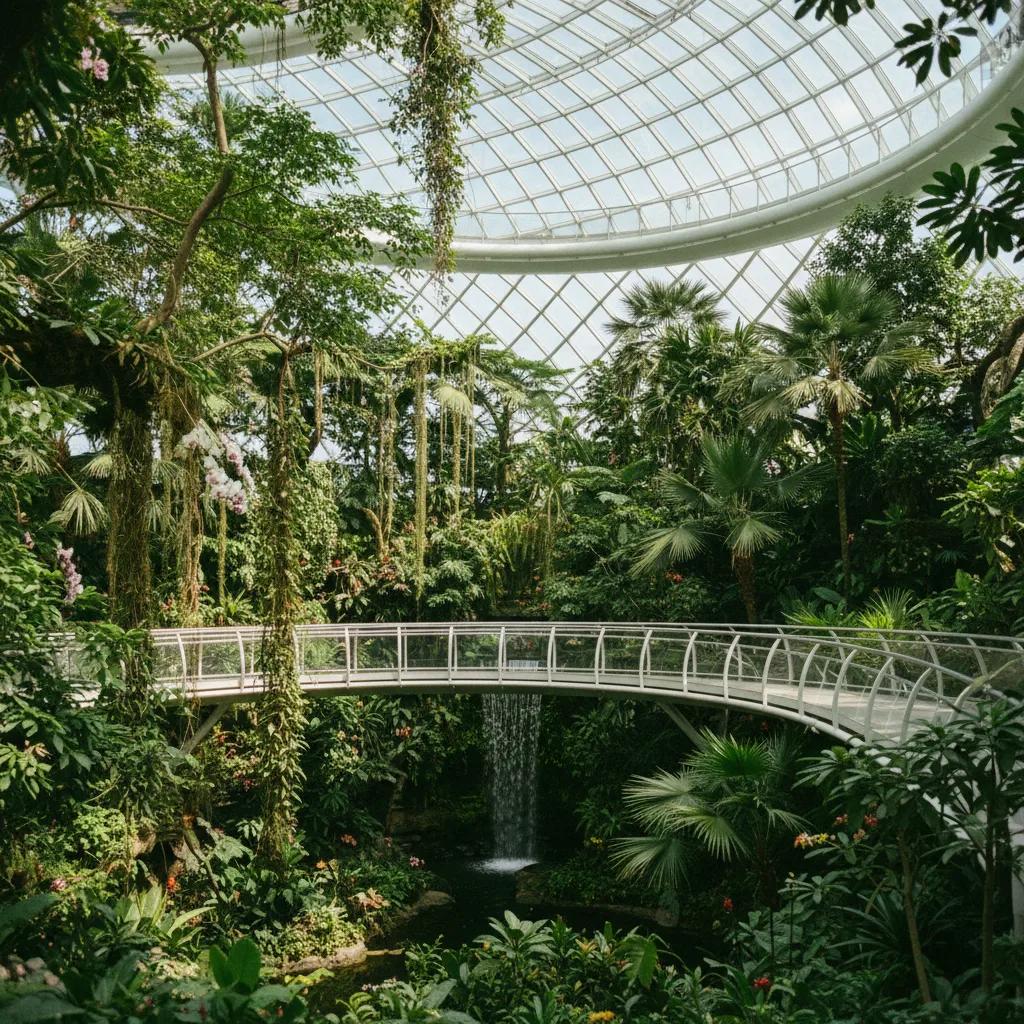
The Academy gets crowded faster than the de Young, which is why it goes second. By mid-afternoon the rainforest queue has usually shortened, and the cafés on the lower level make an easy indoor lunch without leaving the building.
The One Wet Walk: Conservatory of Flowers
The third stop asks for an umbrella. The Conservatory of Flowers sits east of the concourse on John F. Kennedy Drive, roughly a ten-minute walk through the trees, and nothing covers the route. The reward is the oldest public wood-and-glass conservatory in North America, opened in 1879, with a white-painted frame and a central dome that looks especially good streaked with rain.
Inside, the galleries run from lowland tropics with giant water lilies to highland tropics full of cool-loving orchids, plus aquatic plants and a potted plants room. Rain drumming on the glass while you stand in humid tropical air is the whole point. The building is smaller than the two museums, so plan forty minutes to an hour here rather than half a day.
If the rain is heavy enough that the walk sounds miserable, drop the Conservatory and spend the extra time in the Academy's natural history halls instead. Two big museums are already a full day.
Getting In and Out Without a Car
Muni's N Judah line stops in the Inner Sunset at Irving Street and 9th Avenue, and from there it is about a ten-minute walk north into the park to the concourse. The 44 O'Shaughnessy bus runs through the park past the museums, and the 5 Fulton runs along the park's north edge. If you do drive, the Music Concourse garage sits beneath the plaza, which turns the arrival into a dry elevator ride.
Leaving at the end of the day, the Inner Sunset is the nearest place to eat and warm up, with ramen, dumplings and bakeries along Irving Street and 9th Avenue a short walk from the N Judah stop.
Practical Notes
Book timed entry for the Academy on stormy weekends, since it is the stop that sells out first. The de Young also lets you reserve ahead, and San Francisco residents should look at the free-day programs each museum runs. Bring a compact umbrella you can fold away, because large wet umbrellas are not allowed into galleries and coat check queues build quickly when everyone arrives soaked at once.
Wear shoes with grip. The concourse paving and the paths toward the Conservatory get slick, and the Academy's living roof drains onto the walkways in heavy rain. Layers matter too: the rainforest dome is warm and humid, the aquarium level is cool and the walk outside can be cold and windy.
Where Karpo Fits In
Tell Karpo in the Karpo APP that you want an indoor day in Golden Gate Park, how long you have and whether you are with kids, and it can lay out a suggested order for these three stops, compare it with an all-Academy day, and suggest somewhere nearby in the Inner Sunset for lunch or dinner afterwards. Weather, transit and ticket details still come from the museums and Muni on the day you go.
Ask Karpo for more information.
Keep reading
- Stonestown Winter Farmers Market Picker for Student Cooks
 Clement St Winter Farmers Market Picker for Lunar New Year
 Fort Mason Winter Farmers Market Picker for Citrus Bakers