 Bernal Heights Pottery Glaze Supply Browsing Route: Walk
Hidden Gems & Odd Finds
Musical Instrument Store Near Me in Civic Center: Jesse Maschmeyer Violins
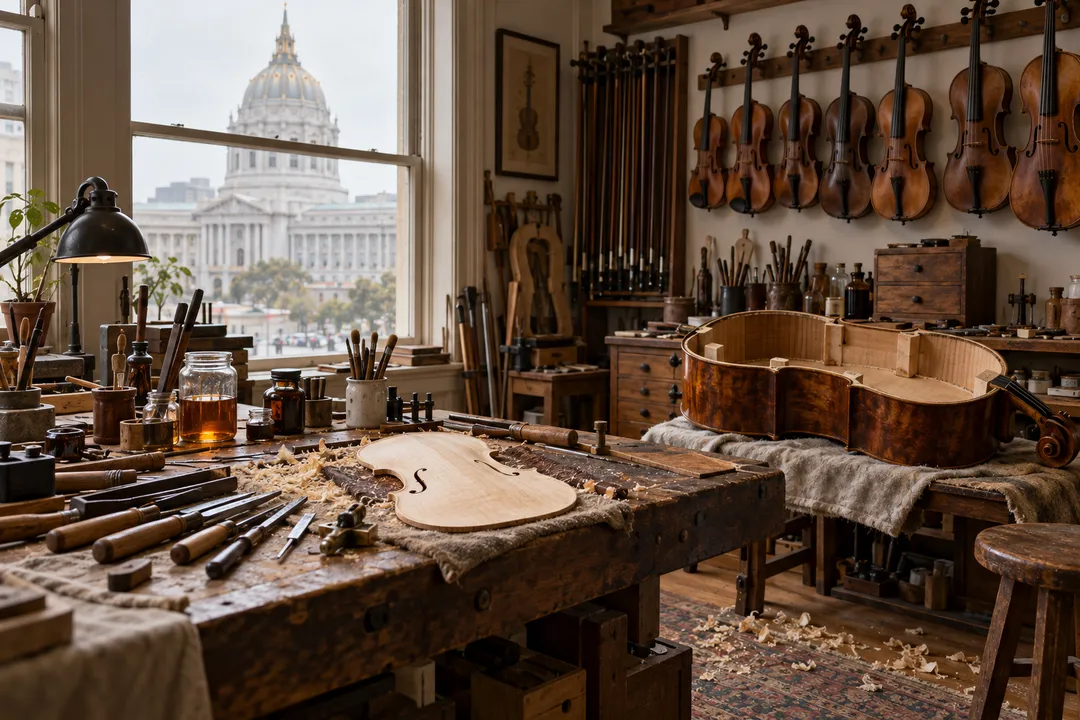
Jesse Maschmeyer Violins at 512 Van Ness Ave #203 faces City Hall, where a Parma-trained luthier restores 18th century Italian violins and builds his own.
Inside a small suite at 512 Van Ness Ave #203, San Francisco, CA 94102, directly across from City Hall, Jesse Maschmeyer restores old Italian, French and German violins and carves new ones in the spirit of the classical masters. Anyone typing musical instrument store near me from a rehearsal break at Davies Symphony Hall will find an appointment-only workshop rather than a browse-in storefront, its air ripe with amber varnish and fresh wood, where cellos, violas and bows wait their turn on the bench.
From an Arborist's Son to a Parma Workbench
The shop's biography starts with a six-year-old hearing his first violin concerto on the radio and becoming so smitten that his mother soon found him lessons. Jesse's father was an arborist, and the boy began carving the wood scraps his father brought home from work. By eight he loved two things equally: playing the violin and building things with his hands, a pairing that never really separated.
A woodworking apprenticeship as a teenager cemented the direction. At 20 he enrolled at the Renato Scrollavezza School of Violin Making in Parma, Italy, training under an old-world maestro in carving techniques that date back to the 17th century. He then spent four years in Los Angeles honing his skills on repairs to instruments played by some of the world's greatest artists, the kind of work where a single misjudged cut is never forgotten by the owner.
A Decade Beside Stradivari Before Opening on Van Ness
In 2004 Maschmeyer moved to Boston for a position in the restoration shop at Reuning & Son Violins. For ten years he worked on 17th century instruments carved by Stradivari, Guarneri and countless other makers. His own biography credits that decade with helping to shape and inspire the instruments he now builds, and it explains why so much of the inventory on his website predates the Civil War by a comfortable margin.
He arrived in San Francisco in April of 2015 to establish a shop of his own, focused on making and restoring violins, violas and cellos. The location was deliberate. Suite 203 sits across from the Louise M. Davies Symphony Hall, blocks from the San Francisco Conservatory of Music, placing his workshop, as the shop puts it, at the heart of the city's vibrant arts community. Even after decades at the bench, he says he is stirred to know his work helps musicians electrify their audiences.
Camilli, Gagliano and a Violin Made in San Francisco in 1924
The violin page reads like a short history of the craft. At the top sit a Camillo Camilli from Mantua dated 1756, a Giuseppe Guadagnini and a Joannes Gagliano made in Naples in 1804. Further down are a Jacques Boquay from Paris, 1708, a Jacob Fendt from London, 1832, and Cremona makers such as Aristide Cavalli and Domenico Regonini, each instrument restored and set up across Jesse's bench before it goes on offer.
Local history turns up too. One listing is an Ignaz Lutz made in San Francisco in 1924, a reminder that this city had its own violin trade a century ago. Next to the antiques hang Maschmeyer's own instruments, including a 2018 violin on a Guarneri model and one he finished in San Francisco in 2025, which gives players a way to compare a fresh build against a two-hundred-year-old Neapolitan.
Violas, Cellos, Bows and the Science Behind an Appraisal
Viola players get their own list, from a Gosewijn Spyker built in Amsterdam around 1760 to an Umberto Lanaro from Padova, 1968, and a Clifford Roberts from Philadelphia, 1985. Cellists can try a Roberto Masini made in Cremona in 2000 or a Kennedy School cello from mid-1700s London. Separate pages cover violin, viola and cello bows, so the stick can be matched to the instrument in the same sitting.
Repairs are the other half of the business: restoration of historical instruments, everyday maintenance, professional setup and sound adjustments. The shop also writes insurance appraisals, and its homepage notes that it uses dendrochronology, the dating of a top by its tree rings, along with careful study to make sure every attribution it sells is accurate. For anyone inheriting an old fiddle, that kind of evidence matters more than a label.
Booking Suite 203 the Way Working Players Do
This is a by-appointment studio, and the website is candid that the calendar often fills up ahead of time. Arriving with a clear request, and your own instrument for comparison, makes the hour far more productive.
Treat the room as a working bench rather than a showroom: ask before lifting anything off the wall, and let Jesse finish a delicate glue joint before starting a conversation. Weekday slots suit anyone who can slip away from an office, while Saturday is the only weekend option, so book it early. Students shopping for a first serious instrument should bring their teacher; a second pair of ears in a quiet room helps far more than another online video.
Rehearsal Row: Davies Hall, the Opera House and the Asian Art Museum
Few shops sit this close to their customers. The War Memorial Opera House and Davies Symphony Hall stand side by side on Van Ness Avenue, and the San Francisco Conservatory of Music is a short walk away on Oak Street. Orchestra musicians, opera pit players and conservatory students all pass this stretch daily, which makes a midday adjustment between a morning rehearsal and an evening call an easy errand.
Make time for the plaza on the other side of City Hall. The Asian Art Museum on Larkin Street fills the old main library building with one of the largest collections of Asian art in the country, a fitting detour after an afternoon of European wood. Walk west instead and Hayes Valley begins within a few blocks, with Patricia's Green on Octavia Boulevard offering benches and rotating public sculpture.
Garage, BART and the 49 Bus to the Door
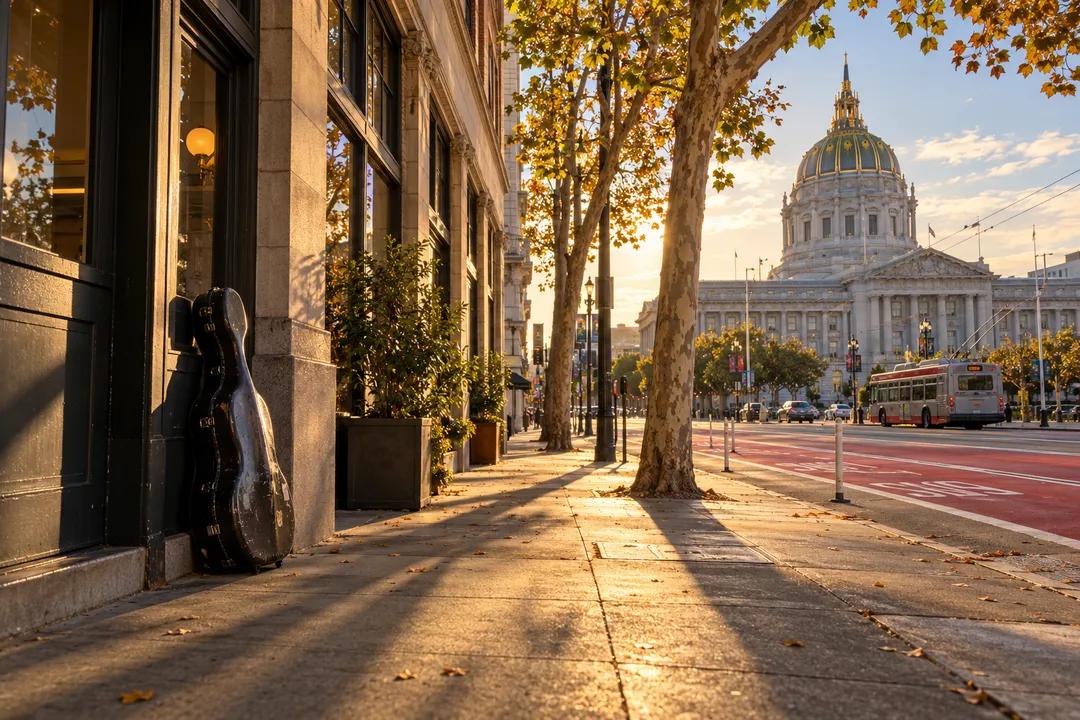
Appointments are available Tuesday through Saturday from 11 am to 5 pm. Drivers have it easy: the shop points visitors to secured parking at the Civic Center Garage, one block away, which is handy when you are carrying a cello and a spare case. The entrance is on Van Ness Avenue itself, so give the suite number, 203, when you arrive, and allow a few extra minutes if you are bringing a large instrument through the lobby.
Transit works just as well. Civic Center Station, served by BART and Muni Metro, sits under Market Street a short walk southeast through the plaza, and Van Ness Station on the Muni Metro lines is a few blocks south. The 49 Van Ness–Mission bus runs along the avenue's center bus lanes, letting riders from the Mission or Fort Mason step off almost in front of City Hall without a transfer.
Ask Karpo for more information.
Keep reading
- Bernal Heights Pottery Glaze Supply Browsing Route: Walk
 Potrero Hill Pottery Glaze Supply Browsing Route: Walk
 Mission Pottery Glaze Supply Browsing Route: Studio Walk