 Stonestown Winter Farmers Market Picker for Student Cooks
Weekend Plans
Mission to Potrero Late Fall Urban Hike for Changing Light
A late fall urban hike from Mission Dolores through Precita and Potrero, balancing murals, hills, quieter blocks, and bay-facing pauses in San Francisco.
A Mission-to-Potrero late fall urban hike should feel like a gradual change in light, not a contest with San Francisco's hills. Begin around Mission Dolores Park, where open grass and palms give everyone a clear orientation. Move east through mural-lined blocks, then let the grade rise toward Potrero Hill and the bayward skyline. The route stays flexible when you treat every climb as a decision point: continue, pause, or switch to a gentler street without apologizing for the choice.
Begin With a Park Lens
Use the opening park section to set a shared pace. The Mission can be visually loud, with painted walls, storefront color, and busy intersections competing for attention. Ask walkers to choose one detail per block rather than photographing everything. This creates room for conversation and keeps the group aware of bikes, buses, and driveways. A slow beginning also reveals how the neighborhood's broad public spaces give way to smaller residential streets as the route turns toward Potrero.
On the Mission streets, follow a line that links public art, corner markets, and open views rather than naming every business. The route is about texture: painted shutters, tiled entries, utility poles, and the sudden glimpse of a hill at the end of a straight block. When a crossing feels complicated, gather everyone before the light changes. The small pause prevents the group from fragmenting and makes the next segment feel like a deliberate departure from the park.
The approach to Precita Park creates a useful reset between the Mission grid and Potrero's rise. Let the group use the green space as a quiet midpoint, then compare the two neighborhoods' visual rhythms. Someone who wants more distance can take a longer arc around the park; someone conserving energy can stay on the flatter line. Keep the choice visible in Karpo APP and name a reunion point. Good route planning makes different capacities compatible rather than hiding them.
Mission Detail at Walking Speed
Once the grade begins, switch from a distance mindset to a hill-management mindset. Shorten the blocks, relax the conversation, and look for landings where everyone can breathe without blocking a doorway. The climb becomes easier when the group notices the changing horizon: rooftops open, the Mission's dense street wall falls behind, and Potrero's industrial edges appear. Encourage walkers to take the inside of a turn and keep a steady rhythm instead of chasing the fastest person.
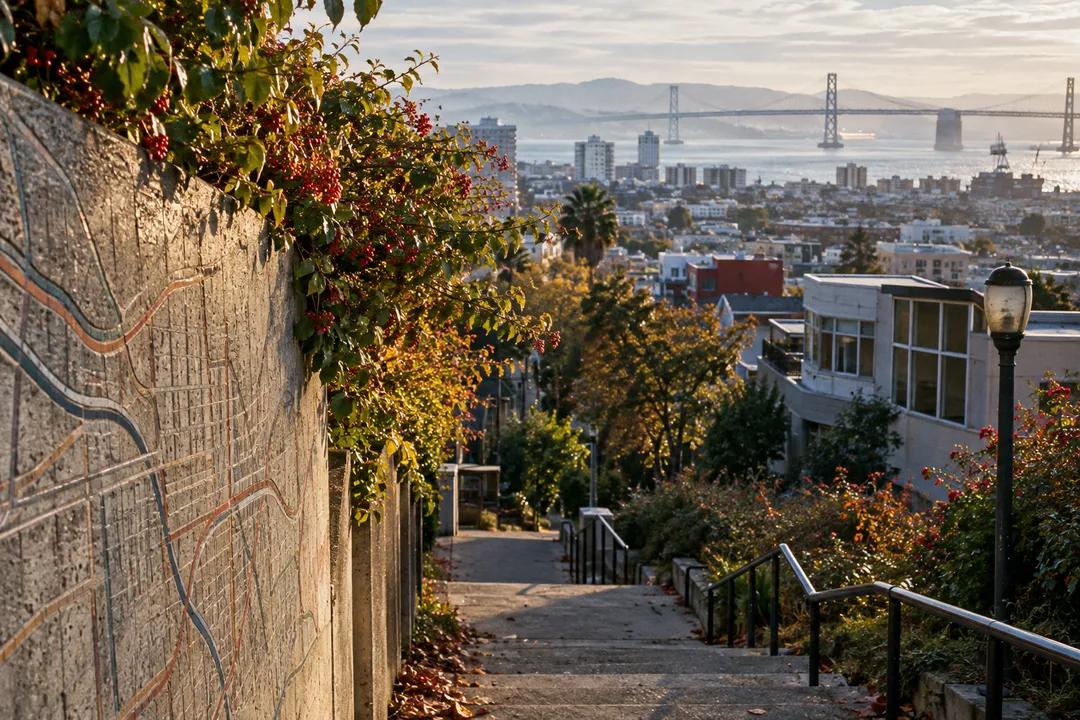
Potrero Hill rewards a pause that looks outward. Choose a public sidewalk or small overlook where the bay-facing skyline can be read in layers, from nearby roofs to distant bridges. Do not promise a perfect sunset; late-fall clouds can make the view more atmospheric than bright. Let the group stay long enough to feel the temperature shift, then add a warmer inland option. The point is to notice how elevation changes attention, not to wait for a postcard.
The Hill Changes the Route
A route crossing the Mission and Potrero works better when you keep a low-pressure social prompt. Ask each person to name the moment the light changed, the steepest block they enjoyed, or the view they would return to with a visitor. These questions are concrete enough to avoid small talk and open enough for different ages. They also help a mixed group feel that the hike belongs to everyone, not only to whoever chose the route.
If the hill feels heavier than expected, use a neighborhood loop as the full ending. Potrero's streets can supply a satisfying finish through brick walls, gardens, and quiet corners without forcing a long descent. If energy remains, extend toward a bayward viewpoint and then choose a transit-oriented return. Save both versions before leaving the Mission. The short plan is not a compromise; it is a route with a different balance of elevation, detail, and recovery.
The descent deserves as much care as the climb. Knees and ankles notice steep pavement after the group has relaxed, so shorten steps and leave space between walkers. Avoid letting everyone bunch at the first downhill corner. Use a broad regrouping point, then continue toward the Mission or Potrero's transit connections as a single unit. Karpo APP can show the gentler return when the direct line feels too abrupt, keeping the final chapter calm.
A Bayward Pause
Late-fall weather in San Francisco can change within one neighborhood. Fog may soften the skyline, wind can arrive over the hill, and sun may return on the Mission side. Carry a shell, keep a dry layer available, and treat the forecast as a planning input rather than a promise. If the route turns damp, favor murals, stoops, and sheltered streets over exposed overlooks. A good urban hike adapts its subject when the sky changes.
Give special attention to how the group occupies residential blocks. Keep voices down near homes, do not use stoops as seats, and leave painted gates and planted edges untouched. On busier Mission streets, make crossings compact and let other pedestrians pass. These habits are practical, but they also improve observation: when the group is not creating friction, it can notice the difference between a public artwork, a private garden, and a storefront someone is still trying to open.
Build Two Finish Options
Comfort comes from small preparations. Wear shoes with grip for the climb and descent, bring water, and keep gloves or a hat where they are easy to reach. A snack helps children and anyone sensitive to hill effort, but avoid making food stops the route's organizing principle. Give one person responsibility for the shared map and another for the group's rear. The arrangement is simple and lets the walker at the front look outward instead of constantly counting heads.
Set the route in Karpo APP with three anchor types: park, hill, and skyline pause. Then add a short route that ends before the steepest section and a full route that continues after the view. This structure keeps the group from debating every corner. Ask the app for a nearby return option when fatigue appears, and save the chosen line for later. A repeat walk becomes more personal when the map records the group's real preferences.
Practical Notes
Photography should follow the route's changing elevation. In the Mission, take close frames of painted surfaces and street-level color. On the climb, photograph the view opening behind the walkers rather than only the destination ahead. At the Potrero pause, make one wide frame and then put the camera away. The sequence tells a richer story than a collection of isolated murals, and it invites everyone to remember how the city appeared at each effort level.
Skip a distant waterfront extension if it turns the final descent into a race. The Mission, Precita, and Potrero already provide a complete arc of public space, neighborhood texture, and elevation. If the group wants a reward, choose a simple nearby ending after the route rather than adding another long objective. Leaving a little energy unused is a sign that the plan worked. It means people can talk about the next walk before this one is over.
Keep the Crossing Human
Practical notes: gather at a visible park edge, set a rear walker, and brief the hill strategy before leaving flat streets. Save short and full versions in Karpo APP, carry one extra layer, and use regroup points before complicated crossings. Give the skyline pause a time limit that protects the descent. Respect homes, murals, planted edges, and other pedestrians. Let weather decide whether the final scene is bay light, fog, or a quieter Mission block.
This Mission-to-Potrero crossing earns its place among late fall urban hikes because the city changes in front of you. Public park, mural streets, a real climb, and a bayward pause form a route with emotional shape. No single viewpoint has to carry the day. Open Karpo APP when you are ready to choose the effort level, preserve the gentle finish, and let the changing light become the guide rather than a detail you chase.
Ask Karpo for more information.
Keep reading
- Stonestown Winter Farmers Market Picker for Student Cooks
 Clement St Winter Farmers Market Picker for Lunar New Year
 Fort Mason Winter Farmers Market Picker for Citrus Bakers