Search romantic dinner near me in Miami and you will be shown rooftops, waterfront terraces and rooms with a resident DJ. Some of them are genuinely wonderful. Almost none of them are romantic in the sense most people mean, which is a table where two people can hear each other for two hours. Miami's restaurant culture is loud by design — the music is part of the product and the volume is a deliberate signal that the room is alive. If that is what you want, the city delivers it better than almost anywhere. If it is not, you need to select on completely different criteria, and the good news is that the quiet rooms exist and are usually easier to book.
Karpo can find Miami rooms that stay under conversation volume tonight, check which have a real two-top rather than a bar rail, and book the quiet corner.
Choose the neighbourhood before you choose the restaurant
Miami's noise level is more a function of district than of individual restaurant. Brickell and much of South Beach are built for volume: hard surfaces, high ceilings, amplified music, and a crowd that arrives late and stays. Coral Gables and Coconut Grove run at a fundamentally lower register — older buildings, more soft furnishing, tree cover, and a clientele that books at eight rather than ten.
That single decision does more for the evening than any amount of research into individual rooms. If quiet matters, start in the Gables or the Grove and work inward, rather than starting with a list of the city's best restaurants and hoping.
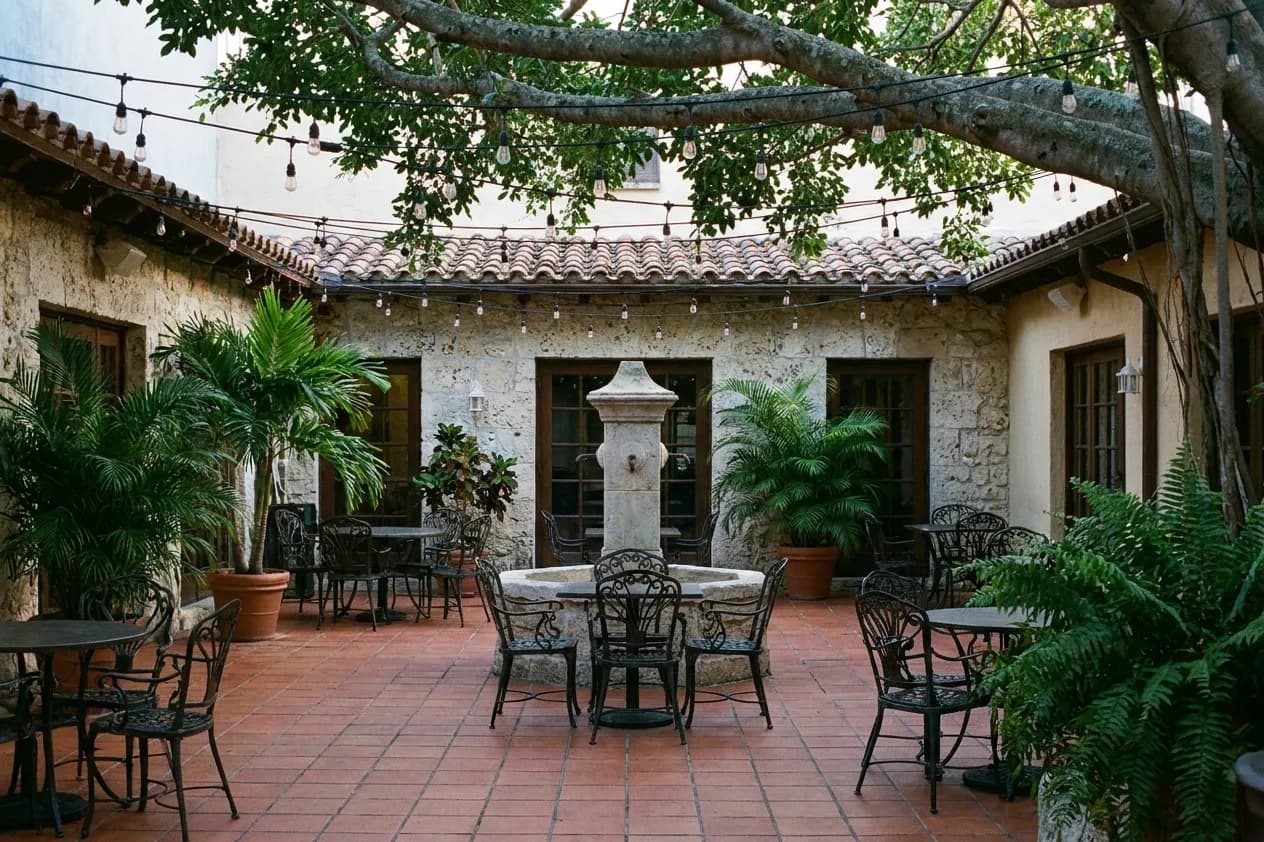
The courtyard is Miami's best romantic format
The most reliably romantic setting in this city is not a rooftop and not a waterfront terrace. It is a courtyard: enclosed on several sides, planted, open to the sky, and acoustically soft because the greenery absorbs what the walls would otherwise bounce. Coral Gables in particular is full of them, a legacy of the neighbourhood's Mediterranean-revival planning.
Courtyards also solve Miami's weather problem more gracefully than open terraces. They hold shade in the afternoon, catch the evening breeze, and most have some covered portion for when a storm arrives without warning between June and September. Ask when booking whether the courtyard has cover; the answer determines whether a summer reservation is a plan or a gamble.
What to actually ask when you book
Three questions get you a better table than any amount of choosing the right restaurant. Ask for a table for two away from the bar and away from the kitchen pass — those are the two loudest points in almost every room, and staff will accommodate the request if you make it at booking rather than on arrival. Ask what time the music changes, because many Miami restaurants shift from background to foreground volume at a specific hour, usually somewhere between nine and ten. And ask whether there is a courtyard, patio or garden section, and request it.
Booking earlier is the other lever. A 7pm reservation in Miami is early by local standards, which means a half-empty room, unhurried service and conversation at normal volume. The same table at 9:30pm is a different restaurant.
Views are overrated and priced accordingly
A water view in Miami carries a substantial premium and is almost always paired with the conditions that make conversation hardest: an open terrace, wind, and a room designed to be seen from outside. The view is also, in practice, something you look at for the first ten minutes and then stop noticing while you talk to the person opposite.
If a view genuinely is the point, the way to have it without the noise is to arrive for sunset rather than for dinner — a drink on a terrace at golden hour, then dinner somewhere quiet ten minutes away. You get the photograph and the conversation, and you pay the view premium on one round of drinks rather than on an entire meal.
Nights of the week change everything
Miami's volume is strongly night-dependent in a way that is not true of every city. Thursday through Saturday, the loud rooms are very loud and the quiet ones fill up. Sunday through Wednesday, much of the city is genuinely calm, and restaurants that would be impossible on a Friday will seat you at a good table with no notice.
This is the easiest optimisation available. A Tuesday dinner at a restaurant you could not get into on Saturday, in a room operating at half capacity, is a better version of the same restaurant. If the occasion can move, move it.
Small details that carry a two-top evening
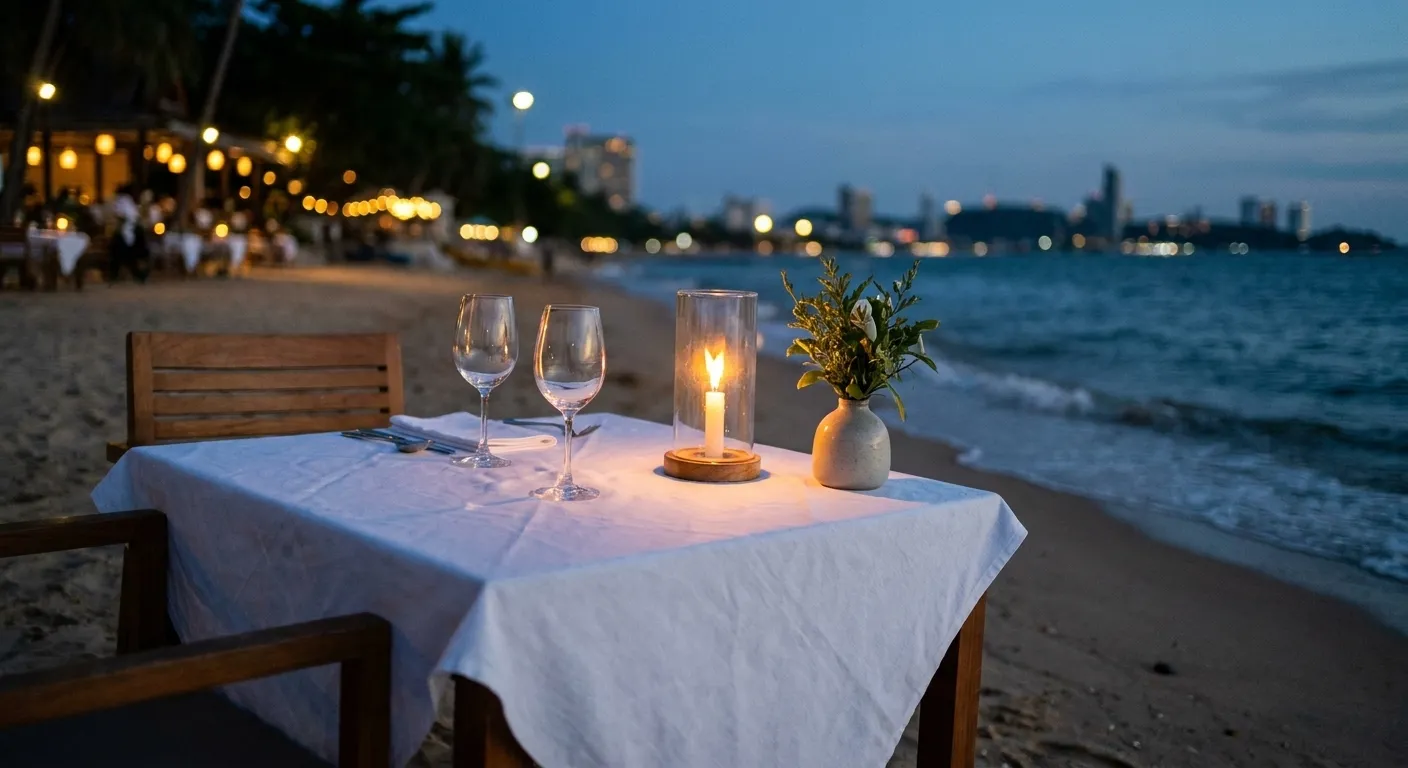
Light matters more than décor. A room lit from table level — candles, small lamps — reads as intimate almost regardless of what else is happening. A room lit from the ceiling does not, even if it is beautiful. You can assess this from any restaurant's own photographs in about five seconds.
Seating geometry matters too. A banquette where you sit at ninety degrees rather than opposite is easier to talk across in a room with any ambient noise, and most Miami restaurants have a few. Ask for one. And skip the tasting menu unless you both actively want it: a long sequence with a server explaining each course interrupts the conversation roughly every eight minutes, which is precisely the opposite of what the evening is for.
One last thing that costs nothing: tell the restaurant why you are coming. A note on the booking saying it is an anniversary or a first proper dinner out in months changes how a room treats a table more reliably than any amount of choosing the right restaurant. Miami hospitality is genuinely warm when given something to work with, and the difference between an anonymous two-top and one the staff are quietly rooting for is the whole evening.
Tags: #MiamiDining #RomanticDinner #CoralGables #CoconutGrove #DateNight #DinnerNearMe #MiamiFood #QuietRestaurants #Courtyard #MiamiEats #TableForTwo #WeekendPlans #Brickell #DinnerIdeas
Please drink responsibly. Must be of legal drinking age.
All trademarks are the property of their respective owners.
Ask Karpo first
Want to know which Miami rooms are running quiet tonight, which have a covered courtyard if the weather turns, and where the good two-tops are? Ask Karpo before you book.