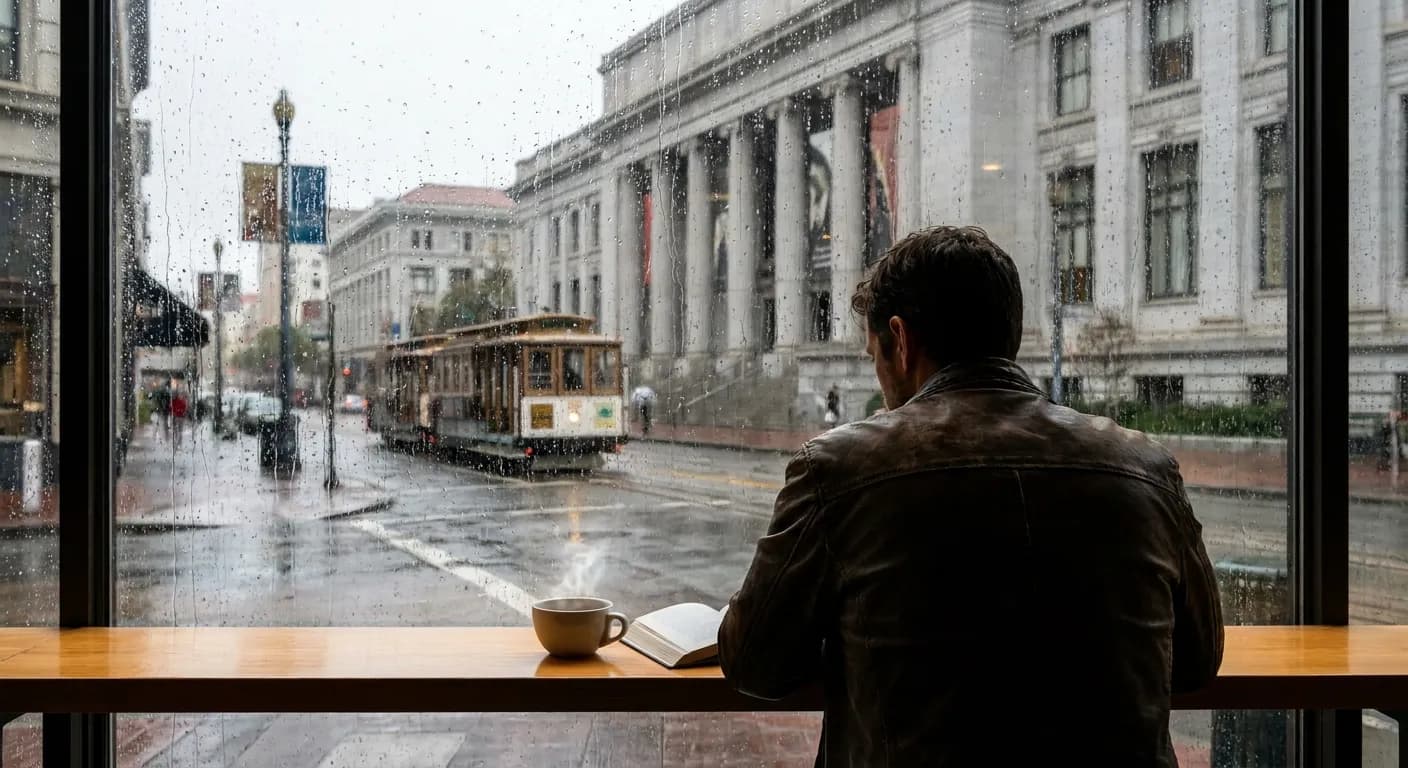
San Francisco does most of its raining between November and March, usually in committed, all-day sessions that make a hiking itinerary look like a dare. The standard response is to treat indoor plans as Plan B — a consolation list of 'well, there's always a museum.' That framing sells the city short. San Francisco's indoor bench is deep enough that a rainy weekend, planned right, beats a sunny one in half the cities you could fly to.
The trick isn't finding indoor things — every listicle has those. It's architecture: clustering each half-day in one neighborhood so you're never zigzagging across town between downpours, soaked and negotiating for parking. Here's a full two-day blueprint built on that principle, anchor by anchor.
The Rule: One Neighborhood Per Half-Day
Rain punishes transitions, not activities. The misery of a wet weekend is the forty minutes between things, so build each block of the day around venues within a few minutes' walk of each other, and let Muni or a rideshare handle the one big move at midday. A few principles worth following:
- Pick one anchor per half-day (a museum, a bathhouse, a movie palace) and let food orbit it.
- Book the things that book up — spa slots, dinner, film screenings — before Saturday morning.
- Layers beat umbrellas here; SF rain arrives with wind that turns umbrellas into modern art.
- Save the bathhouse for last. Nothing after it will feel important, and that's the point.
Saturday Morning: Golden Gate Park's Museum Double-Header
Start at the Music Concourse in Golden Gate Park, where the de Young Museum and the California Academy of Sciences face each other across a plaza — the shortest dash between two world-class institutions in the city. The Cal Academy is the rainy-day cheat code: an aquarium, a planetarium, and a four-story rainforest dome under one living roof, which means you can spend a storm in a humid glass jungle watching butterflies while the weather does its worst outside. Across the concourse, the de Young covers American art, textiles, and big traveling exhibitions. Doing both in one day is ambitious; pick the one that fits your crowd and arrive at opening, since everyone else in the city has the same rainy-day idea by noon.
Saturday Afternoon: SoMa and SFMOMA
One ride across town lands you at SFMOMA, one of the largest modern and contemporary art museums in the country — seven floors, which is not a museum visit so much as a weather-proof afternoon with escalators. The surrounding Yerba Buena blocks keep you fed and dry between galleries, and the museum's own cafes solve lunch without going back outside. If your energy dips, the upper floors are quieter; the crowd thins the higher you climb.
Saturday Night: A Movie Palace, Not a Multiplex
A rainy night is the correct night for cinema with some ceremony to it. In the Mission, Alamo Drafthouse New Mission runs first-run films inside a restored 1920s theater with seat-side food and drink service and a proper bar downstairs — dinner and a movie collapsed into one dry building. A few blocks away, the Roxie on 16th Street is the long-running indie house for repertory picks and documentaries you won't find anywhere else. And the marquee option is back: the Castro Theatre reopened in early 2026 after a two-year, $41 million renovation, running a calendar of films, concerts, and comedy under that famous neon sign — check what's on, because a stormy night inside a 1922 movie palace is the kind of plan you move a flight for.
Sunday Morning: Ferry Building and the Embarcadero
Start Sunday under the Ferry Building's long arched nave, where the marketplace keeps coffee, bread, oysters, and about forty impulse purchases within one covered stroll. Rain on the bay is genuinely pretty from indoors, which is the Embarcadero's whole rainy-day argument. From there it's a flat, quick hop up the waterfront to the Exploratorium on Pier 15 — nominally a science museum, actually a warehouse of hundreds of hands-on experiments that adults enjoy exactly as much as the kids they brought as cover. Between the two, you can lose an entire morning within a half-mile of covered space.
Sunday Afternoon: Japantown, the All-Weather Neighborhood
Japantown might be the single best rainy neighborhood in San Francisco because its center is literally indoors: the Japan Center malls connect shops, restaurants, and the Kinokuniya bookstore in one interior wander, no umbrella required. Do a slow lap, eat something steaming, browse stationery you didn't know you needed — then finish the weekend at Kabuki Springs & Spa, the Japanese-style communal bathhouse that has anchored the neighborhood since 1968. Hot pool, cold plunge, sauna, steam room: it is the single most weather-appropriate activity in the city, and booking ahead is strongly advised on wet weekends because locals know it too.
The Wildcard: A Russian Banya in Dogpatch
If communal-bathing-as-weather-defiance appeals but you want the maximalist version, swap Kabuki for Archimedes Banya on Innes Avenue near Dogpatch — an Eastern European bathhouse layering saunas, steam, plunge pools, and an on-site restaurant into a multi-hour ritual with bay views. It runs into the late evening most nights but is closed Tuesdays, and it's the kind of place a rainy Sunday can disappear into entirely. Consider yourself warned about how hard it is to leave.
Rainy Weekend FAQs
When is San Francisco's rainy season?
The vast majority of the city's rain falls between November and March, often in multi-day storm systems, while summers are nearly rain-free (fog is a separate department). If you're visiting in winter, assume at least one wet day and build a plan like this one rather than gambling on the forecast.
Do I need a car for this itinerary?
No — and in the rain you specifically don't want one, since parking hunts are the wettest part of any SF day. Each cluster here is walkable internally, and the between-cluster moves are single Muni rides or short rideshares. The N Judah and the 5-Fulton both serve Golden Gate Park's museums; downtown clusters are even easier.
What should I book in advance?
Spa entries at Kabuki Springs and Archimedes Banya, any Castro Theatre or Alamo Drafthouse showing you care about, and Saturday dinner near your evening anchor. Museum tickets are worth grabbing online the night before on wet weekends since crowds swell. For everything else, stay loose — rainy days reward the ability to duck into whatever looks warm. Ask Karpo on the day and it'll re-route your afternoon around whatever the sky is doing.