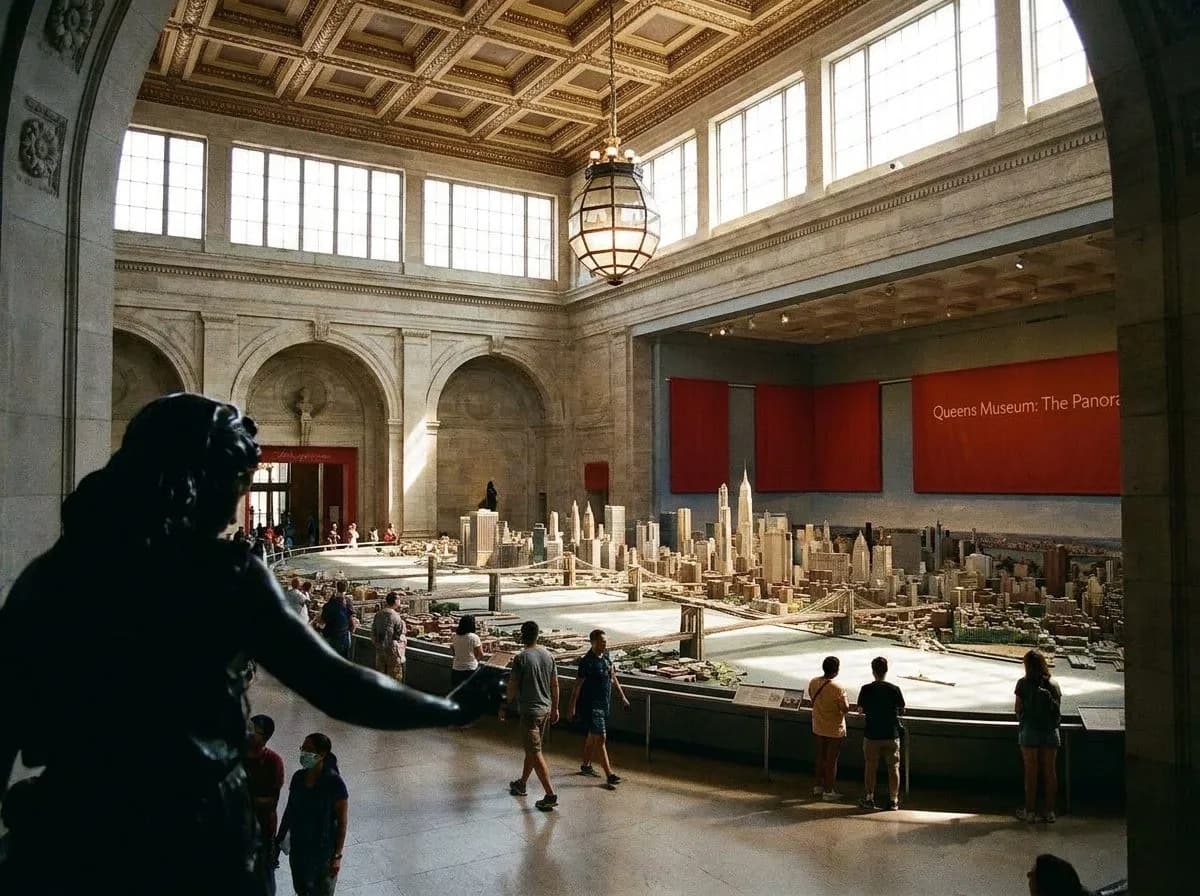
Stand on the railed walkway and you're looking down on a god's-eye view of the entire city—all 320 square miles of it, compressed into a single climate-controlled gallery. The Panorama of the City of New York is not a map. It's not quite a sculpture. It's a room-sized obsession, built in 1964 at Robert Moses's direction and maintained ever since with the quiet devotion usually reserved for ship models and bonsai. Every building that stood in the five boroughs when Lyndon Johnson was president is here, rendered in miniature. So are sixty thousand more added since. You walk around it slowly. You lean over the rail. You find your block.
A World's Fair leftover that never left
Moses wanted fairgoers to grasp the scale of his ambitions—the bridges, the highways, the parks he'd carved into the city's fabric. So he hired a team led by Lester Associates to build the Panorama as the centerpiece of the New York City Pavilion at the 1964 World's Fair. The model took three years and nearly a million dollars to complete. When the fair shuttered, most pavilions were dismantled or repurposed. The Panorama stayed, a world's fair legacy marooned in Flushing Meadows Corona Park, waiting for the museum to grow around it.
The Queens Museum inherited the building—the same structure that housed the United Nations General Assembly before it decamped to Manhattan—and the Panorama became its anchor. It's the largest architectural scale model of any city ever built, a superlative that sounds quaint until you're standing beside it. The thing is huge. It fills a gallery the size of a small airplane hangar. You can see the rivers curve, the grid buckle at Broadway, the way Brooklyn's street plan refuses to align with Queens's.
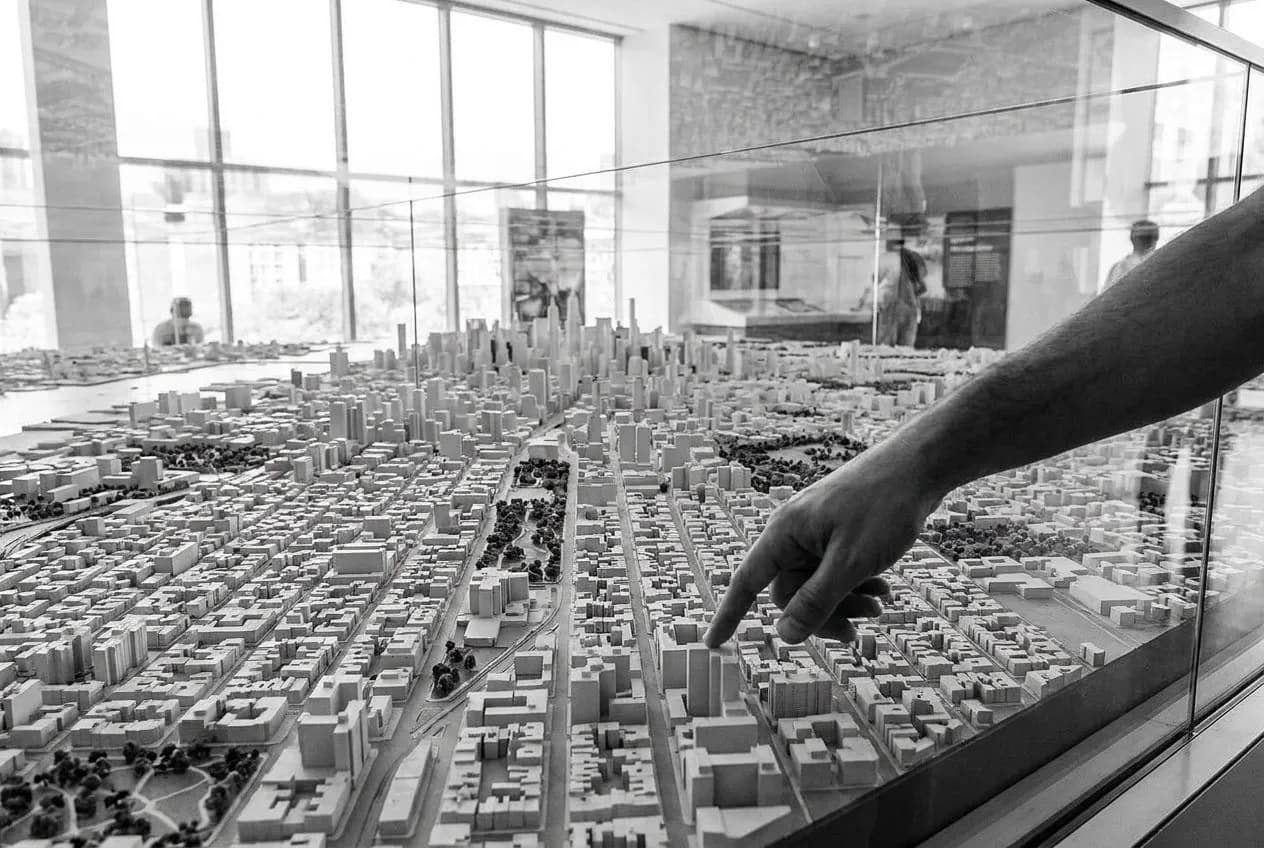
Every building, block by block
At 1:1200 scale, a six-story brownstone is about half an inch tall. The Empire State Building rises to fifteen inches. Skyscrapers are recognizable by silhouette—the Chrysler's spire, One World Trade's flat top—but most of the model is a low, granular sprawl of row houses and mid-rises, textured and painted to approximate their real-world materials. It's the density that startles. You think you know New York is crowded. Then you see it all at once, and the sheer cumulative weight of eight million lives housed in wood and brick and concrete clicks into focus.
The model was updated in 1992 to add sixty thousand new structures—towers that went up in the eighties, whole neighborhoods that hadn't existed when the Beatles played Shea Stadium. Staff still make small corrections using architectural plans and satellite images, a quiet campaign of civic cartography carried out with tweezers and glue. A demolition in Astoria means a technician pries a tiny building off the board. A condo rises in Williamsburg, and someone fabricates a replacement. The Panorama is a living document, never quite current, never quite obsolete.
Free admission and summer refuge
You can see the Panorama without spending a dollar. Free admission on Fridays from 5:00–8:00 p.m. and free admission on the first Sunday of each month makes it one of the city's best-kept secrets for budget-conscious exploration. The suggested admission donation is around $8 for adults, but it's never enforced at the desk—walk in, nod, proceed. The museum doesn't advertise this widely, but the staff won't stop you.
Late-2026 summer in the city means finding air-conditioned sanctuary wherever you can. The Panorama gallery stays cool even in July, a deep chill that makes you grateful for the extra layer you brought. The light is dim and even, calibrated to protect the model's paint and glue. There's no noise except the occasional murmur of other visitors and the hum of the climate system. It's a room built for lingering.
What to look for
Start with your own neighborhood. Everyone does. You find your block, trace your commute, spot the park where you eat lunch. Then you zoom out. The airports become obvious—LaGuardia's stub runways jutting into the bay, JFK's sprawl to the southeast. Central Park is a long green void, shockingly empty against the surrounding grid. Governors Island floats in the harbor like a misplaced game piece. The bridges are delicate, almost fragile. The Verrazzano spans the Narrows on toothpick cables.
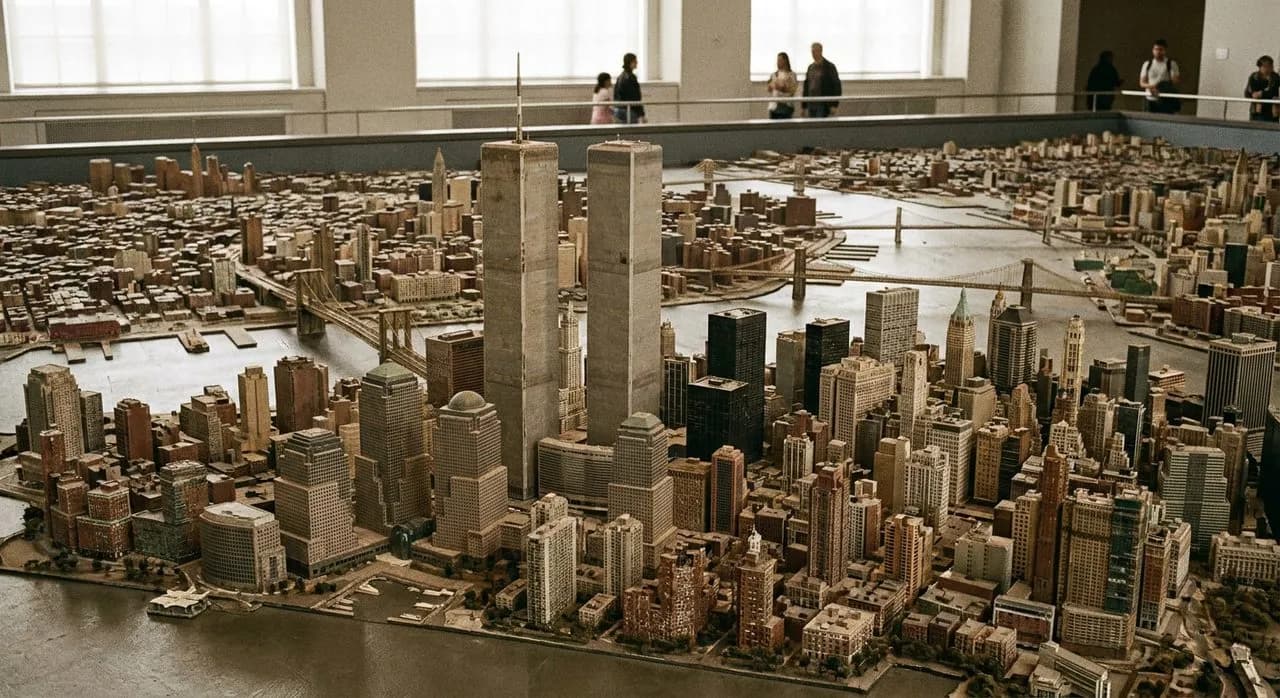
Look for the buildings that aren't there anymore. The original Twin Towers stood tall on this model until 1992, when they were updated to reflect the actual skyline. One World Trade now rises in their place, a tiny obelisk you can cover with your thumb. History layers over history. You're looking at the city as it was, as it is, as it's always becoming.
The walk through Flushing Meadows
Take the 7 train to Mets–Willets Point; the museum is a six-minute walk through Flushing Meadows Corona Park, past the Unisphere. That giant steel globe, another World's Fair survivor, marks the way. In summer, the park hosts festivals and pickup soccer games, the paths crowded with families and joggers. You'll pass the remnants of both the 1939 and 1964 fairs—pavilions converted to skating rinks and science halls, the bones of utopian ambition softened by decades of use.
The museum building itself is low and unassuming, a modernist box with big windows and a certain mid-century confidence. Walk in and the Panorama pulls you straight back. You'll spend an hour, maybe two. Bring water. Wear comfortable shoes. The rail runs the perimeter of the model, and you'll want to make the full circuit at least twice.
Practical notes
Queens Museum, New York City Building, Flushing Meadows Corona Park, Queens. Nearest subway: 7 train to Mets–Willets Point, then six minutes on foot past the Unisphere. Limited street parking available on park roads; verify restrictions. Free admission Fridays 6–8 pm and first Sundays; suggested donation other days. Open year-round except major holidays; confirm hours directly before visiting. Fully accessible; wheelchairs available at the desk. Bring a light jacket—the gallery runs cold. Restrooms and a small café on-site. Plan ninety minutes minimum.
Tags: #PanoramaOfNewYork #QueensMuseum #FreeAndFine #NYCHiddenGems #FlushingMeadowsCoronaPark #WorldFairLegacy #CivicCartography #FreeNYC #SummerInTheCity #QueensNY #NYCCulture #ArchitecturalModel #IndoorEscape #NYCSummer2026 #CityExploration
Sources consulted: Wikipedia - Panorama of the City of New York · Wikipedia - 1964 World's Fair · Queens Museum · Flushing Meadows Corona Park · Time Out New York - Museums
All trademarks are the property of their respective owners.