 Where to Eat Near Penn Station That Isn't a Chain
US Open 2026
Public Art Near the US Open Worth Seeing
Between tennis sessions, Flushing Meadows offers sculptures, civic landmarks, murals, and museum stops that can turn spare time into a Queens art walk.
A US Open day does not have to be limited to the walk between transit, security, food, and your seat. The USTA Billie Jean King National Tennis Center sits inside Flushing Meadows Corona Park, one of New York’s richest landscapes for public art and civic memory. Within a manageable radius are monumental World’s Fair structures, outdoor sculptures, museum collections, lakeside paths, and busy neighborhood streets where murals, signs, and storefront art add a different Queens texture. The best approach is not to treat these stops as a second itinerary competing with tennis. Treat them as flexible layers. If you have 20 minutes, you can make one iconic photo stop. If you have a longer break, you can build a compact walk around the park’s most recognizable landmarks. If you are staying nearby or returning on a non-match day, you can push farther toward Flushing’s commercial corridors and look for street-level art that changes with the neighborhood.
Text Karpo for a current, low-friction plan for public art near the us open worth seeing—including timing, route checks, and practical options that fit your day.
Start With the Unisphere
The Unisphere is the natural first stop because it is both a sculpture and a compass. The stainless-steel globe, created for the 1964-65 New York World’s Fair, remains the visual anchor of Flushing Meadows Corona Park. For tennis fans, it is also useful: easy to recognize, close to the tournament grounds, and memorable enough to serve as a meeting point if your group separates before or after a session.
Do not only take the straight-on photo and leave. Walk around the fountain area and watch how the globe changes against the sky, the museum building, the passing crowds, and the open parkland. On a tournament day, the contrast is part of the scene. Fans in tennis clothes, families using the park, visitors with cameras, and locals crossing the plaza all move through a space designed to project global ambition. That makes the Unisphere more than a backdrop; it places the US Open inside a public landscape with its own identity.
Read the Park's Sculptures
From the Unisphere, look for the large-scale works and architectural remnants that give the park its distinctive atmosphere. Rocket Thrower is one of the most striking nearby sculptures, a dynamic figure from the World’s Fair era whose stretched, athletic form feels especially apt on a tennis day. It was not made as tennis art, but its sense of motion, reach, and release can echo the physical drama fans have just watched on court.
The New York State Pavilion adds another layer. Its towers and circular form are among the park’s most recognizable remnants, and even exterior views communicate a story about spectacle, optimism, and the afterlife of major events. Pairing the pavilion with the Unisphere and Rocket Thrower creates a loose outdoor gallery: not a quiet sculpture garden, but a working urban park where art sits beside recreation fields, paths, roads, and crowds.
- For a short loop, pair the Unisphere with Rocket Thrower and exterior views of the New York State Pavilion.
- For a slower walk, spend time on sightlines, shadows, and surfaces instead of only collecting landmark photos.
- For families or groups, choose one major landmark as a regrouping point before heading toward the tennis grounds.
- For photographers, try wide shots first, then details that include people moving through the park.
Visit Queens Museum
The Queens Museum is the most natural indoor cultural stop near the tennis center. Its best-known attraction, the Panorama of the City of New York, gives visitors a rare way to understand the US Open’s setting within the full city. After hours of watching a rectangular court, the shift in scale can be refreshing: Queens, Manhattan, Brooklyn, the Bronx, and Staten Island appear as one connected urban system rather than separate names on a transit map.
A museum stop also helps explain why Flushing Meadows feels different from a typical sports district. This is not simply a stadium surrounded by parking and restaurants. It is a park shaped by world’s fairs, civic ambition, recreation, and later sports development. If you are visiting from outside New York, the museum can make the day feel less transactional. You are not only arriving for a match and leaving afterward; you are spending time in a borough with its own institutions and visual language.
Choose this stop based on energy, weather, and timing. If the day is hot or your group has already done a lot of walking, an indoor art break may be more appealing than extending a route across the park. If you are traveling with someone who cares more about architecture or urban history than tennis, the museum, the Unisphere, and the pavilion can turn the outing into a shared experience rather than a sports-only day.
Look for Flushing Murals
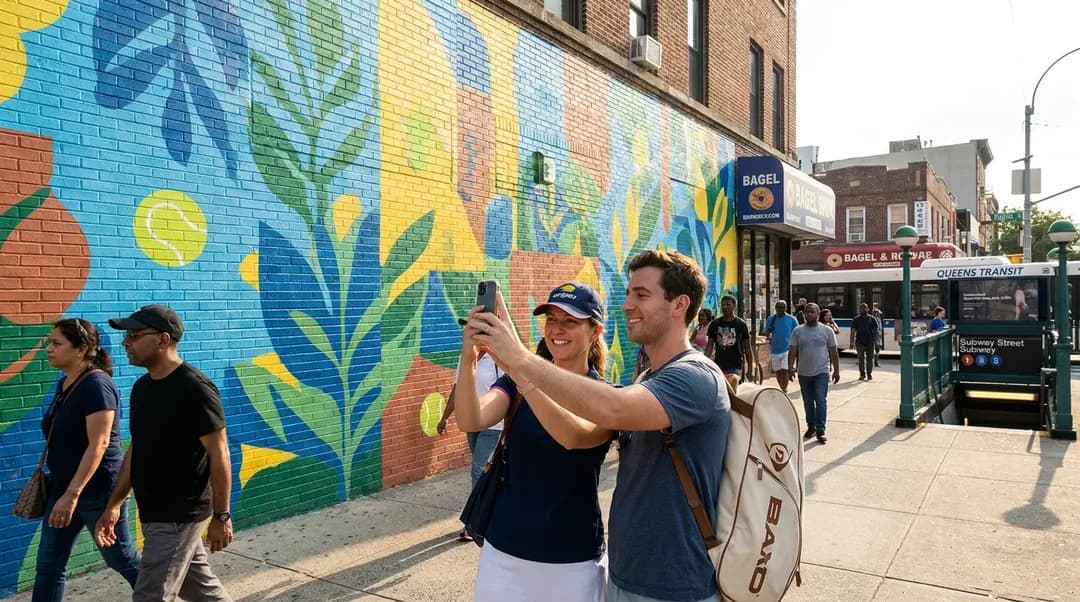
Fans who want a less monumental art walk should look beyond the park toward Flushing’s busy streets. Murals and street-level visuals here can be temporary, commercial, community-based, or partly hidden among signs, shutters, window graphics, and storefront displays. That changeability is the point. Unlike the Unisphere, a mural may not remain exactly as a past photo showed it, so this kind of walk works best as open-eyed wandering rather than a fixed checklist.
Main Street and nearby commercial blocks can create a vivid transition from tournament atmosphere to neighborhood life. You may notice painted walls, multilingual signs, decorative awnings, religious imagery, food-shop graphics, and small design choices that rarely appear in official tennis coverage. The result is not a polished outdoor museum. It is a dense urban environment where art, advertising, language, and daily errands overlap. For visitors, that overlap can be one of the most memorable parts of Queens.
Set a boundary before you go. Decide whether you are taking a short look near transit, adding a meal-adjacent stroll, or saving the neighborhood walk for a separate morning. Stay aware of traffic, avoid blocking storefronts for photos, and treat privately owned walls or interior displays respectfully. If a piece has changed, the walk has not failed; you are seeing the neighborhood as it is now.
Practical Notes
Advice: make the route modular. For “Public Art Near the US Open Worth Seeing,” the useful 2026 calendar anchor is August 23 through September 13, with singles main-draw play beginning August 30. A quick version is the Unisphere plus one nearby sculpture or pavilion view. A medium version adds the Queens Museum area. An expanded version includes a Flushing mural walk when you are not rushing to a match or carrying more than you want to manage.
Before traveling, recheck the official US Open schedule, Fan Week information, Plan Your Visit guidance, gate details, security rules, and conditions that could affect your day. Because “Public Art Near the US Open Worth Seeing” depends on live operations, verify the specific schedules, gates, transit conditions, local hours, inventory, and venue rules that affect this plan. Before acting on “Public Art Near the US Open Worth Seeing,” recheck the official security page; its current limit is one searchable bag per guest, no larger than 12 by 12 by 16 inches. For the Queens Museum, restaurants, shops, and any neighborhood stop, verify current hours, access, and availability directly before relying on them.
Tags: #USOpen2026 #Tennis #NewYork #Queens #FlushingMeadows #USOpenGuide #TennisFans #SportsTravel #NYCEvents #HardCourt #KarpoFinds #Karpo
Sources consulted: usopen.org — Official reference · usopen.org — Official reference · usopen.org — Official reference
All trademarks are the property of their respective owners.
Ask Karpo first
Want to know what is confirmed, when to show up, and what is actually open to the public? Ask Karpo for the latest US Open updates and a practical New York plan for public art near the us open worth seeing.
Ask Karpo for more information.
Keep reading
- Where to Eat Near Penn Station That Isn't a Chain
 Andytown Coffee in the Outer Sunset: The Snowy Plover Explained
- Best Things to Do in Chicago: What the City Gives Away