Three completely different foods are sold in this city under the same four-letter word, and most of the frustration people have with New York pizza comes from ordering one while expecting another. A Neapolitan pie and a New York slice are not variations on a theme - they use different flour hydration, different ovens, different cook times, different cheese and different eating protocols. Sicilian is a third thing again. The good news is that you can identify which one you are dealing with from the pavement, before you order, using about four seconds of observation.
Style is the thing that decides whether a pizza is right for what you are doing tonight, and it is almost never the thing listed in a search result. Tell Karpo what the evening looks like - eating on your feet, sitting down properly, feeding four people who cannot agree - and it will point you at the right style rather than the nearest oven.
Look at the oven first
The oven tells you everything and it is usually visible from the door. A New York shop runs a deck oven: a squat rectangular steel box with two or three horizontal chambers and a flat stone floor, sitting at roughly five hundred and fifty to six hundred degrees Fahrenheit. Pies go in for eight to twelve minutes. That long, moderate bake is what produces the sturdy, foldable, slightly dry base that can survive being cut, held under a lamp and reheated.
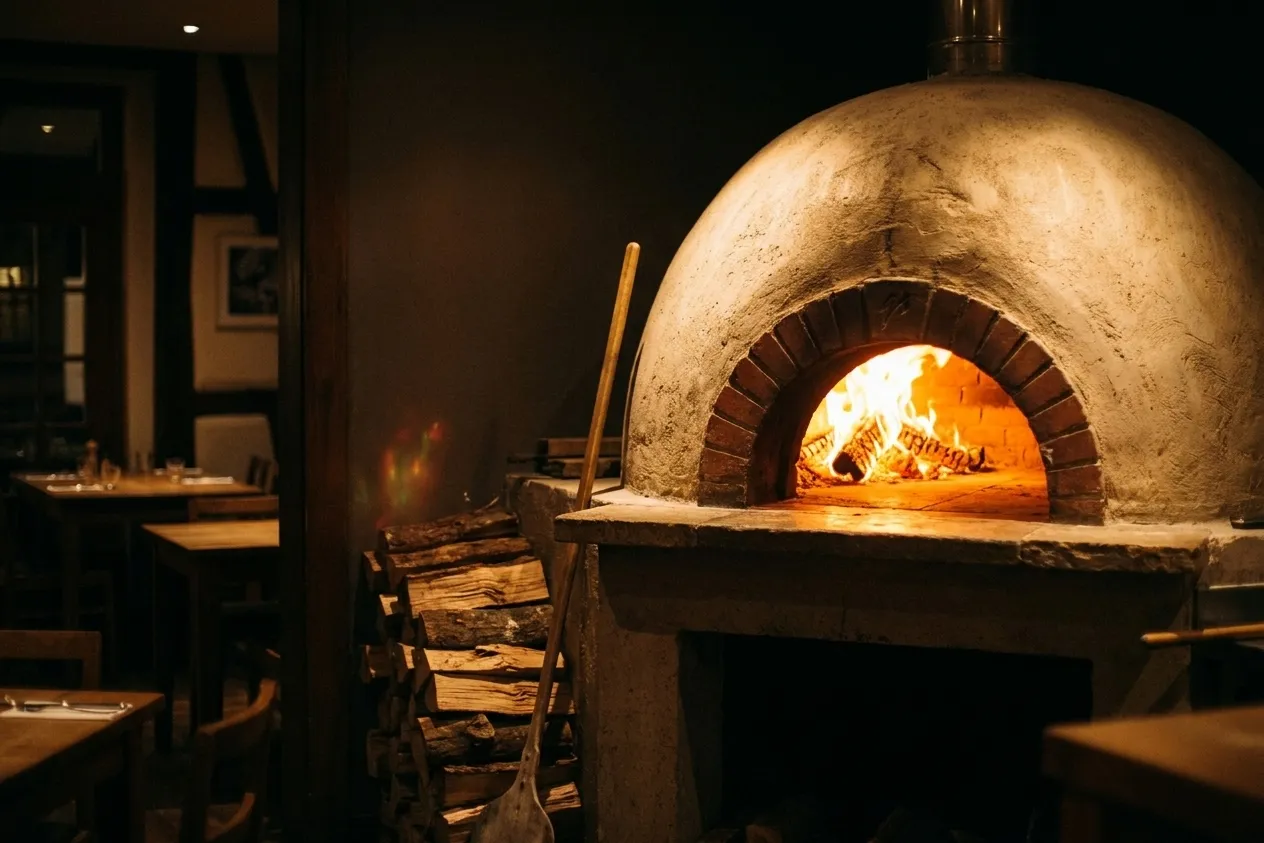
A Neapolitan kitchen runs a domed wood or gas oven, usually round, usually tiled, with a visible fire at the back, and it runs near nine hundred degrees. A pie cooks in under two minutes. That is why the centre stays soupy and the rim blisters and chars: there is not enough time for the middle to dry out. It is also why Neapolitan pizza is essentially never sold by the slice - it does not hold, it does not travel, and it is unrecoverable ten minutes later.
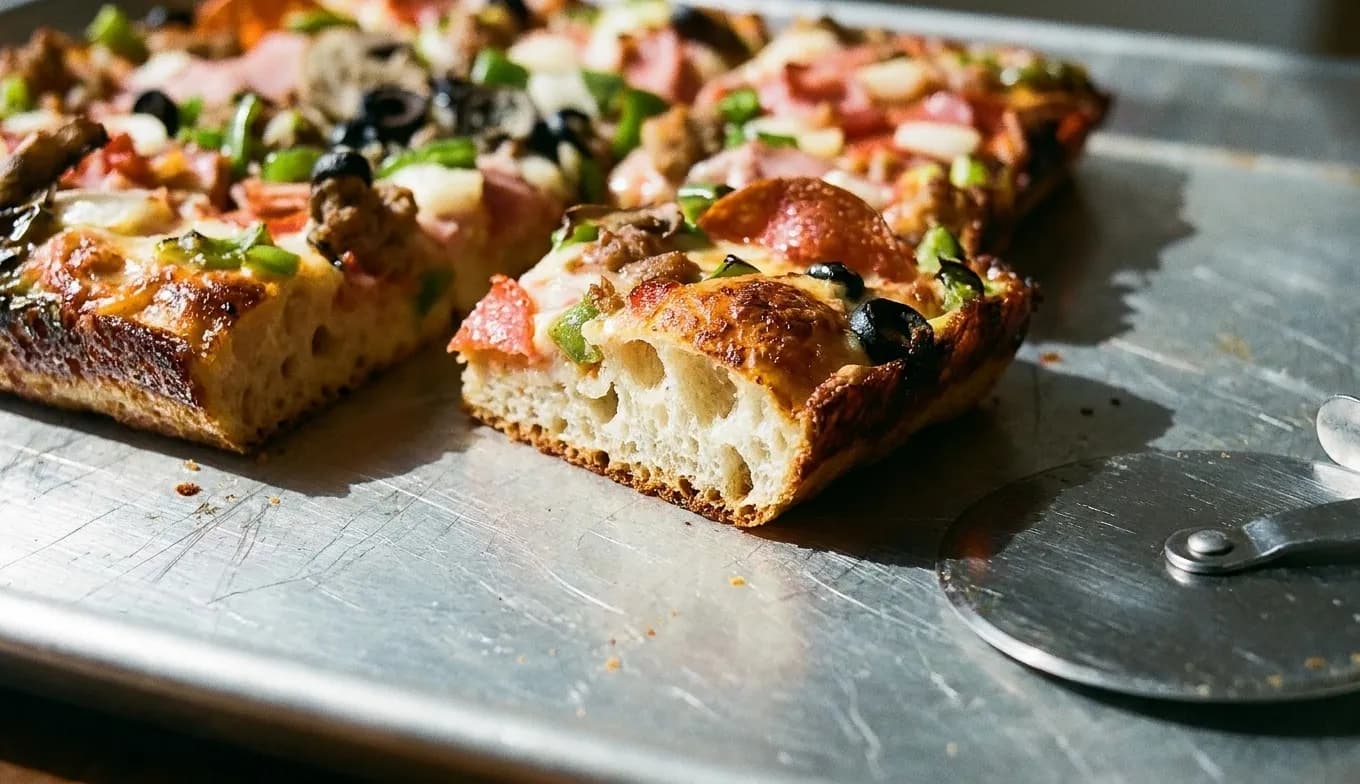
A Sicilian or grandma operation bakes in oiled steel pans in a conventional or deck oven, and you will see the trays rather than the pies. Thick, rectangular, cut into squares.
Then look at how it is being sold
The sales format follows directly from the oven and is the second reliable tell. If there is a warm case at the front with cut pies in it and someone with a peel taking single slices out, you are in a New York shop. If there is a host stand, a menu and no visible slices, you are in a Neapolitan restaurant and you are buying a whole pie for one person. If there are metal trays of squares behind the counter, that is the pan operation.
This matters for practical reasons that have nothing to do with authenticity. A New York slice is a five-minute transaction that costs a few dollars and can be eaten standing up. A Neapolitan pie is a sit-down meal, takes twenty minutes to arrive, and is best eaten with cutlery in the first three minutes. Ordering the second when you wanted the first is the single most common bad pizza evening in this city.
What each one is actually for
New York style is the utility pizza and it is engineered for it. The base is dry and strong enough to fold lengthwise and eat with one hand, it survives an hour under a lamp, and it reheats genuinely well in a hot deck oven. This is the pizza for eating between two other things, for feeding a group with no plan, and for eleven at night.
Neapolitan is the sit-down version and it is a two-minute window food. Order it, eat it immediately, do not take it away, do not expect leftovers to be worth anything. It rewards a proper table and punishes everything else.
Sicilian and grandma - the two are related but not identical, the grandma being thinner and usually baked in a shallower pan - are the most forgiving of all three. Thick, open-crumbed, high moisture, oil-fried on the base from the pan. They hold heat, hold structure and reheat better than anything else, which makes them the right order in a slow hour, the right thing to take home, and the right thing to feed a crowd from.
Why the same shop rarely does two of them well
It is reasonable to wonder why a kitchen does not simply make all three. The answer is that the oven is a fixed asset and the dough is a fixed decision. A deck oven at 575 cannot produce a Neapolitan char, and a 900-degree dome will incinerate a New York base before the middle sets. Dough hydration compounds it - Neapolitan runs wet and slack and is shaped by hand at the last moment; New York dough is drier, stronger and often rested for a day or more so it can be stretched thin without tearing.
So when a place advertises all three, it is usually doing one properly and approximating the others. That is not necessarily a problem - an approximated square is still a square - but it is worth knowing which one the kitchen is actually built around. The oven answers it, and so does the menu's centre of gravity: whichever style has the most variations listed is the one they make every day.
Two smaller distinctions worth having
Bar pizza and tavern-cut pizza turn up around the city and are a fourth thing: very thin, cooked hard, cut into squares rather than wedges regardless of being round. If you are handed a round pie cut in a grid, that is deliberate and it is a different tradition, not a mistake.
And there is a growing category that is technically Neapolitan-derived but built to survive - longer bake, lower hydration, a base with actual structure. It is often described as New York-Neapolitan and it is genuinely the best of both for a sit-down meal where you might want a second slice twenty minutes in. If a place has a domed oven but is cutting the pies into eight and running them a little longer, that is what you are looking at.
Practical notes
New York style: rectangular steel deck oven, roughly 550 to 600 degrees, eight to twelve minutes, sold by the slice from a warm case, folds, reheats well. Neapolitan: domed oven near 900 degrees, under two minutes, sold as whole pies at a table, soft centre, charred rim, does not keep. Sicilian and grandma: oiled steel pans, thick and rectangular, cut into squares, the best keeper and the best reheat of the three.
If you cannot see the oven, look at the counter. A warm case of cut pies means slices; a host stand and no case means whole pies at a table.
Tags: #PizzaNearMe #NYCPizza #NeapolitanPizza #SicilianPizza #GrandmaSlice #NewYorkSlice #DeckOven #PizzaGuide #NewYorkCity #NYCFood #HowToOrder
All trademarks are the property of their respective owners.
Ask Karpo first
Most bad pizza decisions in New York are style mismatches rather than quality problems. Ask Karpo which of the three is nearby, which of them suits the kind of evening you are actually having, and where the ovens are that are still running at the hour you want to eat.