 Scenic Walking Trail Near Me: Central Park North Woods Ravine and Loch Walk
Free Things to Do
Scenic Viewpoint Near Me: Brooklyn Heights Promenade at Sunset
A practical guide to Brooklyn Heights Promenade at Montague Street and Pierrepont Place, Brooklyn, NY 11201, with the best viewing angles, arrival timing, walking route, and neighborhood plan.
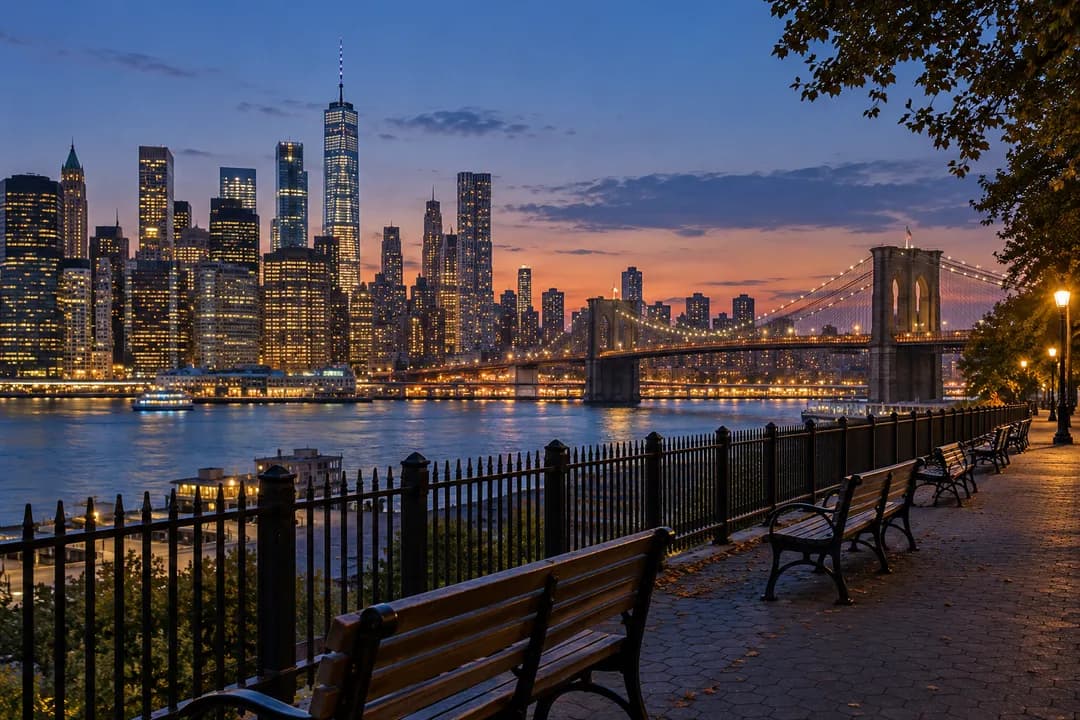
Brooklyn Heights Promenade is the scenic viewpoint near me to choose when the goal is a wide, instantly legible New York panorama rather than a single lookout platform. The elevated walk runs above Brooklyn-Queens Expressway along Brooklyn Heights, with the Brooklyn Bridge, Lower Manhattan, New York Harbor, and the Statue of Liberty spread across the view. Use the entrance near Montague Street and Pierrepont Place, Brooklyn, NY 11201, then let the promenade do the work: it is a public walking route, not a ticketed observation deck, so the best visit is built around light, wind, and a comfortable pair of shoes.
The View Is Layered, Not Just a Manhattan Backdrop
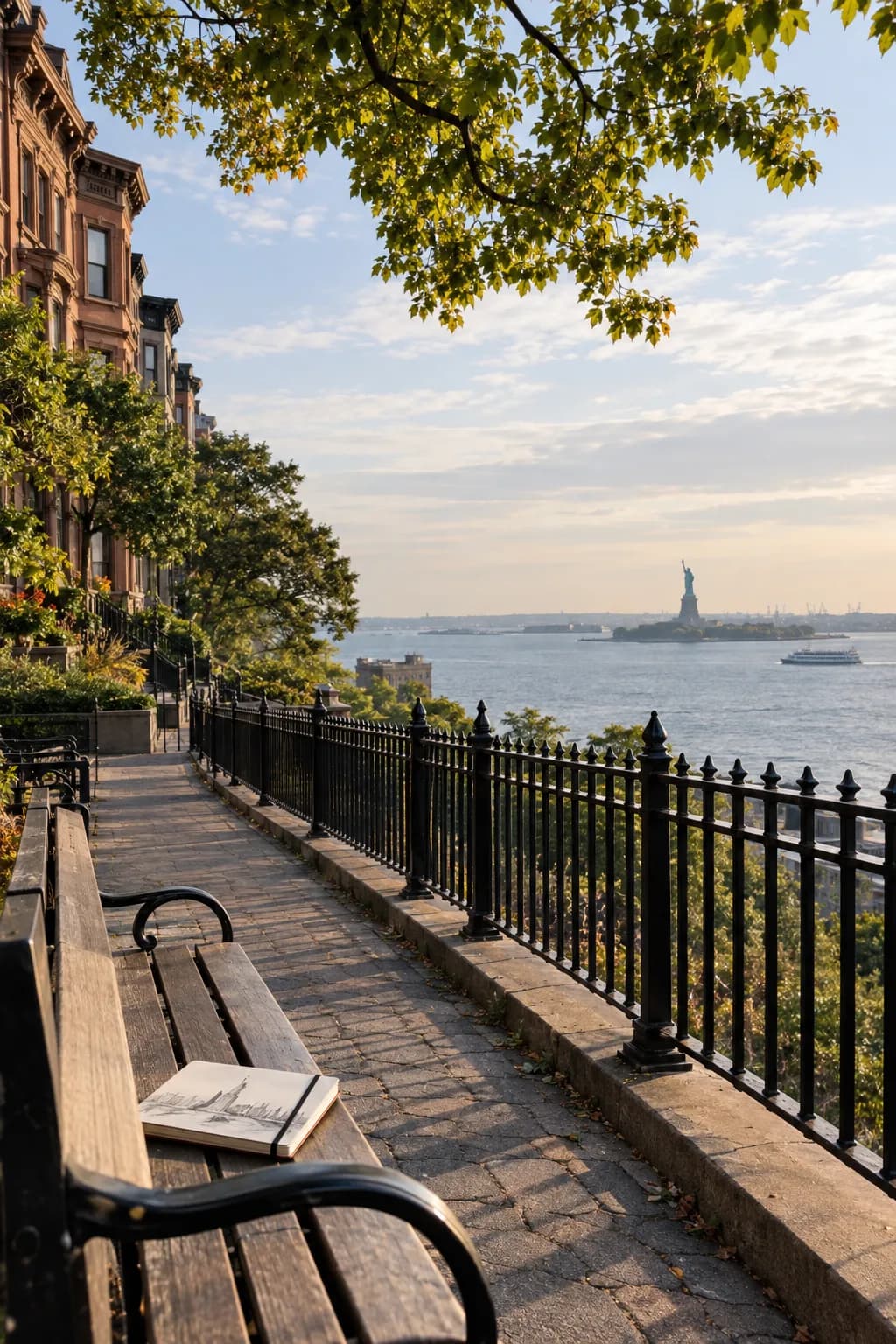
The first thing to notice is how many separate planes the view contains. The Brooklyn Bridge cuts diagonally across the foreground, Manhattan towers rise behind it, and the harbor opens south toward Governors Island and the Statue of Liberty. That layering makes the Promenade more rewarding than a generic skyline photo. A person who wants architecture can work the bridge cables and civic buildings; someone waiting for sunset can watch the river change from silver to copper. The railing is the main visual anchor, but do not crowd it or lean over it for a picture.
Morning visitors get a cleaner, cooler walk and more room for a tripod-sized composition. Late afternoon brings warmer stone, a busier promenade, and the strongest contrast between the shaded Brooklyn Heights buildings and the bright skyline. The hour after sunset is worth keeping: the bridge lights become distinct while the sky still holds color. If the wind comes off the harbor, the temperature can feel sharply lower than it did on Montague Street. A light layer is more useful than carrying a large blanket or picnic setup.
The promenade is a place for moving slowly, but it is still a shared public path. Runners, dog walkers, parents with strollers, and residents using the route as daily infrastructure all pass through. Keep the railing edge clear, avoid stopping in the narrowest sections, and take group photographs from a wider landing rather than making a queue behind you. There is no café or staffed visitor center on the promenade itself, which is useful to know before you arrive with the expectation of buying dinner at the view.
How to Arrive Without Turning the Visit Into a Chore
The simplest arrival is the 2 or 3 train to Clark Street or the R to Court Street, followed by a short walk west through the brownstone grid. The Promenade runs from the west end of Remsen Street to the west end of Orange Street, and Montague Street, Pierrepont Place and Clark Street all feed into it, so you can enter at one end and leave at the other. A car is a poor match for a short sunset stop because Brooklyn Heights curb space is competitive and the expressway sits directly below the walkway.
Brooklyn Heights itself supplies the story around the view. Its brownstone streets make a sharp contrast with the financial district across the water, and two landmarks are worth a detour of a block or two. The Center for Brooklyn History, at 128 Pierrepont Street, occupies the George B. Post building raised in 1878 to 1881 for the Long Island Historical Society. A few minutes north, Plymouth Church at 57 Orange Street was built in 1849 to 1850, and its first minister, Henry Ward Beecher, made it a center of the abolitionist movement. Then angle toward Brooklyn Bridge Park if you want a longer riverfront route.
For a shorter outing, stay on the promenade and stop at several wider viewpoints instead of treating the route like a race to one famous photo. For a longer outing, continue toward the park and use the waterfront as the return leg. Jane's Carousel, the piers, and the bridge approaches are nearby visual subjects, but they change the mood from residential overlook to active park. Decide whether that is the point of the day. If you mainly want the skyline, do not dilute the visit with too many stops before the light peaks.
Brooklyn Heights Walking Details That Change the Experience
The best queue-avoidance trick is to avoid creating a queue at all: arrive before the exact sunset minute, walk until you find a clear sightline, and take the photograph after watching the scene for a few minutes. The promenade has no reservation system and no admission line, so timing is about pedestrian density rather than tickets. Weekday evenings usually feel more manageable than warm weekend sunsets. If the river haze is heavy, shift the plan toward a brownstone walk; the neighborhood remains worthwhile even when the far skyline loses definition.
A good practical sequence is Montague Street, the Promenade, a descent into Brooklyn Bridge Park, and a final look back toward the bridge from below. Wear shoes that handle stairs and uneven transitions, keep valuables secure in crowded photo moments, and bring water because the overlook itself is not a concession zone. Restrooms and food are easier to find once you are back in the surrounding commercial streets than on the elevated route. This is a free city viewpoint, but it rewards preparation more than impulse.
There is one honest reason to skip the Promenade on a particular evening: if the goal is a quiet, private sunset, a public residential overlook may feel too social. Residents use it, photographers wait along the rail, and visitors naturally gather when the bridge lights begin to glow. Choose Fort Tryon Park for a greener, less central feeling or Riverside Park for a longer Hudson-side walk. Choose Brooklyn Heights when the priority is the classic relationship between bridge, harbor, and Manhattan.
A Practical Sunset Plan for the Promenade
The walkway is a piece of postwar engineering hiding in plain sight. Clarke & Rapuano designed it in 1946 as the top tier of a three-level cantilevered structure: two stacked roadways of the Brooklyn-Queens Expressway run underneath, and the Promenade sits level with the neighborhood streets above them. The southern half opened to the public on October 7, 1950, and the northern half on December 7, 1951. It stretches 1,826 feet, is owned by the city Department of Transportation, and is maintained by NYC Parks, which is why it feels like a park even though it is technically a deck over a highway.
Photographers should look for moments when the bridge traffic, ferry wakes, and changing window light create scale. Families may prefer the earlier part of the evening, when the route is easier to navigate and children can see the bridge details before darkness. Couples can walk after dinner, but the wind and stairs make a compact layer and comfortable shoes more valuable than a formal outfit. Everyone benefits from leaving the rail unobstructed and treating the view as shared space.
Brooklyn Heights Promenade succeeds because it is specific: it gives you the harbor from above, the bridge at close range, and Lower Manhattan across a real body of water. It is not trying to be a tower, a museum, or a hidden local secret. Go for the geometry, stay for the changing light, and use the surrounding neighborhood to turn a twenty-minute photo stop into a complete Brooklyn evening. That is the reliable answer when a search for a scenic viewpoint near me really means a memorable city walk.
Leave through the brownstone streets rather than treating the promenade as a standalone attraction. The wrought-iron benches on the harbor side are there for a reason: sit for ten minutes, watch the ferries and tugboats cross the East River, then walk back up Montague Street as the shop lights come on. That final change of scale, from bridge cables and harbor water to stoops, trees, and neighborhood corners, is what makes this Brooklyn Heights route feel personal.
Ask Karpo for more information.
Keep reading
- Scenic Walking Trail Near Me: Central Park North Woods Ravine and Loch Walk
 Scenic Viewpoint Near Me: Riverside Park Hudson River Walk
 Scenic Viewpoint Near Me: Gantry Plaza State Park Skyline Walk