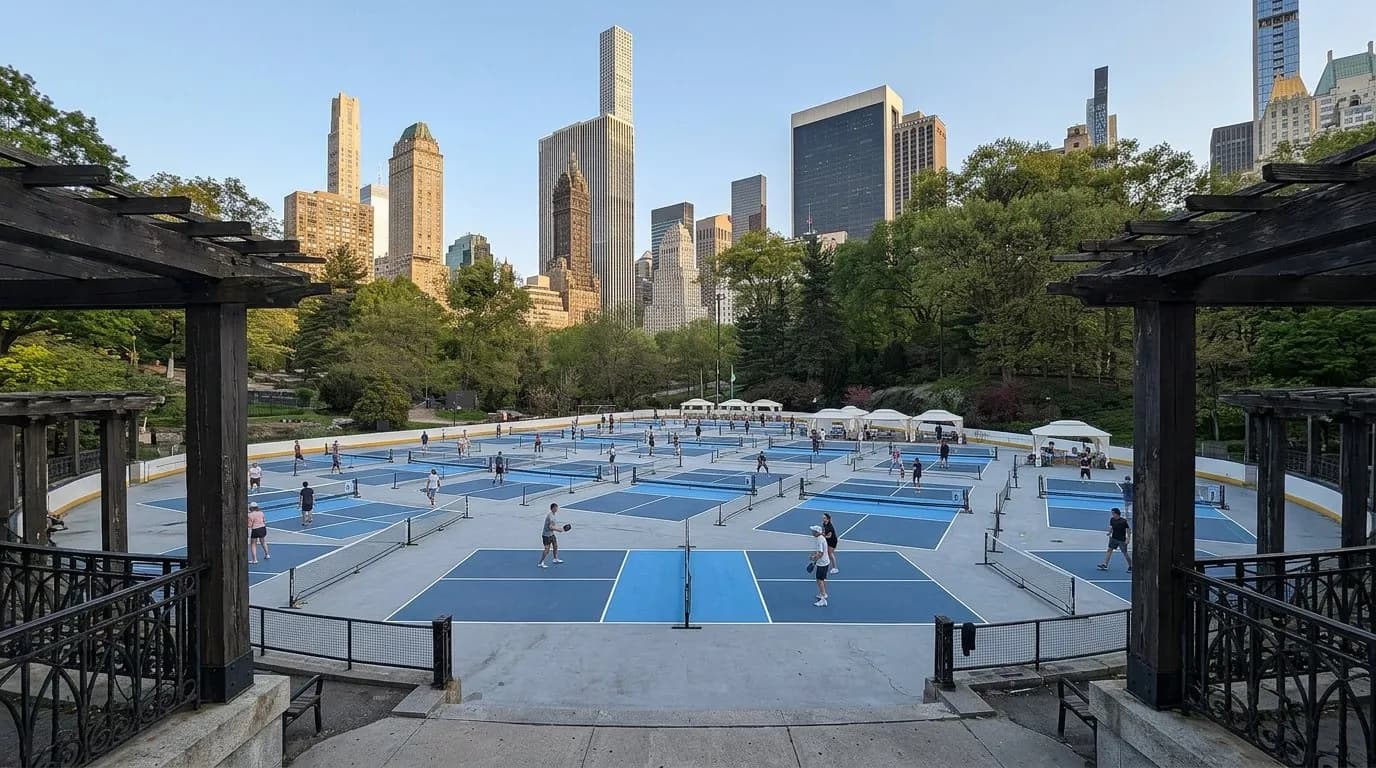
The courts look temporary: painted lines laid over an ice rink, cabanas that could be struck down by October, a five-dollar community session tucked between pricier peak slots. But CityPickle's fourteen courts on Wollman Rink's deck now sit under a twenty-year license worth more than a hundred million dollars. What reads like a pop-up is, on paper, one of the most secure pieces of recreational infrastructure in the park.
Karpo can check today's court availability and current off-peak pricing at CityPickle before you head into the park.
A rink that spends half the year pretending it isn't one
Wollman Rink has been a fixed point in Central Park for seventy-five years, known first and mostly for ice. For part of the year now, that identity flips entirely. The same sunken bowl, ringed by the park's tree line and the same railings that keep skaters on the ice in winter, fills instead with fourteen pickleball courts laid out in tidy rows, their nets branded and uniform, tournament-style, across the whole deck.
The effect is a bit like walking into a familiar room that's been rearranged. The skyline is still there beyond the tree canopy, midtown's towers visible over the park's greenery, but the surface underfoot has changed from carpeted ice-rink flooring to a resurfaced hard court, built to replace an earlier rolled-out acrylic layer. It looks, at first glance, like scaffolding for a summer event. It isn't.
The paperwork behind what looks like a pop-up
CityPickle started in 2021 as a three-year seasonal arrangement, the kind of thing that could plausibly vanish after a lease review. That's no longer the case. Following a competitive process run by NYC Parks, the operation was awarded a twenty-year license, with a cumulative minimum fee to the city of ninety-one million dollars and a minimum capital investment of 10.9 million dollars layered on top. Add it up and the deal's value to the city is put at more than a hundred million dollars over its term.
That's a striking amount of institutional weight to put behind something that still, physically, gets covered over each winter when the rink reverts to ice. But it explains why the courts feel more finished than a typical seasonal build: the resurfaced playing material was chosen partly because it drains and dries faster after rain than the old carpet, a small but telling sign that this was built to be used for years, not one summer.
Fitting a season around a fixed footprint
Because the pickleball setup shares its footprint with a working ice rink, the season is bounded by when the ice comes off. Openings have landed as early as the first week of April in recent years, running through early autumn, though the exact start and close have shifted season to season and are worth confirming before building a trip around them.
Daily play hours have generally run from eight in the morning to nine at night, with at least one earlier season opening as early as seven. Cumulative attendance across the first three seasons topped 180,000 players, a figure that suggests the courts fill reliably once the season is underway, particularly on weekends.
Getting a court without paying the peak rate
Pricing runs on a sliding scale that rewards showing up earlier in the day. Off-peak sessions, generally mornings and weekdays, have been priced around ten dollars a player, while peak evening and weekend slots have run from roughly 12.50 up to 15 dollars, depending on the season. Arriving before the after-work rush is the simplest way to keep the cost down.
There's also a Community Play tier, priced around five dollars a person and including a free paddle rental, that runs during specific daily hour blocks rather than all day. It's the cheapest way onto the courts by a wide margin, but it isn't a standing offer, so checking the current schedule before assuming it's available is worth the extra minute.
Reservations tend to open roughly a week before opening day each season, and weekend slots have a habit of filling quickly once booking opens. Anyone set on a specific Saturday morning slot is better off checking early rather than a day or two out.
The layer above standard court time
Beyond the basic per-player fee, CityPickle runs group clinics, private coaching, leagues, open play sessions and kids' summer camps, giving the facility a programming depth that goes well past drop-in play. Food and drink service, handled by Great Performances, means there's a proper concession operation rather than a snack stand at the gate.
For anyone planning something bigger than a casual match, courtside cabanas and a VIP Players Lounge are available to reserve separately, aimed at birthday parties, corporate outings and similar group bookings. These sit outside the standard court fee and likely need their own reservation and price tier, so it's worth confirming current cabana and lounge terms directly rather than assuming they're bundled into a normal court booking.
What you're actually looking at once you're inside
Standing at the rail above the rink, the scene reads as a strange but coherent overlap of park and sports facility: open-air courts sunk into a bowl of concrete, tree cover and skating-rink railings framing the sides, and Central Park's own paths and lawns just beyond. It doesn't look like a commercial strip, because it isn't one. There's no signage-heavy approach, no storefronts, just parkland leading down into a court complex that happens to be the largest pickleball facility in New York City and, by most counts, the largest in the Northeast.
That contrast, quiet park setting wrapped around a genuinely large-scale sports operation, is probably the clearest way to understand what CityPickle at Wollman Rink actually is. Not a temporary rig squeezed into unused park space for a few summers, but a permanent fixture that happens to share its footprint, and its off-season silence, with one of the city's oldest ice rinks.
Practical notes
CityPickle sits inside Central Park on the deck of Wollman Rink; the exact street address and nearest subway entrance weren't confirmed, so check current park maps or the booking site before heading over. The season generally runs from early April through early autumn, with daily play roughly 8am to 9pm, though hours and dates shift year to year. Reservations typically open about a week before opening day, and weekend slots go quickly. Off-peak pricing (mornings, weekdays) runs cheaper than peak evening and weekend rates, and a discounted Community Play block has been offered at specific hours. Cabanas and the VIP lounge require separate booking. Expect an open-air, tree-ringed setting rather than a commercial strip.
Tags: #CentralPark #PickleballNYC #WollmanRink #CityPickle #NYCParks #SportsAndSocial #PickleballCourtsNearMe #ManhattanRecreation #OpenAirCourts #ParkLifeNYC #PickleballLeagues #SummerInNYC #CourtBooking #NYCOutdoors #PickleballSeason
All trademarks are the property of their respective owners.
Ask Karpo first
Not sure whether tonight's slot falls in the cheaper off-peak window or the pricier evening block, or whether the Community Play discount is even running today? Ask Karpo to pull up current CityPickle hours and pricing before you book.