 Ghost Walk Near Me in Greenwich Village: Edgar Allan Poe's Haunts
Weekend Plans
Ghost Walk Near Me in Lower Manhattan: Phantoms of City Hall Park
Boroughs of the Dead leads a two-hour Lower Manhattan ghost walk from City Hall Park fountain through Trinity Churchyard and colonial burial grounds for $40.
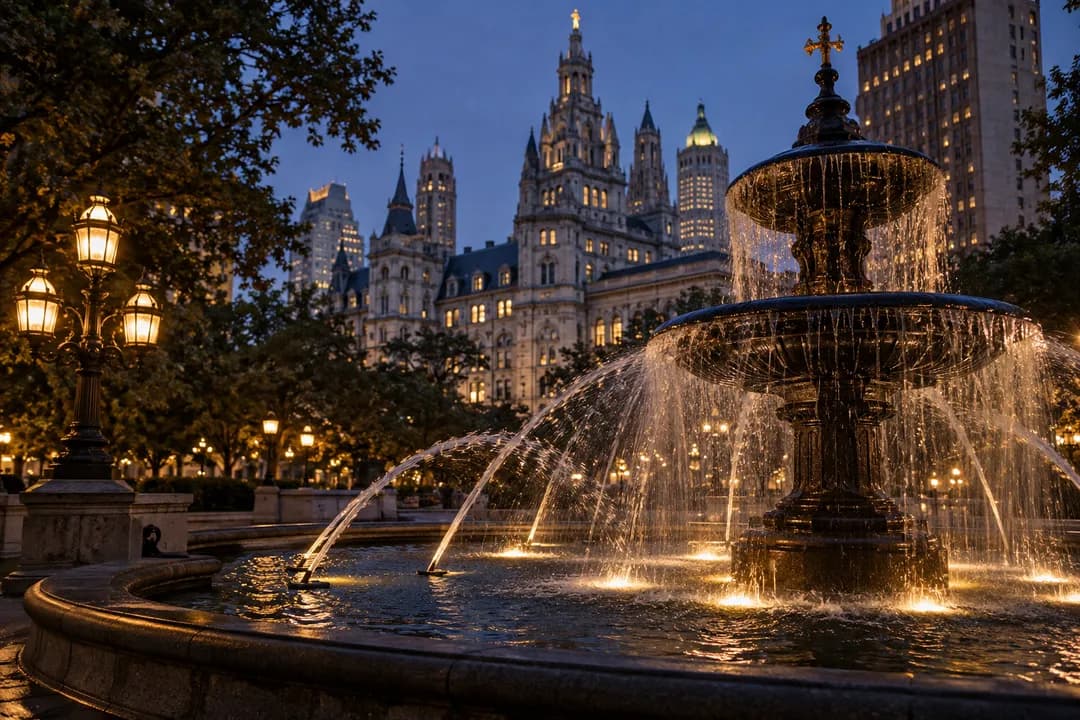
The Ghosts of Old New York walking tour by Boroughs of the Dead convenes beside the circular granite fountain inside City Hall Park, near the intersection of Broadway and Murray Street, New York, NY 10007. Designed and researched by founder Andrea Janes, this two-hour historical investigation covers Lower Manhattan's seventeenth- and eighteenth-century colonial landscape, where Revolutionary War prison ships, municipal gallows, and mass yellow fever trenches left an indelible imprint. Operating with admission tickets at $40 per adult, the route provides travelers searching for a ghost walk near me with an impeccably documented encounter with the oldest haunted grounds in New York City.
City Hall Park Gallows and Revolutionary War Cruelty
The tour gathers around the illuminated fountain in City Hall Park fifteen minutes before twilight. Long before landscaped flowerbeds and municipal government offices occupied this parcel, it was known as the 'Commons'—an open expanse on the city's outskirts utilized as a public pasture, execution site, and almshouse burial ground. During the British occupation of Manhattan from 1776 to 1783, thousands of captured American Continental soldiers were crammed into the Provost Jail and the stone Bridewell prison that stood on this very turf. Denied food, medical care, and winter clothing by British Provost Marshal William Cunningham, more American patriots perished from starvation and smallpox inside these prisons than fell in all the armed battles of the Revolution combined.
Guides point across the manicured lawns toward the current Tweed Courthouse, explaining how post-war excavations routinely unearthed communal trenches packed with unmarked pine coffins and skeletal fragments. Even in the modern era, municipal utility workers digging along Centre and Chambers Streets frequently encounter discarded colonial artifacts and bone fragments, grounding the park's eerie late-night reputation in undeniable archival reality.
St. Paul's Chapel and the Legend of George Frederick Cooke
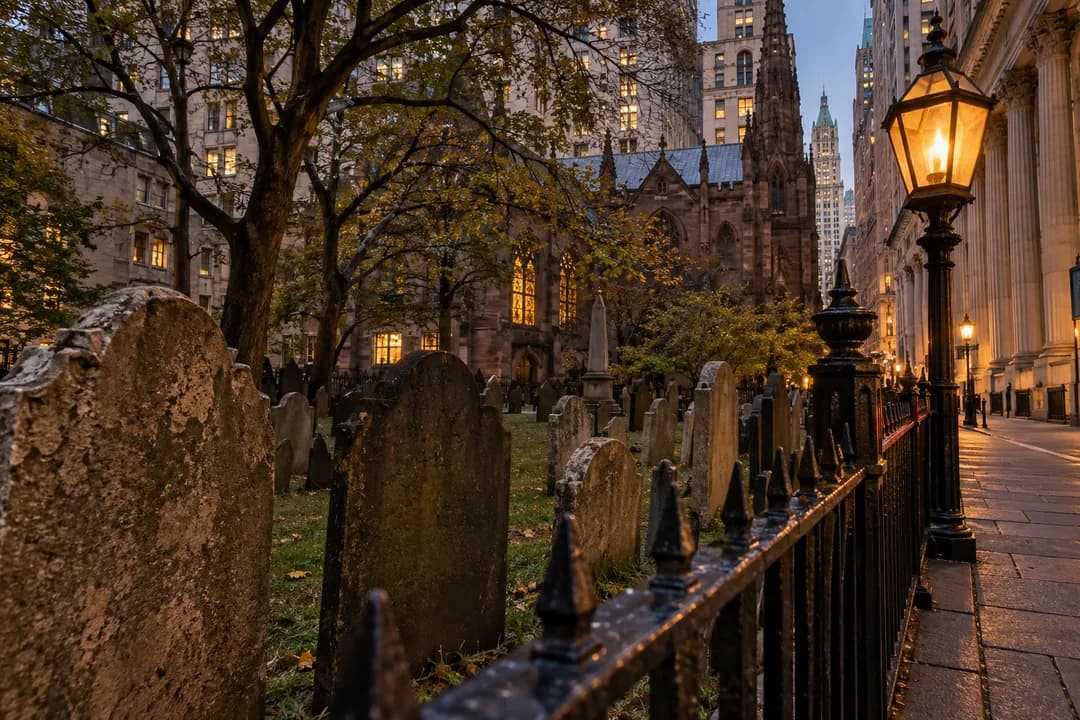
The tour proceeds south along Broadway to St. Paul's Chapel at 209 Broadway, Manhattan's oldest surviving church building, completed in 1766. Miraculously surviving both the Great Fire of 1776 and the collapse of the World Trade Center towers directly across Church Street in 2001, St. Paul's is famed for its lush historic graveyard. Here rests the celebrated English theatrical actor George Frederick Cooke, who passed away in Manhattan in 1812 from severe dropsy and alcoholism. His memorial obelisk, erected in 1821 by fellow tragedian Edmund Kean, marks one of the city's most macabre ghost legends.
As the guide recounts, Cooke's body was exhumed shortly after burial by curious medical students, and his skull was allegedly sold to pay off lingering debts, later surfacing as a theatrical prop in local productions of Hamlet. Century-old sexton journals describe sightings of a headless phantom in nineteenth-century stage attire wandering the mossy pathways between the brownstone headstones, supposedly searching for his missing cranium. The guide pairs this theatrical lore with authentic probate court records and medical school inventories from nineteenth-century New York.
Trinity Churchyard and the Financial District's Buried Secrets
Continuing south on Broadway, the walk stops before the towering neo-Gothic bronze gates of Trinity Church at 89 Broadway, situated at the head of Wall Street. Founded under a charter granted by King William III in 1697, the church's churchyard contains burial vaults of foundational figures, including Alexander Hamilton, his wife Elizabeth Schuyler Hamilton, and steamboat inventor Robert Fulton. During catastrophic yellow fever epidemics in the late 1790s and early 1800s, burials were conducted by torchlight in quicklime trenches along the western churchyard perimeter to prevent contagion.
Further down toward Bowling Green and Pearl Street, the group surveys Fraunces Tavern at 54 Pearl Street, where George Washington bid farewell to his Continental Army officers in December 1783. The surrounding narrow alleys of Stone Street and Coenties Slip sit directly above the Dutch colonial landfill that buried seventeenth-century canal slips and tavern basements. Neighborhood security guards and nighttime cleaning crews in Financial District office towers regularly report unprompted elevator descents, sudden cold spots, and heavy door latches moving on their own.
Tour Organization, Distance, and Advance Ticketing
The Ghosts of Old New York route spans approximately 1.5 miles of concrete and stone sidewalks across Lower Manhattan, concluding near the Wall Street subway station. The tour is conducted over two hours at an unhurried, narrative pace suitable for walkers of moderate fitness. Boroughs of the Dead operates throughout the four seasons, advising participants to check the evening forecast, dress warmly for chilly harbor breezes coming off the Hudson River, and wear cushioned walking shoes.
Reservations must be booked in advance via boroughsofthedead.com or through customer service at (646) 389-4678. The standard adult ticket is $40. Due to detailed discussions of war atrocities, executions, and colonial medical practices, the tour is recommended for ages twelve and older, although mature younger teenagers accompanied by an adult are welcome.
What to Skip and What to Appreciate
Skip looking for staged jump-scares or theatrical props on this walk. Boroughs of the Dead is led by published historians and licensed city guides who treat municipal history with intellectual respect. If you prefer costumed actors shouting horror trivia through megaphones, this tour is not for you. Additionally, skip bringing heavy backpacks, as you will be standing on sidewalk corners for extended storytelling stops.
Pay close attention to the street layout as you walk south of Wall Street. Notice how the grid dissolves into curving, seventeenth-century Dutch lanes like Beaver Street and Mill Lane. Looking down into subway grates occasionally reveals original colonial retaining walls and stone foundations preserved beneath modern glass skyscrapers, illustrating how Old New York's past remains physically sealed under the financial capital.
Transportation, Restroom Facilities, and Contingency Plans
City Hall Park is exceptionally easy to reach via public transit, situated adjacent to the City Hall subway station (R, W lines), Brooklyn Bridge–City Hall (4, 5, 6 lines), and Chambers Street (J, Z lines). Public restrooms are not maintained in City Hall Park after twilight, so use the restroom facilities inside nearby transit concourses or commercial cafes along Broadway prior to check-in.
In the event of severe storm warnings, Boroughs of the Dead will notify guests via email and provide credit or refund options. If your tour finishes in Lower Manhattan and you want to continue your evening surrounded by historical atmosphere, walk south to Fraunces Tavern at 54 Pearl Street to enjoy a pint in the historic Dingle Whiskey Bar, or visit The Dead Rabbit at 30 Water Street for renowned craft cocktails in a historic multi-story townhouse.
Ask Karpo for more information.
Keep reading
- Ghost Walk Near Me in Greenwich Village: Edgar Allan Poe's Haunts
 Ghost Walk Near Me in the West Village: Phantoms by Commerce Street
 Ghost Walk Near Me in the East Village: Phantoms Along Astor Place