On the morning of August 12, 2026, the path of totality for a solar eclipse will cross directly over Brooklyn. Crown Heights sits near the centerline, which means roughly four minutes of full darkness around 10:30 a.m. That also means every greenspace within walking distance of the 2, 3, 4, and 5 trains will be standing-room-only by 9 a.m. if the forecast is clear. The eclipse august 2026 event is the first total solar eclipse visible from New York City in more than a century, and everyone who can get to Brooklyn that morning will try.
Karpo tracks real-time crowd reports, subway delays, and park closures the morning of the eclipse. Text it at 6 a.m. on August 12 for the clearest route and a backup spot if your first choice is packed.

Crown Heights gets totality, but not quietly
The eclipse begins its partial phase around 9:15 a.m., reaches totality near 10:30, and wraps up by noon. That's a narrow window, and it falls on a weekday. If you work in Manhattan, you're looking at a reverse commute: outbound trains will be heavy, and the return trip after totality could mean standing in a hot railcar with a few thousand other people who just watched the same thing. If you're coming from outside the city, PATH and commuter rail into Penn Station or Atlantic Terminal will be crowded before sunrise.
The practical question is not whether to go—if it's clear, you go—but where to stand and how to get home without spending an hour underground. The parks everyone names first—Prospect, Fort Greene, McCarren—will be shoulder-to-shoulder. You want a spot with a clear northern sky, room to sit, and a subway line that doesn't require a transfer if half the system is running slow.
Eastern Parkway or Herbert Von King Park
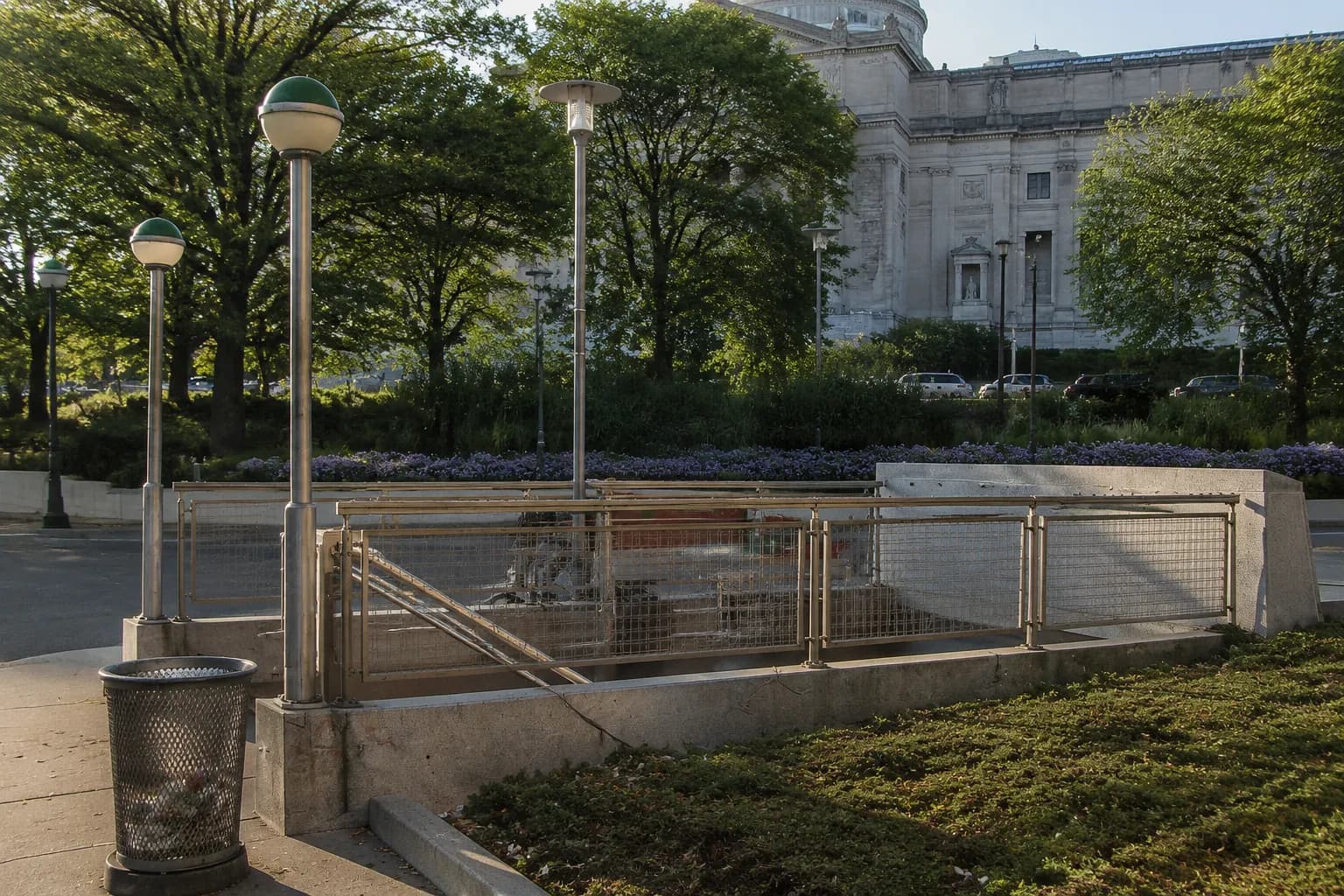
Eastern Parkway between Washington and Classon has wide medians, benches, and a straight sightline north. It's also right on top of the 2 and 3 at Eastern Parkway–Brooklyn Museum, which means you can walk up from the platform at 9 a.m. and claim a spot without a long hike. The parkway was built for crowds—it handles the West Indian Day Parade every September—so the infrastructure is there. Expect food carts by 8:30 and a lot of families with lawn chairs. The downside: no bathrooms unless you walk into the Brooklyn Museum or the library, and both will have lines. After totality, the 2 and 3 will be packed, but they run express and you're one stop from the junction at Franklin, so if you're heading back to Manhattan you'll move.
Herbert Von King Park, a few blocks north in Bed-Stuy, is quieter and has more grass. It's a small park—one square block bounded by Greene, Marcy, Lafayette and Tompkins—but it has open sky, a playground if you're bringing kids, and bathrooms that are usually unlocked by 9 a.m. The G train at Bedford–Nostrand is two blocks west; the A and C at Nostrand are four blocks east. The G is your best exit if you're going to North Brooklyn or Queens, because it skips Manhattan entirely and won't be crushed by the eclipse august 2026 surge. The A and C will be slower. Von King also borders residential streets, so if the park fills up you can stand on Marcy Avenue with a clear view and walk to the train when it's over.
Both locations require eclipse glasses. The American Astronomical Society posts a list of approved vendors; buy them ahead of time, because sidewalk sellers the morning of the eclipse will be moving counterfeits. If you forget, do not look up during the partial phases. During totality—the few minutes when the moon fully covers the sun—you can look with bare eyes, but the partial phases before and after will damage your retina.
Subway math and the cost of going
A single ride is $2.90 as of early 2025; check the MTA site for current fare. If you're coming from outside Brooklyn, budget for round-trip subway or commuter rail, and assume your return train will be standing-room. The 2 and 3 run express between Franklin and 14th Street during weekday hours, so the trip from Crown Heights to Union Square is about twenty minutes if the train is moving. Add fifteen minutes of platform wait if you're traveling right after totality, because half of Brooklyn will be doing the same thing. The 4 and 5 also serve Crown Heights but require a transfer at Nevins or Borough Hall to reach most Manhattan destinations, and transfers the morning of August 12 will be slower than the map suggests.
If you drive, street parking in Crown Heights is metered until 7 p.m. on weekdays, and the neighborhood does not have excess capacity. Arrive before 8 a.m. or don't bring a car. There are no large public lots within walking distance of the parks. A safer plan is to park at a subway terminus in Queens or the Bronx and ride in.
Food and coffee: bring your own, or expect to wait. The bagel shops and bodegas along Nostrand and Franklin will be busy by 8 a.m. There is no table service in the parks. If you're planning to stay in the neighborhood after the eclipse august 2026 event, brunch spots on Franklin between Eastern Parkway and Atlantic will have long waits until early afternoon. Confirm the restaurant is open that day before you walk over.
Check the forecast three days out and have a bail plan

The solar eclipse august 2026 path is fixed, but weather is not. If the National Weather Service shows overcast or rain for August 12, you will not see totality from New York City. The next morning, check again. If the forecast improves to partly cloudy, go anyway—even broken clouds can give you a view during the four-minute window. If it's a total washout, the eclipse still happens, but you're watching it streamed from somewhere else.
The path of totality stretches from Greenland through Iceland, Spain, and into North Africa. If you're willing to travel and the New York forecast looks bad a week out, consider flying to Madrid or Lisbon, where August weather is more predictable. That is obviously a different trip. But if you've been planning for this since 2024 and the weekend before shows solid clouds over the Northeast, it's an option.
If you're committed to New York regardless of weather, have an indoor plan. The American Museum of Natural History and the Hayden Planetarium will likely host eclipse programming, though they have not yet posted August 2026 schedules as of this writing. The Intrepid Museum and Brooklyn Public Library may do the same. Confirm before you go. A cloudy eclipse is still a cultural moment in the city, and you'll be with people who tried.
One last timing note: the eclipse is on a Tuesday. If you work a standard schedule and your employer is not giving time off, you're looking at a late arrival or a half-day. The event will not wait. Totality in Crown Heights lasts four minutes, and if you're on the subway when it happens, you miss it. Plan accordingly.
Practical notes
- Totality occurs around 10:30 a.m. on August 12, 2026; arrive by 9 a.m. to claim a spot.
- Buy ISO-certified eclipse glasses in advance; do not trust sidewalk vendors the morning of.
- The 2 and 3 trains at Eastern Parkway–Brooklyn Museum are express to Manhattan; expect crowding after 10:45 a.m.
- Herbert Von King Park has bathrooms; Eastern Parkway medians do not.
- Check the National Weather Service forecast three days before; if it's overcast, totality will not be visible.
- Street parking in Crown Heights is metered on weekdays; arrive early or take the subway.
Tags: #karpo #nyc #crownheights #brooklyn #eclipseaugust2026 #solareclipse #solareclipse2026 #totaleclipse #weekendplans #nycweekend #brooklynparks #mta #nycsubway #eclipse2026 #newyorkcity
Sources consulted: NASA Eclipse Maps · American Astronomical Society – Eclipse Glasses · MTA Service Status · National Weather Service New York
All trademarks are the property of their respective owners.
Ask Karpo first
Text Karpo the morning of August 12 to check real-time crowding at Eastern Parkway and Von King Park, confirm which subway lines are running local or express, and get a live route home that avoids transfer delays. It will also tell you if the forecast has changed overnight and whether your backup viewing spot is still open.