 Astoria Chess Cafe Night Planner: How to Become a Regular
Sports Social
Union Square Chess Cafe Night Planner: A Weekly Team Ladder
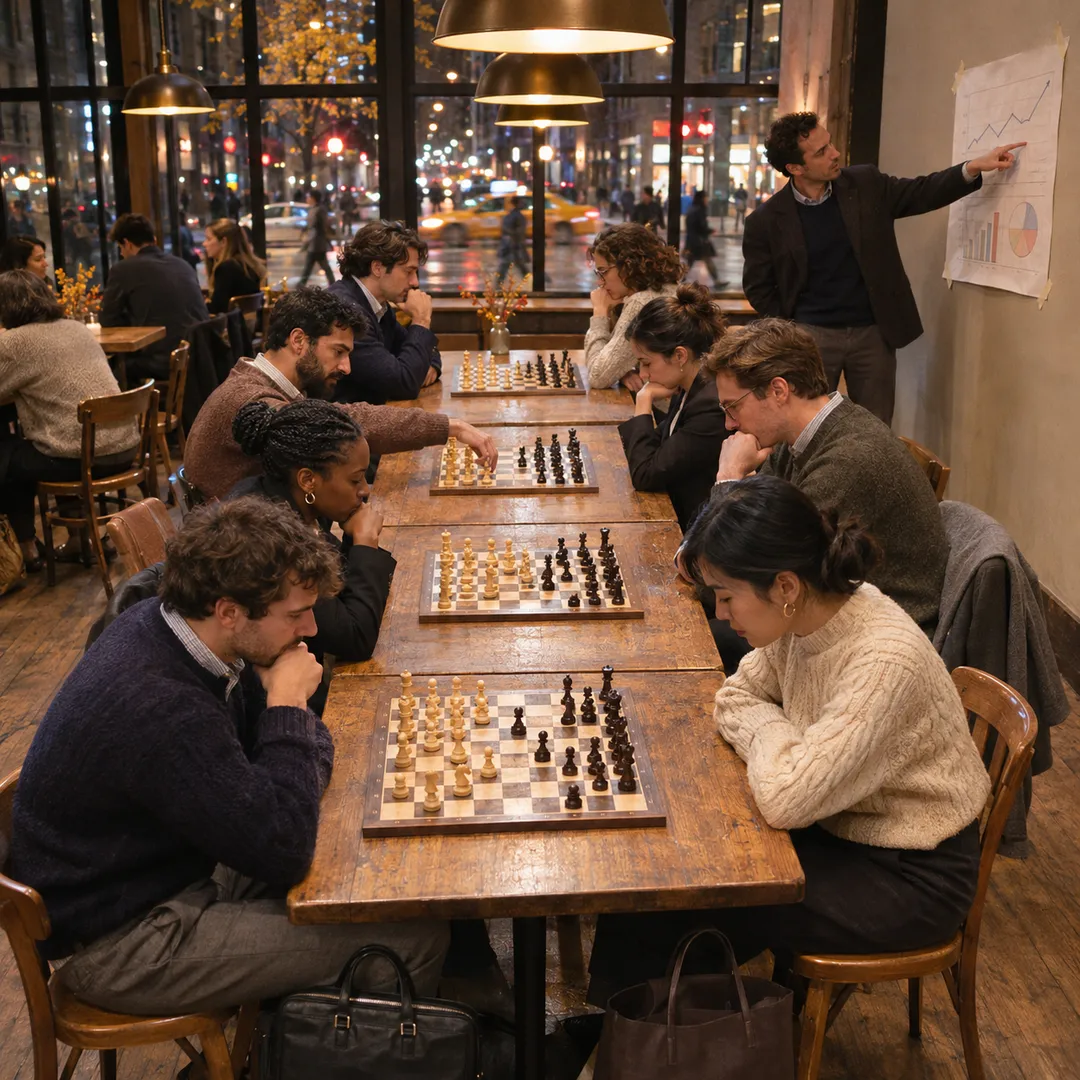
Turn a Union Square chess cafe night into a weekly team ladder: pick a midweek evening, pair mixed skill levels with clock odds, and seat eight coworkers.
Union Square sits on top of one of the busiest subway hubs in Manhattan, which is exactly why it suits a weekly office chess night: everyone can reach it from work in a few minutes and get home on a different line. This chess cafe night planner is for a team of six to ten coworkers who want a standing evening of games where the beginner and the former club player both have a reason to come back next week.
Pick the Night Before You Pick the Cafe
Choose a fixed midweek evening, Tuesday or Wednesday, and protect it. Thursday drifts into drinks, and Friday cafes around Union Square fill with dates and groups who will not want eight people and four boards beside them. A standing night also lets the cafe staff get used to you, which matters more than any single feature of the room. Start straight from the office, so nobody goes home first and then decides the sofa looks more inviting.
Keep the first session short, ninety minutes at most, and end while people still want one more game. Teams that open with a three-hour marathon tend to lose half their players by week three. Send the time and meeting point in the team channel on the morning of, and keep the message to two lines. Nobody needs a calendar invite with a dress code for chess.
Making Mixed Skill Levels Fair
Every office has one person who played seriously at school and one who learned the knight move last month. Without a handicap, the strong player wins every game and the beginner stops coming. Clock odds are the simplest fix: the stronger player gets three minutes and the weaker one gets ten, adjusted each week depending on results. Nobody has to remove pieces, the games still look like real chess, and the beginner feels the stronger player sweat.
For bigger gaps, add material odds as a second step. The stronger player starts without a knight, then without a rook if they keep winning. Write the odds next to each name on the ladder so the arrangement feels like a rule rather than a favour. The goal is that every game feels winnable for both people, which is the only thing that keeps a group of busy adults showing up after the novelty fades.
Running a Paper Ladder
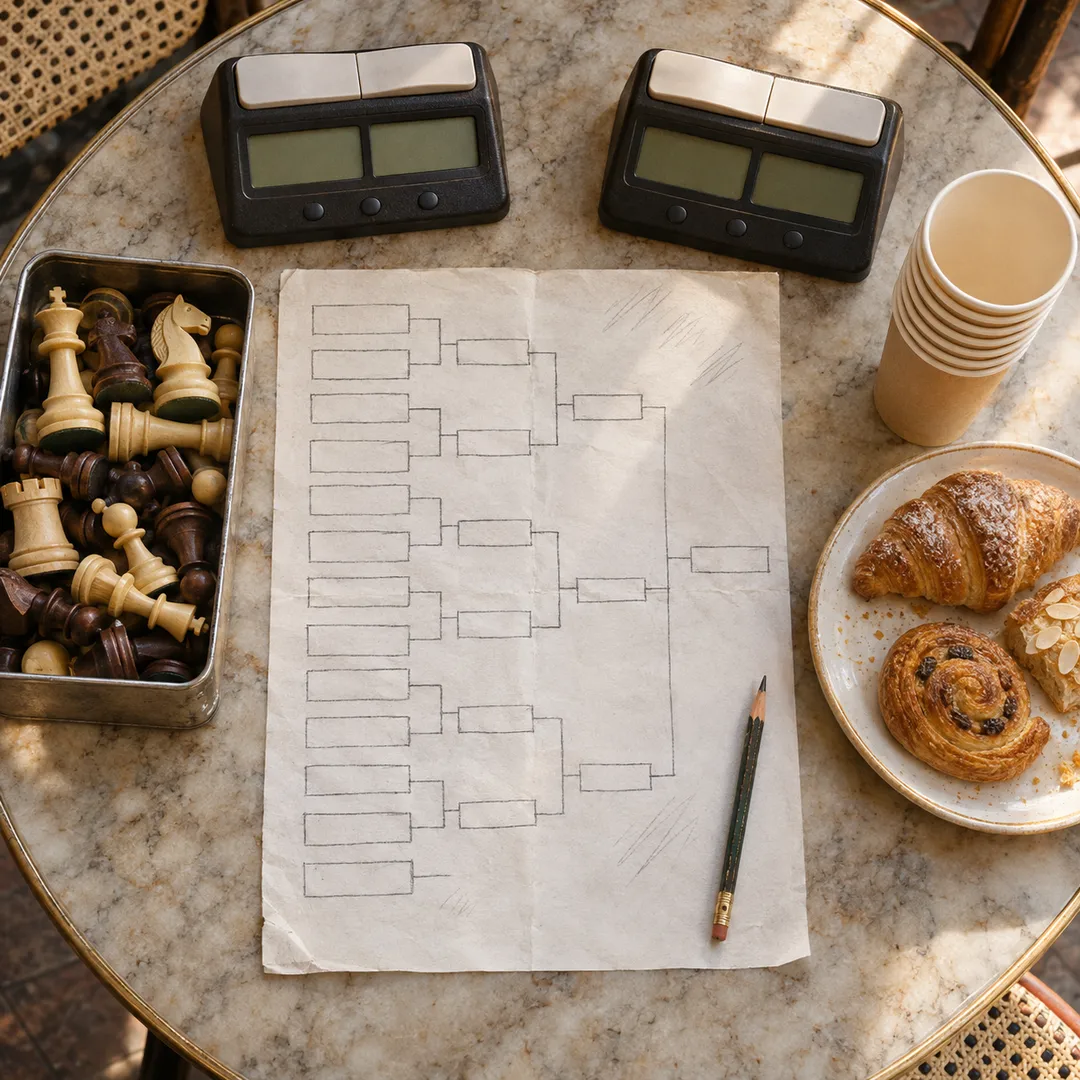
A paper ladder beats an app for this kind of night, because it sits on the table where everyone can see it. List the names top to bottom, let anyone challenge a player up to two places above them, and swap names when the challenger wins. Someone volunteers to keep the pencil each week. By week four the ladder starts telling stories, and people begin planning their challenge on the walk over.
Rotate pairings so people do not just play their desk neighbour. A simple rule works: you cannot play the same person twice in a row. Leave one seat for anyone who only wants to watch or learn, and let the strongest player spend the first twenty minutes teaching one opening idea at that board instead of playing. It turns the evening from a tournament into something closer to a club.
What to Look for in a Cafe That Fits Eight
Most cafes around Union Square are built for pairs and laptops, so walk past a few on a quiet afternoon before your first session. You want tables you can push together, staff who do not mind four boards at once, and lighting good enough to read a position. Ask at the counter whether a group of eight playing chess one evening a week would be welcome, and come back to the place that smiles at the question.
Treat the cafe as the host. Everybody orders something on arrival and again halfway through, and someone tidies the pieces and wipes the tables before leaving. Bring your own boards and clocks in a tote bag so you never depend on house sets. To compare cafes within a short walk of the park and see which ones have room for a group, search the Karpo APP for chess and board game cafes around Union Square.
Who Shows Up, and How to Keep Them
Expect three kinds of regulars after a month. There is the competitive one who studies openings on the train and wants to be top of the ladder, the social one who comes mainly for the conversation, and the quiet one who never says much but improves faster than anybody. Each needs something different. The competitive player needs a real challenge, the social player needs a table that laughs, and the quiet one needs to be asked.
An honest warning: skip the simultaneous exhibition where the strongest colleague plays everyone at once. It sounds fun on paper, but in practice it turns into one person showing off while seven others lose quickly and wait. Equally, do not invite the senior manager to the first session. Let the group form its own habits first, then invite leadership once the ladder has a few weeks of history and a culture of its own.
Around the Square Before and After
Union Square has always been a gathering place, from labour rallies to the farmers' market stalls that set up on the north and west sides. On the south plaza near the subway stairs you will often find people with boards on folding tables offering quick games to passersby. Stopping for one game on the way in is a good warm-up, and it reminds the team that chess here lives on the street as much as indoors.
After the session, a short walk north along Broadway into the Flatiron district or east toward Irving Place gives everyone time to replay their games out loud. Gramercy Park sits a few blocks further, a fenced square only keyholders can enter, and its iron railings are a pleasant loop on a cold night. The used and rare print shops along Broadway are worth a browse for anyone hunting an old chess manual.
When the Plan Falls Apart
Some weeks the cafe will be full or closed for a private event. Have a second place picked in advance, and if neither can take eight, split into two groups of four at nearby cafes and compare ladder results the next morning. If only three people show up, play a round robin rather than calling it off. Cancelling once is fine. Cancelling twice in a row usually ends a club for good.
On wet nights the street players vanish and the cafes fill up early, so arrive straight from work and claim tables before the after-work crowd. The 14th Street station at Union Square serves many lines, so nobody needs to leave early to catch a particular train. When the ladder is full of history after a few months, hold a final night and give the winner something silly, such as a plastic trophy or naming rights to the group chat.
Ask Karpo for more information.
Keep reading
- Astoria Chess Cafe Night Planner: How to Become a Regular
 Upper West Side Billiards Bar Night Planner for Old Friends
 Park Slope Chess Cafe Night Planner: A Date With Odds