 Astoria Chess Cafe Night Planner: How to Become a Regular
Sports Social
Astoria Billiards Bar Night Planner: Carom Meets Eight Ball
Astoria billiards bar night planner for families: let an elder teach carom, let the teens pick eight ball, then share meze and walk to Astoria Park after.
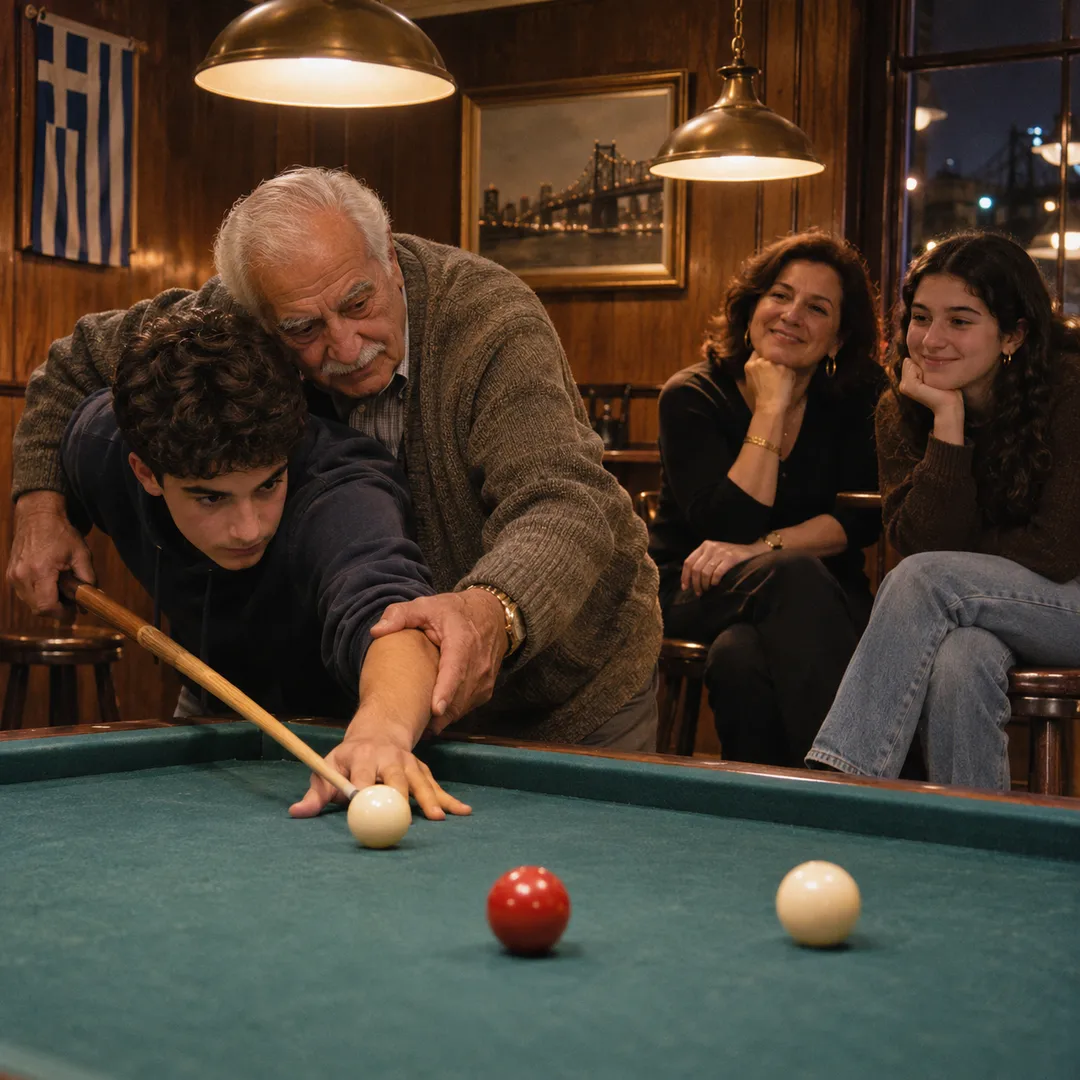
Some Astoria grandparents learned billiards in a village kafeneio, on a heavy table with no pockets at all. Their grandchildren learned on a sticky bar table with a coin slot. A family billiards night is where those two worlds meet. Astoria, with its long Greek and Cypriot roots, its newer Brazilian, Egyptian and Bangladeshi neighbours and its strong sense of family evenings, is the perfect place to try it. This billiards bar night planner shows how to make a multigenerational outing work for everyone at the table.
What Is Carom, and Why Does Grandpa Love It?
Carom billiards uses a table without pockets and just three balls, two cue balls and one object ball, often red. In the three-cushion version, your cue ball must touch both other balls and hit the cushions at least three times before the second contact. It is a game of angles and patience, more geometry than power, and it has deep roots in Greece, Turkey, Egypt, Spain and Latin America, where cafe tables were once the centre of neighbourhood life.
For an older relative who grew up with it, a carom table carries memories of coffee, card games, politics and long arguments between shots. Asking them to teach the basics is a gift. They get to be the expert, and the younger players discover that their eight-ball tricks barely help. Carom tables are rarer than pocket tables in New York, so ask in advance whether the room you choose keeps one, and plan the night around it.
Pocket billiards came later for many of these families, carried home from American bars and arcades. That is why a single evening can bridge two very different traditions. In carom, a miss is a lesson in angles; in eight ball, a miss is a chance for your opponent. Explaining that contrast out loud, with the elder demonstrating a slow three-cushion route around the table, is often the moment the teenagers stop checking their phones and start watching closely.
How Do You Keep Teenagers Interested?
The answer is variety. Split the evening into two halves. Start with the elder's lesson on the carom table, keeping it short and playful, with points for any successful three-cushion shot at all. Then move to a pocket table and let the teenagers choose the game, usually eight ball or a quick round of cutthroat with three players. Switching tables halfway keeps attention up and gives each generation a turn as the teacher.
Mixed teams help too. Pair the strongest adult with the youngest player and let the family keep a running score on a paper napkin across both games. Phones become cameras rather than distractions when someone is assigned to film the finest shot of the night. Many billiard rooms admit younger guests with an adult during earlier hours, but rules differ, so ask before you bring minors, especially in rooms with a full bar.
Where Does Food Fit Into the Evening?
In Astoria the answer is almost always before or after, rather than at the table. Plan an early meal at one of the Greek tavernas around Ditmars Boulevard or 30th Avenue, with grilled octopus, horiatiki salad, spreads like tzatziki and taramosalata and bread to wipe the plates. A family meal like that sets a warm tone, and everybody arrives at the billiards room relaxed and full rather than hungry and impatient.
Afterwards, the neighbourhood rewards a sweet finish. Order an iced frappe, the foamy whipped coffee that every Greek grandparent has an opinion about, or share loukoumades drizzled with honey at a dessert cafe. Younger relatives may prefer gelato or a bakery stop on Steinway Street. The point is to treat billiards as one chapter of a longer family evening, not the whole story, which keeps the energy friendly when someone loses.

What Is Astoria's Story Beyond the Tavernas?
Astoria's identity layers several waves of arrivals. Greek families made it the most famous Hellenic neighbourhood outside Greece in the eyes of many New Yorkers, and Orthodox churches, social clubs and bakeries still anchor its streets. Later, Steinway Street became known as Little Egypt for its cafes and hookah lounges, while Brazilian, Bosnian and Bangladeshi communities added their own markets. Few places in the city mix languages so easily on one block.
The area also has a film history. The Kaufman Astoria Studios have made films and television since the silent era, and the Museum of the Moving Image next door is a fun family stop on a different day, packed with old cameras, costumes and arcade games. Mentioning that the neighbourhood once rivalled Hollywood often surprises visiting relatives and gives a nice thread between the billiards story and the screen.
Is There a Good Walk to Finish?
Astoria Park is the natural ending. It stretches along the East River beneath two great bridges, the Robert F. Kennedy (formerly Triborough) and the red steel arch of the Hell Gate railway bridge, which looks enormous at dusk. Walk the riverside path with the grandparents setting the pace, sit on a bench and watch the Manhattan skyline across the water while the kids race ahead to the lawns.
On a calm evening the park feels like a neighbourhood porch, with elders on benches, joggers along the water and families sharing snacks on the grass. In colder months, keep it short and bundle up; the wind off the river can be sharp. From the park, Ditmars Boulevard leads back to the subway at the end of the line, so even the tired members of the party have an easy way home.
Which Mistakes Should a Family Avoid?
Skip the late weekend slot. Rooms fill with adult groups and leagues later in the evening, and noise levels rise, which makes it harder for older relatives to hear and for younger ones to feel welcome. Early evening on a weekday or a weekend afternoon is far better. Also avoid scheduling the outing straight after a heavy feast without a break, since bending over a table on a full stomach is no fun.
Do not let the night become a competition the youngest cannot win. Handicap generously: older experts shoot one-handed, teenagers get two shots per turn and the smallest children can roll the cue ball by hand on a pocket table. Above all, let the elder finish their stories. Billiards rooms in Astoria are as much about community as about scoring, and a long tale about a village cafe tournament is part of the evening.
Practical Tips Before You Go
Use the Karpo APP to look for billiards rooms and family-friendly restaurants around Ditmars and Broadway, and keep a second room in mind if the carom table is taken. Carry a light sweater, since billiard rooms keep the air cool. Bring reading glasses for grandparents who need them to see the far rail. Agree beforehand who settles the bill, so nobody argues at the counter, and keep a small prize, perhaps a box of pastries, for the overall family champion.
Ask Karpo for more information.
Keep reading
- Astoria Chess Cafe Night Planner: How to Become a Regular
 Upper West Side Billiards Bar Night Planner for Old Friends
 Park Slope Chess Cafe Night Planner: A Date With Odds