New York City sits on an ocean, but most visitors treat it like a landlocked grid. The truth is you can stand in saltwater within an hour of Penn Station without renting a car or begging a friend with one. Four beaches—Rockaway, Fort Tilden, Coney Island, and Brighton—are reachable by subway, and each has a completely different personality. Rockaway pulls surfers and young crowds looking for a party vibe. Fort Tilden is quiet, almost empty, favored by people who want dunes and solitude. Coney Island is pure Americana, a boardwalk carnival with fried clams and the Cyclone. Brighton Beach is the Eastern European enclave next door, where you'll hear more Russian than English and smell grilled meats from the boardwalk cafes.
Looking for the right beach based on your vibe today—whether that's surf-able waves, empty sand, or boardwalk energy? Karpo reads the conditions, cross-checks transit times, and narrows your choices before you get on the train.

Rockaway Beach: waves, crowds, and the Ramones
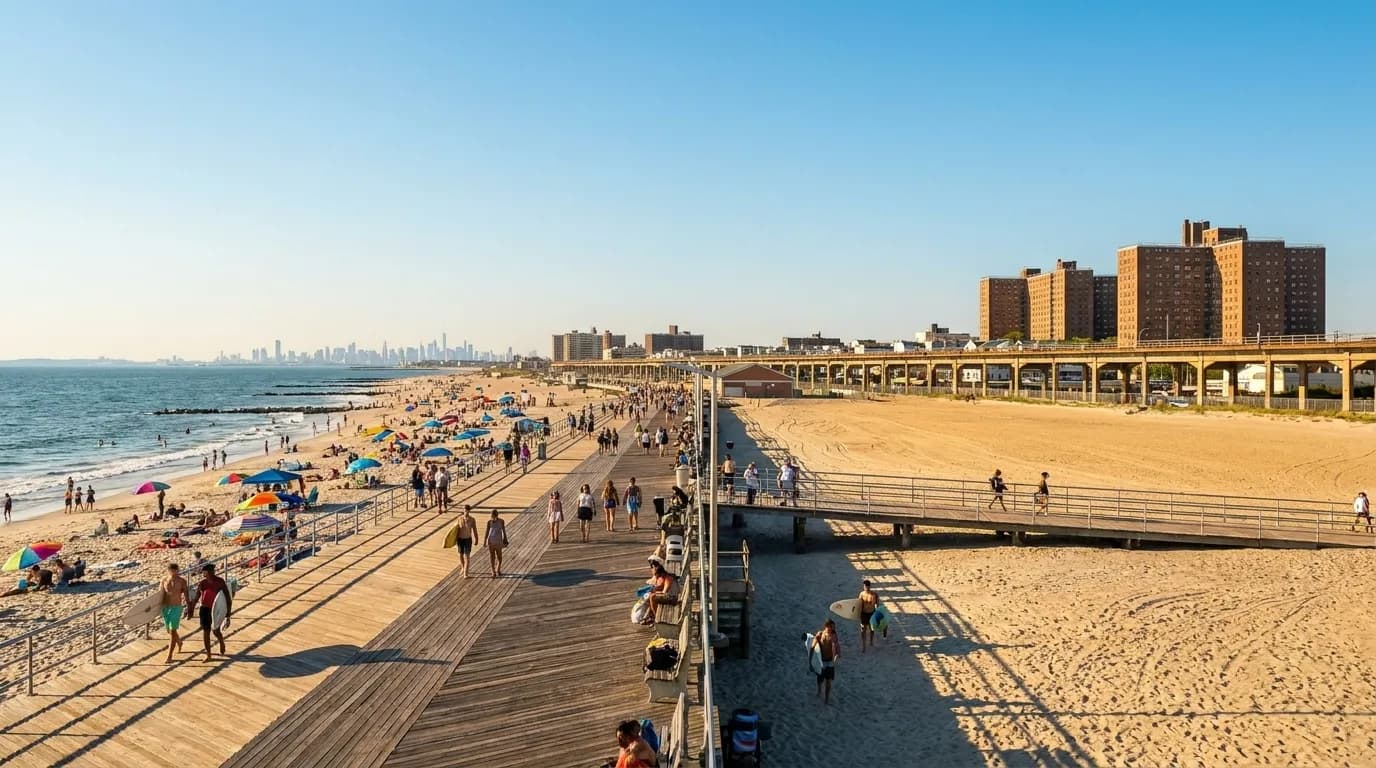
Take the A train to Rockaway Park-Beach 116th Street and you'll spill out two blocks from the widest, most swimmable stretch of city sand. This is the beach that actually gets waves worth riding—locals paddle out year-round in wetsuits, and summer weekends see a rotating cast of learners wiping out in the shorebreak. The water is cold even in July (low 70s on a good day), but it's real ocean, not a bay.
The strip around Beach 96th to 110th is where the action clusters: Rockaway Beach Surf Club, Rippers, and a string of taco and tiki bars that fill up by noon on Saturdays. Arrive before 11 a.m. if you want a spot near the lifeguard stands without stepping over blankets. The boardwalk is concrete, recently rebuilt after Sandy, and runs for miles in both directions. Locals know to head east toward Beach 120th for more space and fewer Bluetooth speakers, or west toward Beach 67th for a slightly younger, more aggressively social scene.
If you're serious about the water, rent a board from Locals Surf School near Beach 69th Street or bring your own—there's no rule against it, and you'll see longboards propped against the boardwalk railings all day. The best window for clean waves is early morning on a rising tide. Afternoons tend to flatten out or get choppy depending on wind direction.
Fort Tilden: dunes, solitude, and the long walk
Fort Tilden is technically part of the Rockaway peninsula, but it feels like a different country. Take the A to Rockaway Park-Beach 116th, then catch the Q22 bus toward Fort Tilden or walk about 25 minutes west along the boardwalk and through the old military base. The beach here is undeveloped National Park Service land—no concessions, no lifeguards after Labor Day, no boardwalk. Just dunes, beach plum, and a wide crescent of sand that stays nearly empty even in August.
This is where you go when you want to read a book without hearing someone else's playlist. The old gun batteries and abandoned bunkers are still visible inland, slowly being reclaimed by vines and graffiti. It's also the beach of choice for people who prefer minimal tan lines—the far western end has long been clothing-optional, though officially the park service doesn't endorse it. Bring everything you need: water, food, shade. The nearest bodega is back near the subway.
The swim here is a little rougher than the main Rockaway stretch—sandbars shift, currents run stronger, and there's no whistle-blowing lifeguard to warn you off a rip. Go if you're a confident swimmer or content to stay ankle-deep. On weekdays in September, you might have a hundred yards of shoreline to yourself.
Coney Island: boardwalk, rides, and fried everything
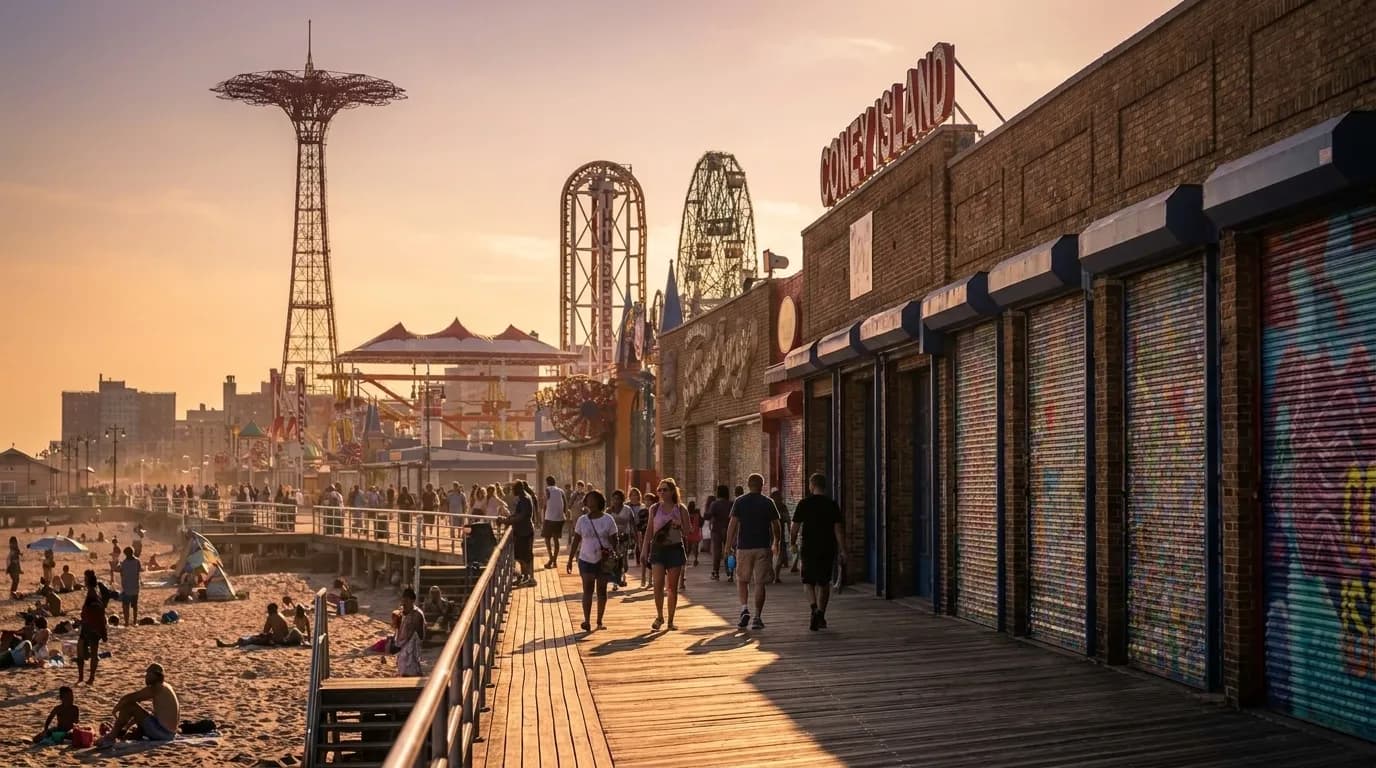
Coney Island is not subtle. Take the D, F, N, or Q to Coney Island-Stillwell Avenue and you'll arrive at a carnival that never quite left. The beach is wide and sandy, the water is swimmable, but the real point is the scene: Nathan's Famous hot dogs, the Cyclone roller coaster rattling overhead, Ruby's Bar blasting oldies onto the boardwalk, and a parade of humanity that includes everyone from Orthodox families to punk kids to the Coney Island Polar Bear Club doing winter swims.
The sand gets packed on summer weekends—arrive by 10 a.m. for a decent spot near the water, or accept that you'll be part of a dense quilt of towels and umbrellas. The boardwalk itself is the reason to come: wooden planks, fried clam stands, arcade games, and the kind of faded Americana that feels like a time capsule. Luna Park is the modern amusement zone, but the old Cyclone and Wonder Wheel are the icons. If you're here for the beach, plant yourself west of the pier where it's slightly less mobbed. The water is calm, protected by a jetty system, and warm enough by mid-July.
Post-beach, walk east along the boardwalk toward Brighton. Stop at Totonno's for coal-oven pizza (cash only, open Thursday through Sunday) or grab a beer at Coney Island Brewery near the subway. If you're here on a Friday night in summer, the minor league Brooklyn Cyclones play at MCU Park, and bleacher seats are around twenty bucks.
Brighton Beach: shashlik, Russian pop, and a quieter stretch
Keep walking east from Coney Island or take the Q directly to Brighton Beach, and the vibe shifts hard. This is Little Odessa—Russian-speaking, full of groceries selling smoked fish and pickled vegetables, and lined with boardwalk restaurants where you can order grilled lamb, cold borscht, and a carafe of vodka while looking at the ocean. The beach itself is calmer than Coney, less touristed, and almost entirely local families.
The boardwalk here is elevated and shaded in spots, with benches occupied by older Russian and Ukrainian émigrés playing chess or cards. The sand is clean, the water is the same as Coney Island (both are part of the same South Brooklyn coastline), but the crowds thin out significantly. If you want to swim and then eat well, this is the move.
Tatiana Restaurant and Volna are the big boardwalk names for sit-down meals—expect live music, maximalist décor, and grilled meats that arrive on sword-like skewers. Both get busy on weekend evenings, sometimes requiring reservations. For something faster, grab pirozhki or blini from one of the takeout windows along Brighton Beach Avenue, one block inland. The whole neighborhood feels like a resort town transplanted from the Black Sea, and the beach is just the excuse to be there.
Which beach when
Rockaway if you want waves, a younger crowd, and a scene that extends beyond the sand. Fort Tilden if you want space, quiet, and don't mind the extra effort to get there. Coney Island if you want the full chaotic boardwalk experience, rides, and fried food as part of the day. Brighton Beach if you want a mellower, more neighborhood feel and the option to eat shashlik under an umbrella while Russian pop plays in the background.
Water temperature across all four hovers in the high 60s to low 70s from June through September. None of them are Caribbean-warm, but all are swimmable if you commit. Weekdays are dramatically less crowded at every spot. Early morning or late afternoon light is better for avoiding the worst of the sun and the peak crush.
Practical notes
All four beaches are free and open to the public. Lifeguards are on duty from late May through early September, typically 10 a.m. to 6 p.m. The A train to Rockaway runs about 70 minutes from Midtown; the Q or F to Coney Island is closer to 50 minutes. Bring cash for food—many boardwalk spots don't take cards. Sunscreen, a hat, and a refillable water bottle are non-negotiable; shade is minimal except on the Brighton Beach boardwalk. Avoid weekends in July and August if you hate crowds. September is underrated—water's still warm, sand is wide open, and the light is gentler. No alcohol is allowed on NYC beaches, and the rule is enforced more strictly at Coney Island than Rockaway.
Tags: #beachnearme #nycbeaches #rockawabeach #forttilden #coneyisland #brightonbeach #subwayaccessible #nycweekend #oceanswim #boardwalk #brooklynbeach #summernyc #daytripnyc #beachday #freebeach
All trademarks are the property of their respective owners.
Ask Karpo first
Choosing the right beach in New York depends on what you're optimizing for—surf, solitude, or spectacle—and Karpo reads your location, checks transit times, and suggests which strand makes sense today. No need to compare train schedules or guess which one is too crowded. Just ask where to go, and Karpo points you toward the sand.