Coney Island reads as one destination and operates as at least four: a public beach, an amusement park, a second and entirely separate amusement park, and a boardwalk of independent food businesses. They have different owners, different tickets and different opening hours. Almost every disappointing day out here traces back to someone buying into the wrong one of the four, or buying into all of them at once.
Four separate businesses, four separate tickets, one boardwalk. Ask Karpo what is open at Coney Island today, what the weather is doing on the water, and how long the ride out takes from where you are.
The beach is free and it is the actual attraction
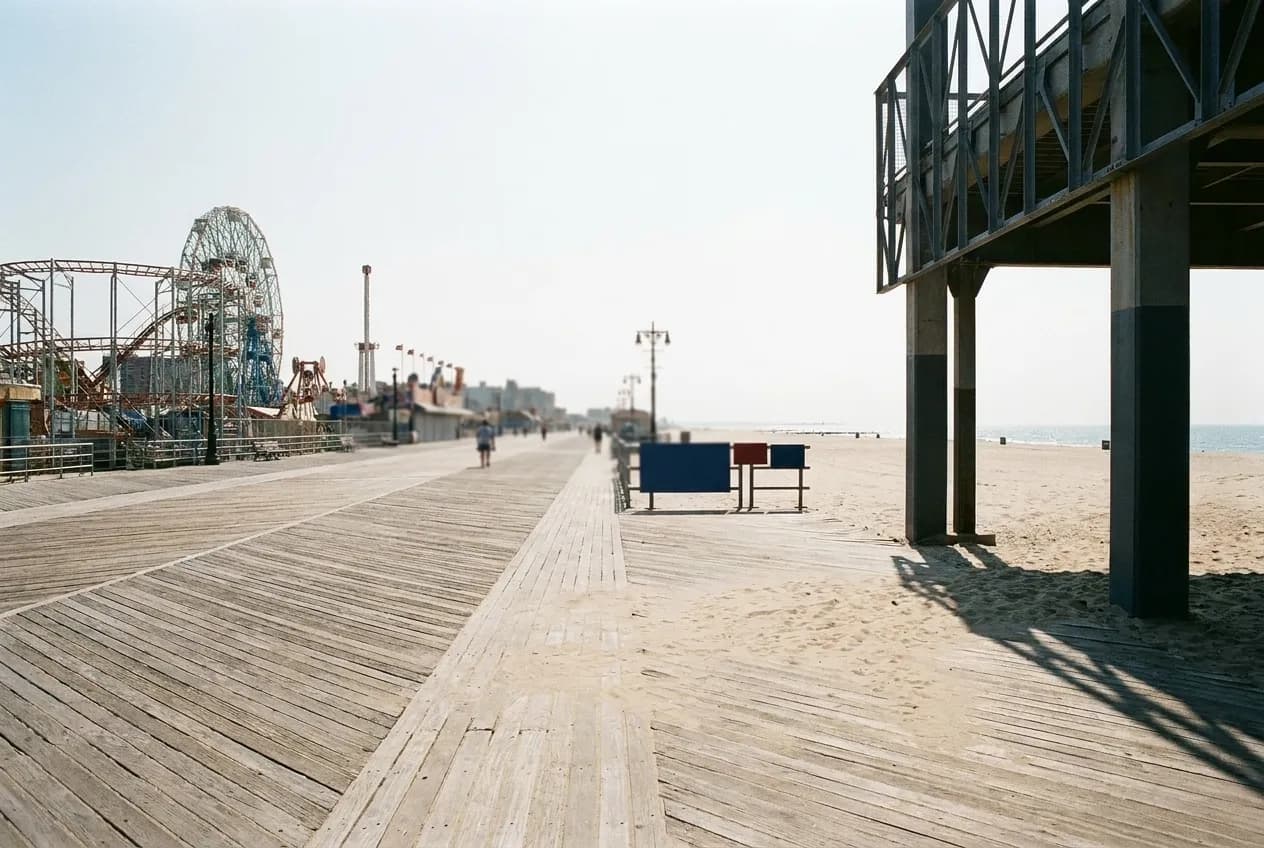
The beach and the boardwalk cost nothing, are open regardless of whether the parks are running, and are the reason to come. This is a genuinely wide Atlantic beach with two and a half miles of boardwalk attached, twenty-five minutes from Lower Manhattan on the subway, and it is entirely possible to have a complete day here without spending anything beyond the fare and lunch.
If you are coming for the water rather than the rides, that changes the whole shape of the visit: come on a weekday, come in the morning, and walk east towards Brighton Beach where the crowd thins considerably and the boardwalk becomes a Russian-speaking neighbourhood with a completely different set of food options. The far end of the boardwalk is the part most first-time visitors never reach and the part regulars go to.
Two amusement parks, and you need to know which is which
Luna Park is the larger operation, with something over thirty-five rides including the Cyclone — the 1927 wooden coaster that is the reason anyone knows this place exists — and the Thunderbolt. Entry to the park itself is free. Rides work either on per-ride credits, starting around three dollars, or on an unlimited wristband that runs roughly thirty-eight to sixty-two dollars depending on the day and the length. Buying that wristband in advance rather than at the gate is worth doing; the gate price sits around fifty dollars where the advance price is closer to thirty-eight.
Deno's Wonder Wheel is a different park with different owners, and this catches people out constantly. The Wonder Wheel is not on the Luna Park wristband. It is its own ticket, from about eight dollars a ride. If the Wonder Wheel is the thing you came for — and for a lot of people it should be, since it is the more distinctive ride and the better view — then you do not need a Luna Park wristband at all.
What the wristband is actually worth
The unlimited wristband only makes sense above roughly twelve to fifteen rides, which is a lot of queuing on a busy day. On a hot Saturday in August, when the lines are long, most people do not get near that number and would have spent less on individual credits. On a quiet weekday in May or September, when you can walk onto most things, the wristband is comfortably the better deal.
So the honest rule is: wristband on quiet days, credits on busy ones, which is precisely the opposite of what most people do. If you are bringing children who will want to repeat the same three rides, the wristband wins regardless. If you are two adults who want the Cyclone, the Wonder Wheel and a look at the rest, buy neither — buy the individual rides and spend the difference on the boardwalk.
The boardwalk, and what to skip
Nathan's Famous has been on the corner of Surf and Stillwell since 1916 and is the one piece of food here that is genuinely part of the place rather than attached to it. Beyond that the boardwalk holds a set of long-running independents — Paul's Daughter and Ruby's among them — which are the ones worth your money. Ruby's in particular is a proper old boardwalk bar rather than a concession.
What to skip: the games, almost without exception, which are priced as entertainment rather than as a contest and should be treated that way if at all; the generic fried-food stands in the middle stretch, which are interchangeable and overpriced; and any sit-down restaurant claiming a sea view, since the boardwalk itself is the view and it is free. Eat standing up here. It is that kind of place and it is better for it.
Two additions worth building in. The New York Aquarium sits directly on the boardwalk and is the obvious wet-weather fallback if the beach plan collapses. And Brighton Beach, fifteen minutes east along the boardwalk, is where the eating genuinely improves — Russian and Central Asian food, bakeries, and prices well below the Coney Island end. A day that starts at Stillwell and ends with dinner in Brighton is the version regulars do, and it costs nothing extra beyond the walk.
Practical notes
The D, F, N and Q all terminate at Coney Island–Stillwell Avenue, which puts you a two-minute walk from everything in this article. The season runs roughly from late March through the autumn, with the parks opening for the year in the last days of March and hours extending as summer comes; outside that window the beach and boardwalk are still open and still worth a cold, empty, genuinely atmospheric walk. Park hours run to about ten at night in high season. Check the wind rather than the temperature — this is an exposed Atlantic beach and a warm day with an onshore wind is colder than the forecast suggests. And go late in the afternoon if you can: the light on the boardwalk after five is the best thing here and the crowds start to thin at the same time.
Tags: #BeachNearMe #ConeyIsland #Brooklyn #NewYorkCity #LunaPark #WonderWheel #NathansFamous #NYCBeach #BrightonBeach #ThingsToDoNYC #WeekendPlans #NYCSummer #Boardwalk #DayTripNYC
All trademarks are the property of their respective owners.
Ask Karpo first
Planning a Coney Island afternoon? Ask Karpo whether the parks are running today, what the wind is doing on the water, which ticket actually fits what you want to ride, and how long the train takes from where you are standing.