 Where to Eat Near Penn Station That Isn't a Chain
US Open 2026

Nationals vs Phillies Ferry Viewpoints After US Open Matches
How to plan a post-match East River ferry route from Flushing Meadows to Manhattan's waterfront, using sunset skyline views and evening transit connections as your wind-down after…
When you're searching for ways to connect a Nationals vs Phillies game broadcast or baseball schedule to your New York planning calendar, you might also be mapping out how to make the most of a US Open day in Queens—and how to turn the trip home into something more than a crowded subway ride. The 2026 US Open at the USTA Billie Jean King National Tennis Center in Flushing Meadows Corona Park runs from late August through early September, and if you're attending an afternoon or evening session, the hours after match point can be the perfect window to trade the tournament crowds for a slower, more scenic route back to Manhattan. Instead of heading straight underground, consider building in time for an East River ferry stop, a sunset skyline view, and a few strategic pauses along the 7 train corridor or the Queens waterfront. This approach turns a tennis day into a fuller New York evening, especially if you're visiting from out of town or simply want to see a different side of the borough before you cross the water.
Text Karpo with your US Open session time and Queens starting point, and we’ll turn this East River ferry stops and sunset skyline routes from Flushing to Manhattan for evening relaxation into a practical local plan.
Why the East River ferry makes sense after a US Open session
The US Open sits at the eastern edge of Flushing Meadows Corona Park, accessible via the 7 train to Mets–Willets Point. Most visitors reverse that route at the end of the day, but if you have flexibility and energy left after your session, you can instead take the 7 train west toward Long Island City or Astoria, then connect to an NYC Ferry route that runs along the East River. The Astoria route, for example, stops at Astoria, Roosevelt Island, Long Island City, and several Manhattan piers, offering open-air seating and wide views of the skyline as the sun drops. The ferry system is operated by Hornblower under contract with the city, and current schedules, fares, and real-time updates are available on the NYC Ferry website and app. Because service patterns and seasonal schedules can shift, it's worth checking close to your visit, but the basic infrastructure—frequent departures, affordable single-ride fares, and bike-friendly boarding—has been consistent since the system expanded in 2017.
Timing your exit from the tennis center
US Open sessions are structured as day (11 a.m. start) or evening (typically 7 p.m. start), and match length varies widely depending on the round and the players. If you're attending a day session and leaving by late afternoon, you'll have plenty of daylight to explore. Evening sessions can run past 11 p.m., especially during the first week when the schedule is packed, so a ferry route works best if you're willing to leave before the final match concludes or if you're attending an earlier round with shorter match times. The official US Open event schedule, published on usopen.org, breaks down session times, court assignments, and typical gate-open windows, and it's updated as the tournament progresses. The USTA Billie Jean King National Tennis Center also publishes a visitor A-Z guide and a transportation directions page that cover everything from accessible seating to ride-share pickup zones, so you can plan your departure with the same care you plan your arrival.

7 train stops worth a pause between Flushing and Long Island City
The 7 train corridor is one of the most culturally dense transit lines in the city, and if you're not in a rush, a stop or two between the tennis center and the ferry can add texture to your evening. Junction Boulevard and 82nd Street–Jackson Heights put you in the heart of Jackson Heights, where you'll find South Asian sweets shops, Latin American bakeries, and a mix of sit-down and counter-service spots that stay open late. Corona Plaza, near 103rd Street–Corona Plaza, is an activated public space with seasonal programming, though it's a short walk from the station and worth checking for events in advance. Further west, Queensboro Plaza is a major transfer point and the gateway to Long Island City, where the waterfront has been transformed over the past two decades into a mix of residential towers, art spaces, and parks. The MTA's official service status page and the agency's US Open transit guide offer real-time updates and suggested routes, and both are especially useful during the tournament when ridership spikes.
Long Island City waterfront and ferry access
Long Island City is home to two NYC Ferry stops—Hunters Point South and Long Island City—both within walking distance of the 7 train. Hunters Point South is adjacent to Gantry Plaza State Park, a narrow waterfront green space with restored gantries from the area's industrial past, benches facing Manhattan, and a small pier. It's a popular spot for photos, especially around sunset, and the park is managed by New York State, so it's well-maintained and accessible year-round. The Long Island City ferry stop is slightly north, near the Pepsi-Cola sign and the East River waterfront promenade. Both stops are served by the Astoria route, which runs seven days a week with varying frequency depending on the time of day and season. If you're planning to catch a ferry, check the NYC Ferry app or website for the current schedule, and build in a buffer—boats do fill up during peak evening hours, and there's no reserved seating.
What to expect on the ferry ride
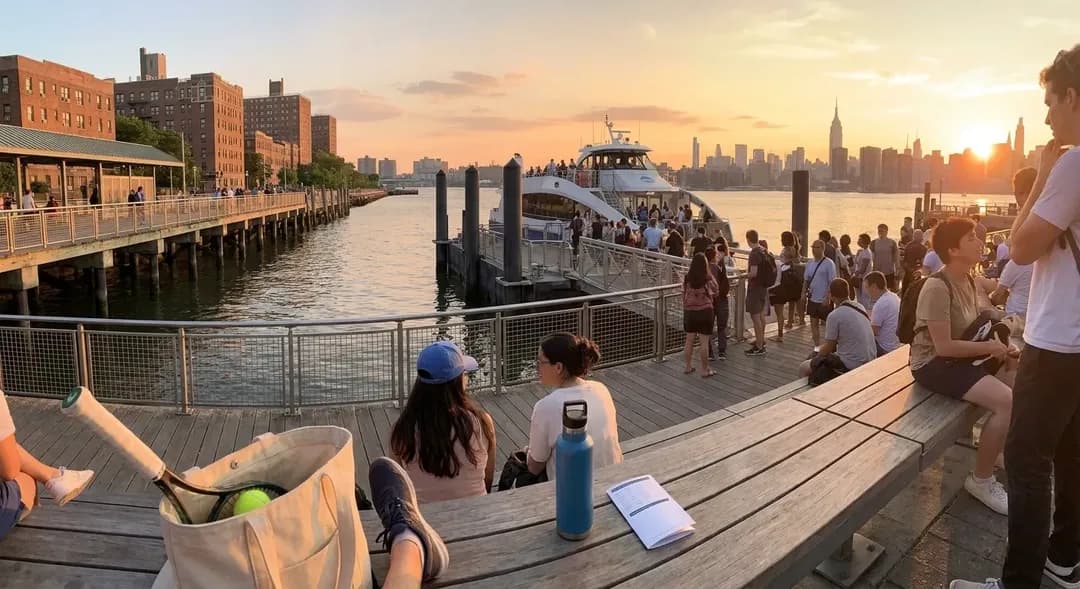
NYC Ferry boats are commuter vessels with indoor and outdoor seating, restrooms, and a small concession counter serving snacks and drinks. The ride from Long Island City to Midtown Manhattan piers takes roughly 15 to 20 minutes, depending on the route and stops. The outdoor upper deck is the most popular section, especially in good weather, and it offers unobstructed views of the skyline, the Queensboro Bridge, and the United Nations headquarters as you approach Manhattan. The ferry system accepts OMNY tap-to-pay, MetroCard, and the NYC Ferry app, and fares are comparable to subway rides. Bikes are allowed on board at no extra charge, and there's dedicated bike storage on the lower deck. Because the ferry is exposed to wind and weather, it's worth bringing a light layer even on warm evenings, and if you're traveling with a group, plan to board early to secure seats together.
Manhattan landing options and onward connections
The Astoria ferry route terminates at Wall Street/Pier 11, with intermediate stops at East 34th Street and East 90th Street, depending on the schedule. East 34th Street is the most central landing for Midtown hotels and transit connections, with access to the 6 train, the M34 Select Bus Service, and a short walk to Penn Station or Grand Central via crosstown bus or subway. If you're staying in Lower Manhattan, the Wall Street stop connects to the 2, 3, 4, 5, J, and Z trains, and it's a quick walk to the Financial District, Battery Park, and the Staten Island Ferry terminal. The East 90th Street stop serves the Upper East Side and is near the Q train at 96th Street. Each pier has a small waiting area, but amenities are limited, so plan your onward connection before you disembark. The NYC Ferry website includes a trip planner that integrates with subway and bus routes, and the MTA's official service status page is the best source for real-time transit updates.
Practical notes for planning your post-Open ferry route
- Check the NYC Ferry schedule and the MTA's US Open transit guide a day or two before your visit, as service patterns can shift during the tournament and on weekends.
- Download the NYC Ferry app for real-time boat tracking, fare payment, and route maps—it's more reliable than trying to navigate on the pier.
- If you're leaving the tennis center during peak evening hours, expect crowded 7 train platforms and consider walking one stop east or west to board a less packed car.
- Gantry Plaza State Park and the Long Island City waterfront are open to the public year-round, but lighting and amenities are minimal after dark, so plan your pause for the hour before sunset if possible.
- The US Open's official prohibited-items guide applies inside the tennis center, but once you're on public transit or the ferry, standard MTA and NYC Ferry rules apply—no large bags, no open containers, and no smoking.
- If you're connecting from JFK Airport to the US Open and planning a ferry route afterward, the AirTrain to the E train to the 7 train is the most direct public-transit path, and the Port Authority's JFK Airport website has current terminal and transit information.
- Flushing Meadows Corona Park itself is worth exploring if you have time before or after your session—the Unisphere, Queens Museum, and New York Hall of Science are all within walking distance of the tennis center, and NYC Parks maintains current hours and event listings.
Why this route works as a visitor ritual
The appeal of a post-US Open ferry route isn't just the skyline views or the novelty of a boat ride—it's the shift in pace and perspective. After hours in the stands, surrounded by thousands of fans and the intensity of live tennis, the open air and quiet hum of the ferry offer a natural transition back to the rest of your evening. You're still moving through the city, still covering ground, but at a speed that lets you process the day and take in the architecture, the light, and the water. For visitors, it's a way to see a side of New York that doesn't show up in most tennis-tournament itineraries. For locals, it's a reminder that the city's best infrastructure—the trains, the ferries, the parks—can be stitched together into something more than a commute. And because the ferry system is still relatively underused compared to the subway, you're likely to find a seat, a bit of space, and a moment to breathe before you rejoin the Manhattan grid.
Tags: #USOpen2026 #Queens #FlushingMeadows #KarpoFinds #Karpo #nationalsvsphillies #NewYorkLocal #TennisTravel #NYCLocalLife #TennisTravel
Sources consulted: usopen.org — Official event schedule · usopen.org — Official visitor A-Z guide · usopen.org — Official transportation directions · usopen.org — Official prohibited-items guide · MTA — Official US Open transit guide · NYC Parks — Flushing Meadows Corona Park · MTA — Service status · Port Authority — JFK Airport
All trademarks are the property of their respective owners.
Ask Karpo first
Want to know what is actually open, how to time the trip, and where to pause around Queens? Ask Karpo for the latest public US Open context, a respectful visitor plan, and a live route around Flushing Meadows before you head out.
Ask Karpo for more information.
Keep reading
- Where to Eat Near Penn Station That Isn't a Chain
 Andytown Coffee in the Outer Sunset: The Snowy Plover Explained
- Best Things to Do in Chicago: What the City Gives Away