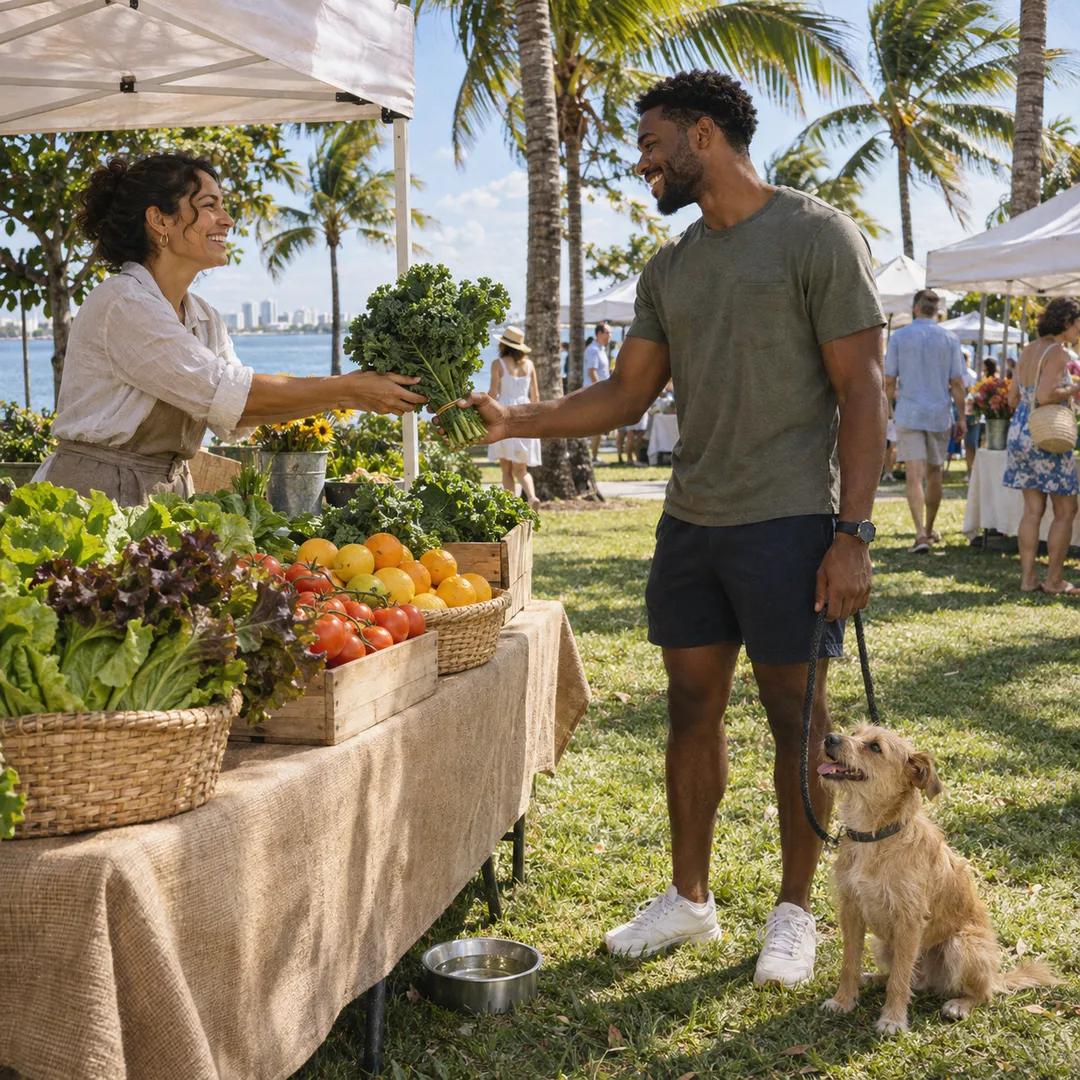
 Upper East Side Winter Farmers Market Picker With a Dog
Weekend Plans

Upper Eastside Farmers Market Brunch Route to Little Haiti
Start at the Upper Eastside Farmers' Market in Miami, then head west into Little Haiti and Little River for Haitian brunch plates, strong coffee and murals.
The Upper Eastside Farmers' Market gathers local growers on the bayside edge of Miami's Upper Eastside, and it makes a natural first stop for a brunch route that heads inland instead of along the water. A few minutes west sit Little Haiti and Little River, two neighborhoods where Haitian kitchens, Caribbean bakeries, galleries and record shops share the same blocks. This route pairs a market lap with a Haitian-style brunch and a slow walk through murals and studios, so the morning moves from the bay to the heart of one of the city's most distinctive communities.
Why Head West After the Market
Most brunch plans in the Upper Eastside stay on Biscayne Boulevard, with its midcentury motels and patio cafés. That is pleasant, but it misses something. Just across the railway tracks and Northeast Second Avenue, the city changes character. Little Haiti grew from the Haitian families who settled here in the late twentieth century and built churches, markets, botanicas and family restaurants. Little River, its northern neighbor, has old warehouses that now hold artists' studios, small galleries and design workshops. Together they offer flavors and stories you will not find on the boulevard.
Pairing them with a farmers market also makes sense. Many of the fruits and vegetables that growers bring to South Florida markets, such as plantains, breadfruit, scotch bonnet peppers, mangoes and herbs like thyme and parsley, are the backbone of Haitian cooking. Shopping first gives you a feel for the ingredients before you taste them on a plate.
A Light Market Lap First
Keep the market stop short and light, since the main meal comes later. Walk the row of tents once, chat with a grower and buy a small snack to share, such as a piece of fresh fruit, a coconut to drink or a pastry. Then pick up something to take home for later in the week: a bag of avocados, a bunch of herbs or a jar of local honey. A small cooler bag in the car keeps everything fresh while you explore.
Open-air markets in Miami can change with the season, the heat and storms, so check ahead before making the trip just for the market. If it is not running on your day, start the route at a park bench by the bay with a coffee and go straight to Little Haiti. The second half of the morning works on its own.
Getting From the Bay to Little Haiti
The ride inland is short. Driving is easiest for a group, and street parking is usually simpler than on Biscayne Boulevard. Cyclists can take quieter residential streets west. Several bus routes also cross the area, so a car-free day is possible with a little planning. Whichever way you travel, look out for the shift in the streetscape: the painted walls get brighter, the music from shop doorways gets louder and you start to hear Haitian Creole on the sidewalk.

What a Haitian Brunch Looks Like
Haitian breakfast and brunch plates are hearty and full of flavor. Look for griot, crispy fried pork marinated in citrus and spices, served with fried plantains called bannann peze and a heap of pikliz, a spicy pickled cabbage and carrot slaw that cuts through the richness. Rice and beans, known as diri ak pwa, appear on many plates. For something lighter, try a Haitian patty, a flaky pastry filled with spiced meat, salted fish or vegetables, or a bowl of creamy cornmeal porridge.
Many family restaurants in the area cook in big pots and serve plates from a counter, so it helps to point, ask questions and share. Order a few dishes for the table and pass them around. Pair everything with a strong coffee or a fresh juice made from passion fruit, soursop or guava. If anyone in the group is new to spicy food, ask for the pikliz on the side, since it can be very hot.
On some days you may also find soup joumou, a pumpkin soup with beef, vegetables and pasta that Haitian families traditionally eat on New Year's Day to mark independence. When it appears outside the holiday, it is worth ordering for the story alone.
A Walk Through Murals and Studios
After eating, walk off the meal. The Little Haiti Cultural Complex, with its bright Caribbean-style buildings, is a landmark for the neighborhood and often hosts art exhibitions, dance classes and community events. Around it, side streets are dotted with murals of Haitian heroes, tropical birds and abstract color. Wander north toward Little River, where warehouse walls give way to galleries, ceramic studios and design shops, many of them run by the artists themselves.
Browse slowly and be respectful. These are working neighborhoods where families live and small businesses depend on regular customers. Buy something if you can, whether it is a print, a bag of Haitian coffee beans, a book or a handmade piece. Ask before photographing people or the inside of churches and shops.
Keep an eye out for small grocery stores and bakeries along the way, too. Haitian bread is soft and slightly sweet, and a loaf makes a good souvenir of the morning. Pair it with a jar of spicy peanut butter, known as mamba, which many Haitian families spread on bread for breakfast, and you have the start of a home brunch for the next day.
Music is part of the walk too. Konpa, the dance music Haitians love, often drifts out of record shops, barbers and cars, and some cafés play it all morning. If you hear a song you like, ask what it is. Shop owners are often glad to talk about the singers and bands that soundtrack family parties back home and here in Miami.
Tips for Different Kinds of Groups
Couples can keep the route compact: a fruit snack at the market, a shared brunch plate and an hour of gallery browsing. Families with kids will find the murals a hit, and the patties are easy for small hands. Groups of friends can turn the brunch into a tasting, with each person ordering a different plate. Visitors who want to learn more about Haitian history and culture should plan extra time at the Cultural Complex and in the neighborhood's book and music shops.
Miami mornings heat up quickly, even in late autumn. Bring water, sunscreen and a hat, and keep the walking part of the route in the shade of tree-lined streets when you can.
Bringing It Home
By the time you drive back toward the bay, your cooler bag holds market produce and maybe a bag of Haitian coffee or a few patties for later. That is the real reward of this route: a taste of two very different parts of the Upper Eastside world in one morning. If you want help finding Haitian restaurants, bakeries and cafés around Little Haiti and Little River for a future weekend, the Karpo APP can help you browse nearby options and save the ones you want to try next.
Ask Karpo for more information.
Keep reading
- Upper East Side Winter Farmers Market Picker With a Dog
 Normandy Village Winter Farmers Market Picker for an Asado
 Coral Gables Winter Farmers Market Picker for New Gardeners