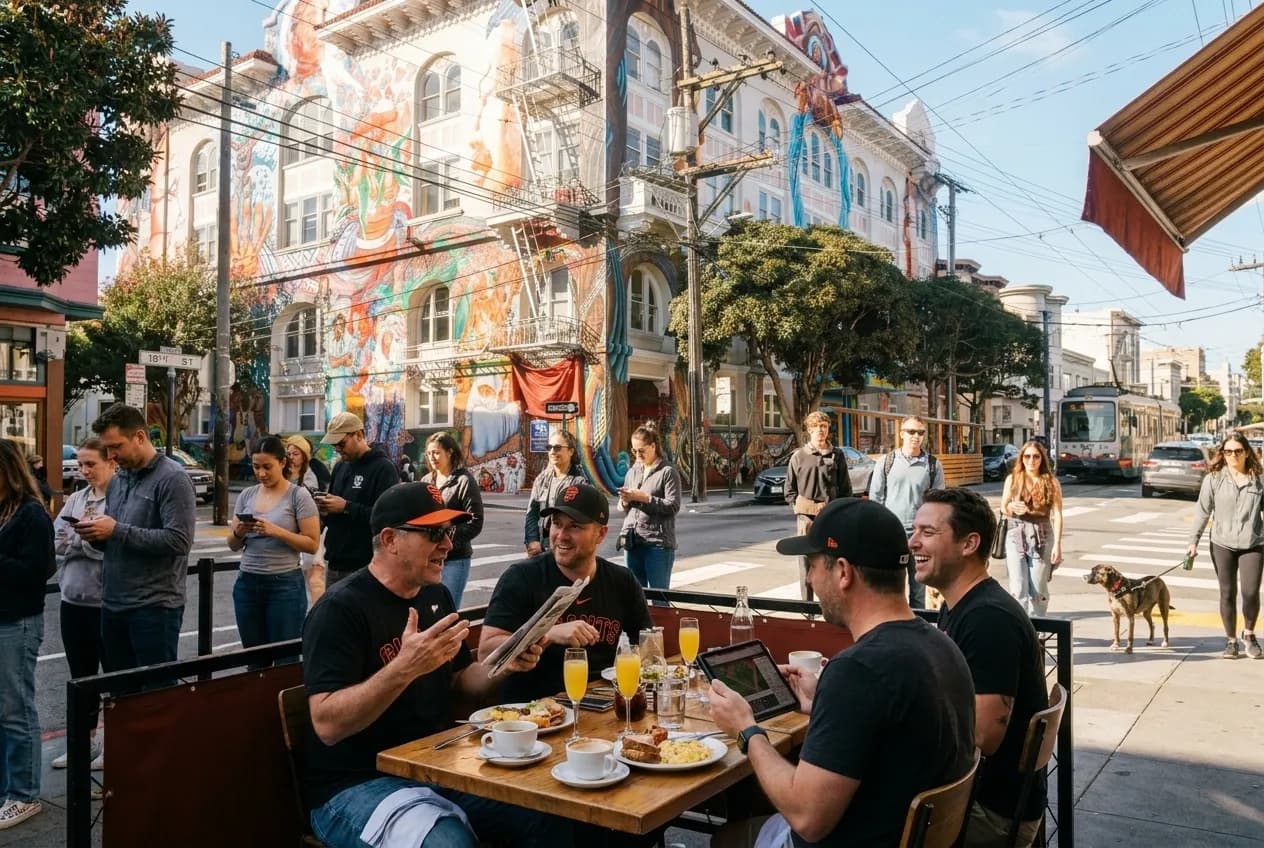
When baseball discourse heats up around topics like the marcelo mayer trade, fans craving substantive analysis need more than a quick coffee—they need brunch venues that accommodate lingering conversations, refillable mimosas, and the kind of relaxed Saturday morning atmosphere where four friends can dissect farm system moves without feeling rushed by hovering servers. San Francisco's brunch landscape presents a strategic challenge for groups planning 10am-to-2pm sessions: some restaurants welcome extended stays while others enforce strict ninety-minute limits during peak weekend hours. The difference between a satisfying four-hour prospect debate and a hurried meal often comes down to reservation policies you won't find listed online, party size restrictions that shift on weekends, and whether boozy brunch service actually extends past early afternoon. This guide explores how to secure the right table, what questions to ask when booking, and which neighborhood trade-offs matter most when your priority is conversation over cuisine.
Text Karpo your starting point, timing, group size, and priorities for a San Francisco plan tailored to this exact situation, with one realistic backup before you leave.

Evaluating Table Time Policies Before You Book
Most San Francisco brunch spots don't advertise their table time limits, but enforcement varies dramatically between weekday and weekend service. When calling to reserve for a Saturday four-top, ask explicitly whether there's a seating duration cap and whether it applies to parties arriving at 10am versus 11:30am. Some restaurants impose strict two-hour windows only during their busiest 11am-1pm crush, meaning early arrivals gain flexibility. Others calculate limits from reservation time rather than actual seating, which matters if you're running late. The distinction between "we'd appreciate tables back in two hours" and "we require tables back in two hours" separates suggestions from enforced policy.
Party size triggers different treatment at many establishments. A four-person group discussing baseball prospects might receive more leeway than larger parties that monopolize prime real estate, but some venues do the opposite—viewing four-tops as ideal turnovers and reserving longer windows for six-plus groups they can't easily re-seat. Ask whether weekend policies differ for parties of four versus three, since dropping to three can sometimes unlock better tables or more relaxed timing. Verify whether the restaurant tracks reservation notes; mentioning "celebrating a birthday" or "special occasion" in booking systems sometimes generates automatic time extensions, though relying on white lies creates awkward situations if staff ask follow-up questions.

Boozy Brunch Service Windows and Last Call Reality
The phrase "boozy brunch" appears on countless San Francisco menus, but actual alcohol service windows vary based on licensing, staffing, and kitchen transitions. Many spots advertise brunch until 2pm or 3pm but stop pouring mimosas or cocktails significantly earlier—sometimes as early as 1pm—as they prepare for lunch or dinner service. When booking, ask specifically what time last call occurs for brunch cocktails, not just when brunch menu service ends. A restaurant serving food until 2pm but cutting bar service at 12:30pm won't support the extended, lubricated baseball debate you're planning.
Bottomless or unlimited mimosa deals carry their own timing constraints. Most impose strict time limits (typically ninety minutes) regardless of the restaurant's general table policy, and some cut service after a certain number of rounds rather than at a specific clock time. These programs rarely accommodate groups arriving in stages, so if one friend runs late, the whole table's bottomless window may start without them. Standard à la carte drink ordering often proves more flexible for four-hour sessions, even if per-glass costs add up. Check whether the restaurant's liquor license allows continuous service through your intended 10am-2pm window; some neighborhoods have conditional use permits with weekend alcohol restrictions that aren't obvious until you're already seated.
Neighborhood Access and Mid-Brunch Mobility
Choosing a brunch location involves transit trade-offs that matter more for four-hour sessions than quick meals. According to SFMTA resources, Muni connects neighborhoods throughout the city, but weekend service frequencies drop on many lines, and four friends arriving from different parts of San Francisco may face coordination challenges. Neighborhoods like the Mission, Hayes Valley, and Inner Sunset cluster multiple brunch options within walking distance, offering backup plans if your first-choice reservation falls through or if the group wants to relocate mid-session when one spot proves too loud or cramped. Parking availability shifts dramatically between 10am and noon on Saturdays as street cleaning restrictions lift and neighborhood residents emerge.
Consider whether your chosen venue sits near parks, plazas, or other public spaces that could extend the gathering if weather cooperates and the restaurant proves inhospitable to long stays. Some groups successfully split their session—brunch for two hours at a restaurant, then coffee and continued conversation at a nearby parklet or library branch. The San Francisco Public Library system operates weekend hours at most branches, with Sunday schedules typically running 1pm-5pm and Saturday hours extending to 6pm at many locations, providing climate-controlled backup space if your brunch spot enforces an unexpected time limit. This strategy works best in neighborhoods where venues and public spaces sit within a few blocks rather than requiring transit between stages.

Menu Pacing for Extended Sessions
Occupying a table from 10am to 2pm requires ordering strategy beyond a single entrée round. Restaurants tolerate long stays more readily when checks grow throughout the seating, but pacing matters—ordering everything at once signals you'll finish quickly, while spacing requests suggests ongoing patronage. Starting with coffee and pastries, adding a full brunch entrée round after an hour, then ordering a third wave of sides, desserts, or snacks around the 90-minute mark demonstrates you're actively dining rather than squatting. Some servers appreciate when groups proactively say "we're planning a long catch-up and will keep ordering," turning potential friction into collaborative service.
Not all brunch menus support extended grazing. Spots emphasizing large-format entrées over small plates leave fewer options for incremental ordering, while restaurants with robust coffee programs, pastry cases, and snack menus enable easier pacing. Check online menus before booking to assess whether the food program accommodates your timeline. Avoid venues where the menu consists entirely of heavy egg dishes and nothing else—you'll struggle to justify a four-hour table when everyone finishes eating by 11am. Restaurants with all-day menus or those transitioning from brunch to lunch service during your window offer more ordering flexibility, though you may need to switch between menus mid-session as kitchens change over.
Backup Plans and Reservation Flexibility
Even confirmed reservations don't guarantee the experience you're planning. Restaurants sometimes overbook, seat parties at counters or high-tops instead of promised tables, or enforce policies that weren't mentioned during booking. Having a backup venue identified in the same neighborhood—ideally one that accepts walk-ins or has late availability—prevents your baseball discussion from derailing when the first choice disappoints. Saturday mornings see moderate reservation competition in San Francisco; it's neither impossible to secure tables nor so easy that you can assume walk-in success at popular spots.
Consider booking two overlapping reservations if your group absolutely requires specific conditions—a practice that's ethically questionable but pragmatic when facing strict cancellation policies. Cancel the backup as soon as you confirm the primary venue meets your needs, ideally at least 24 hours ahead to avoid fees. Alternatively, scout venues the weekend before your planned gathering, observing table turnover patterns, noise levels, and how staff interact with lingering groups. A 20-minute reconnaissance visit reveals more than online reviews about whether a spot genuinely welcomes extended stays. Some restaurants that appear ideal on paper prove uncomfortably loud for conversation or have table configurations that don't suit four people facing each other for substantive discussion.
Tags: #SanFranciscobrunch #weekendbaseballdiscussion #groupdiningSF #extendedbrunchreservations #boozybrunchSanFrancisco #Saturdaybrunchspots #baseballfanmeetups #SFweekendplans #brunchreservationtips #Missionbrunch #HayesValleydining #SFrestaurantpolicies
Sources consulted: Source 1: sf.gov · Source 3: sfmta.com · Source 4: sfpl.org
All trademarks are the property of their respective owners.
Ask Karpo first
Ask Karpo to turn this San Francisco idea into a current plan for your date, budget, companion, transit preference, and energy level. Karpo can narrow the route and flag what to verify before you go.


