Ernest Raymond Beaumont Gantt — who later changed his name legally to Donn Beach — opened a small bar in Hollywood in 1934 and decorated it with Polynesian objects he had collected plus buoys and netting scrounged off the waterfront. He poured rum because rum was the cheapest liquor available after Prohibition. That room invented an entire category of American drinking, and the remarkable thing about Los Angeles is that you can still drink in bars with a direct human connection to it.
Two of the rooms on this crawl seat about a dozen people between them, which makes arrival time the whole game. Tell Karpo which night you are going and how many of you there are, and get an order that gets you in rather than left on the pavement.
The origin story is more interesting than the myth
Donn Beach gets the credit, and he earned most of it — the Zombie came out of that bar, and the aesthetic template for every tiki room built since came from his collecting habit. But the business was built by his wife. While he was overseas during the war, Sunny ran the operation, and by every account she was the better operator of the two: she expanded a single Hollywood room into a national chain.
The Mai Tai is the one thing the Los Angeles story does not get to claim outright. Victor Bergeron made it at his own bar in Oakland in 1944 and the attribution has been argued about ever since. Los Angeles invented tiki; the Bay Area invented its most famous drink. Both cities have spent eighty years being slightly annoyed about the other half of that sentence.
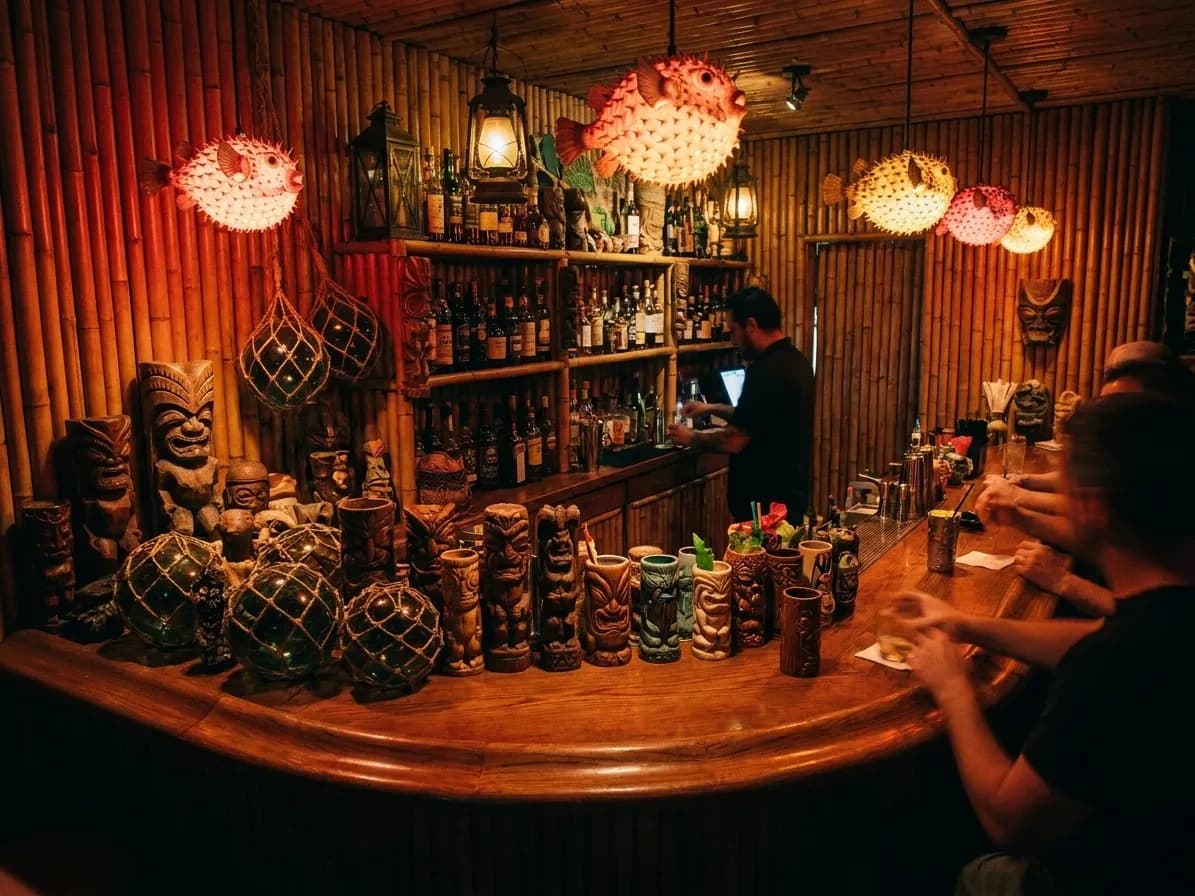
Tiki-Ti is the direct line, and it seats twelve
Ray Buhen opened Tiki-Ti on 28 April 1961 in a former violin repair shop that belonged to his father-in-law. Buhen was one of four Filipino bartenders who worked at the original Don the Beachcomber when it opened at the end of Prohibition, and the secret syrups those bartenders developed are the foundation of the tiki cocktail as a form. The bar is twelve seats. It is still owned and staffed by Mike Buhen Senior and Mike Buhen Junior — Ray's son and grandson — who are its only employees.
That is not a heritage marketing exercise. It is a family business of three generations pouring drinks whose recipes came out of the room where the category was invented, in a space the size of a large living room. It also means the bar has idiosyncratic hours, no meaningful capacity, and a queue whenever it is open. Plan around all three.
Tonga Hut is the oldest room, and the easiest to get into
Brothers Ace and Ed Libby opened Tonga Hut in North Hollywood in 1958, making it the oldest tiki bar in Los Angeles — three years older than Tiki-Ti, though without the direct staff lineage to Don the Beachcomber. What it has instead is space. If your group is more than four people, this is where the evening can actually happen, and the Valley location means parking is a solved problem rather than an ordeal.
The Huntington Beach revival of the Don the Beachcomber name is the third stop if you want to complete the historical circuit, though it is a drive rather than a crawl and belongs to a different evening.
How to run the night
Start at Tiki-Ti early — genuinely early, within half an hour of opening — because twelve seats means the queue forms fast and does not clear. Have one drink, understand that you are in a room where the recipes are older than the building's current use, and move on. Then go over the hill to Tonga Hut, where you can sit down, order a second round and let the group spread out.
Doing it in reverse fails for the same reason it fails in San Francisco: the small room is the constraint, and constraints go first. And treat the drinks with respect — these are multi-rum builds at real strength, designed for a slow evening rather than a round-buying one.
Practical notes
Tiki-Ti opened 28 April 1961, seats twelve, and is run by the founder's son and grandson — arrive within thirty minutes of opening or expect to wait. Tonga Hut in North Hollywood opened in 1958 and is the oldest tiki bar in the city, with room for groups and easy Valley parking. Don the Beachcomber began in Hollywood in 1934 and was scaled into a chain by Sunny Beach while Donn was overseas. Run the crawl small room first, and pace two drinks rather than four.
The revival is a real thing, not a marketing angle
Los Angeles has seen a genuine resurgence of tiki in the last few years, driven partly by a wider cocktail-bar interest in rum and partly by a generation of bartenders who treat the mid-century recipes as a serious historical archive rather than as kitsch. New rooms have opened, older ones have been restored, and the drinks are being made with more precision than they were at the height of the original boom.
The complicated part, which the better bars now address openly, is that the aesthetic was always a Hollywood invention rather than a Polynesian one — a set-designer's idea of the Pacific, assembled in Los Angeles by people who had mostly never been there. Rooms that acknowledge that and focus on the rum and the technique have aged considerably better than rooms that did not.
Tags: #TikiBars #LosAngeles #TikiTi #TongaHut #DonTheBeachcomber #Hollywood #NorthHollywood #CocktailBars #BarsAndNightsOut #LANightlife #RumCulture #LAHistory #LAGuide
Please drink responsibly. Must be of legal drinking age.
All trademarks are the property of their respective owners.
Ask Karpo first
Want to know how long the queue is at a twelve-seat bar tonight, which room can actually take your group, and how the two stops fit together? Ask Karpo for live wait times and opening hours, an arrival order that gets everybody in, and a late kitchen nearby for when you are done.