Angela Bassett's name trends for a few predictable reasons: an awards campaign, a franchise sequel announcement, or someone discovering her back catalogue and wanting to understand the Los Angeles that built that career. The search isn't usually about celebrity sightings or tour-bus routes. It's about the texture of a city that produces actors who stay serious for decades—the museums that anchor craft, the plazas that host free screenings when they happen, the neighbourhoods where production offices sit next to taco trucks and nobody makes a fuss.
Karpo can check which museum galleries are open today, map parking near the plaza without meter traps, and reroute you if the 10 backs up before you leave Culver City.

What people mean when they search this
Los Angeles doesn't package this version of itself neatly. The tourist grid runs from the Walk of Fame to the Grove, but the working city—the one that trains, promotes, and sustains people in the industry—sprawls across a dozen unconnected districts. Culver City is a good anchor because it holds studio history, walkable blocks, and enough daytime transit options that you're not locked into a single parking lot for six hours. From there you can sketch a no-cost route that touches on the civic and cultural places that make LA's entertainment engine legible, without pretending you'll bump into anyone famous or stumble onto a closed set.
Two routes through the city's working spine

Start at the Museum of Jurassic Technology on Venice Boulevard in Culver City. Admission is technically by donation, and a dollar satisfies the ask. The museum is small, dim, and strange—part natural history, part art installation, part joke about how we decide what deserves a label. It has nothing to do with film on the surface, but it's the kind of place that reminds you LA rewards people who take their obsessions seriously and ignore whether the result makes commercial sense. It's open Thursday through Sunday; confirm hours before you drive because it keeps an individual schedule.
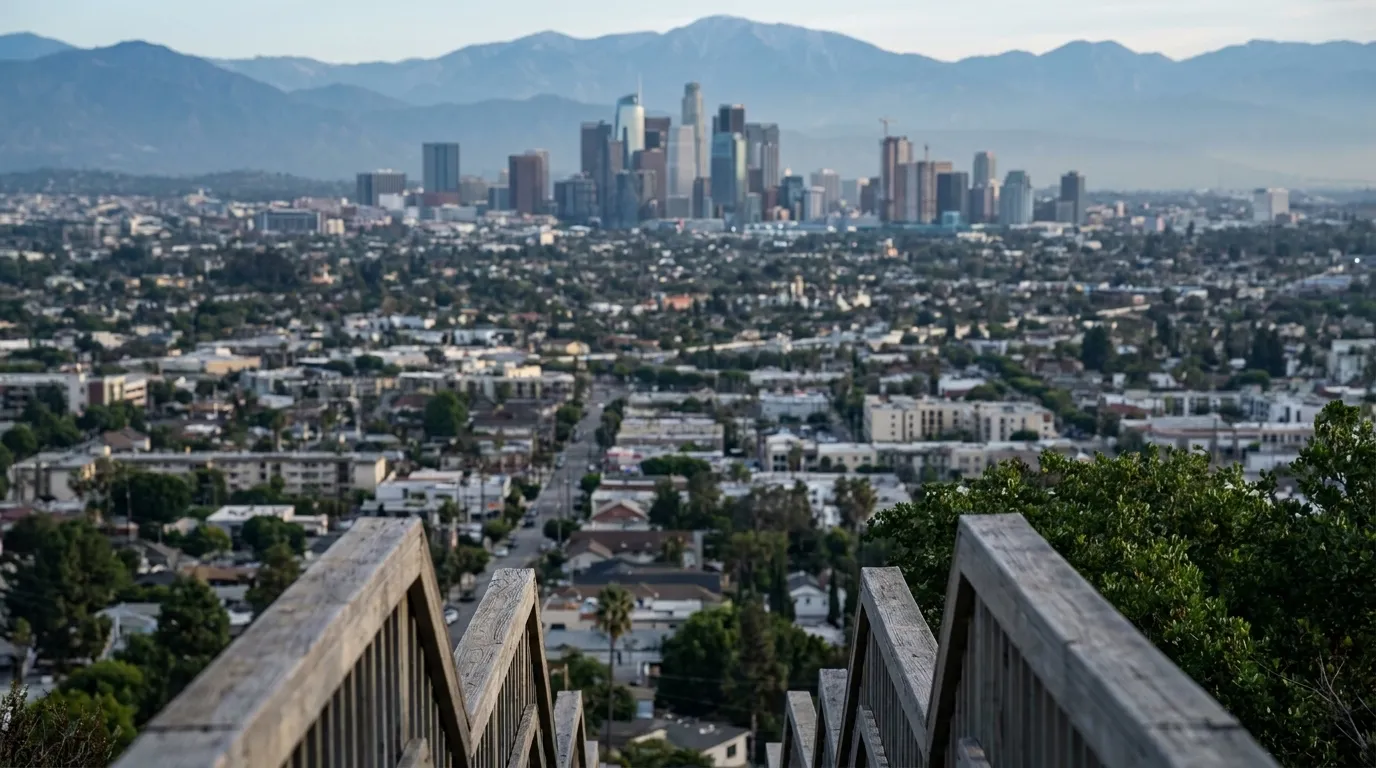
From there it's a fifteen-minute walk west and south to the Culver City stairs, a public wooden staircase that climbs the Baldwin Hills between residential blocks. It's free, always open, and delivers a sight line across the basin that includes studio rooftops, the downtown cluster, and on clear mornings the San Gabriels. Locals use it for cardio. You can sit at the top for twenty minutes and watch the marine layer pull back without anyone asking you to buy anything. The bottom trailhead has street parking that fills by eight on weekends; weekday mornings are quieter.
The second route assumes you're willing to drive twenty-five minutes east into Mid-City and spend the middle of the day at the California African American Museum in Exposition Park. Admission is free every day. The permanent collection covers migration, labour, and art from the twenties forward, and the building shares a plaza with the Natural History Museum and the Science Center, so foot traffic is steady but not Dense like the Getty. Parking in the Expo Park lots runs twelve to fifteen dollars for the day, but if you arrive before ten on a weekday you can sometimes find two-hour street meters on Figueroa south of Exposition that let you stay through lunch for six quarters. The museum's hours are Wednesday through Sunday, and it closes at five, which means if you arrive at eleven you have time to move through the galleries without rushing and still leave before the after-school science-centre crowd clogs the lot exits.
A third anchor—if you want something evening-appropriate and closer to central LA—is Grand Park, the long green strip that runs between the Music Center and City Hall. It's free and open until ten most nights. The park hosts movie screenings and concert series seasonally, almost all no-cost, but the schedule is irregular so check the official site a day or two before you plan to go. Even without a programmed event, the lawn between the fountain and the plaza steps is wide enough that you can sit and watch light drop behind the towers without feeling like you're trespassing on someone's event space. The neighbourhood is Downtown proper, so if you're driving in from the Westside after work, expect forty minutes and twenty-dollar evening parking in a lot on Grand or Hill. The Metro B and D lines stop at Civic Center/Grand Park if you're coming from Hollywood or Koreatown; the walk up from the platform is one long escalator and you're there.
What the day actually costs
Gas and parking are the only hard expenses unless you add a meal. Culver City to Exposition Park is about eight miles; if you're looping back to Culver City after, that's sixteen miles round trip, roughly a gallon in most sedans, five dollars at current LA prices. Parking at Expo Park ranges from free street meters if you're lucky and patient to fifteen dollars in the official lot if you're not. Grand Park after dark has no free parking nearby; budget twenty dollars for a structure within two blocks or take the Metro if your starting point connects cleanly. The subway fare is one seventy-five each way.
If you skip the car entirely and rely on Metro and walking, the math changes. The E line runs from Downtown to Culver City and stops at La Cienega/Jefferson, about a mile north of the Jurassic Technology museum. That walk is flat and takes twenty minutes, but there's no shade for half of it and the sidewalk along Washington Boulevard is narrow with fast commuter traffic, so it's not pleasant in afternoon heat. The B or D line from Culver City to Civic Center involves a transfer at 7th/Metro, and the connection platform can add ten minutes to what looks like a thirty-minute trip on the map. Confirm real-time arrivals before you commit, because weekend frequencies drop and a missed connection turns a short ride into an hour.
Food isn't part of the plan, but if you're out from eleven to four you'll want something. Culver City has tacos and banh mi on Washington near the stairs; figure eight dollars. Exposition Park has a few food trucks on Figueroa that appear around noon on weekends, less reliably on weekdays. Downtown around Grand Park has higher prices—twelve to fifteen dollars for a counter lunch—but also more options within a three-block radius. Bringing a sandwich from home and eating it on the museum lawn or in Grand Park is completely normal and costs nothing.
What to confirm the morning you go

Check museum hours and any holiday closures the day before. Both the Jurassic Technology and the California African American Museum keep limited weekly schedules, and city holiday closures sometimes catch the Exposition Park institutions even when the park itself stays open. If you're counting on a Grand Park evening event, verify it on the park's official event calendar—don't rely on a blog post from three months ago, because programming shifts and cancellations aren't always announced loudly.
Look at drive times before you leave. The 10 between Culver City and Downtown backs up unpredictably between four and seven PM, and the 110 south from Downtown toward Exposition Park can freeze after Dodger day games or weekend Science Center rushes. If you're making this trip on a weekday, leaving Culver City before nine or after ten thirty keeps you out of the worst school and commuter waves. Coming back from Downtown or Expo Park after four PM, add twenty minutes to whatever the map promises.
Parking enforcement in Culver City is steady and the stairs neighbourhood has residential permit zones on the south side of the hill. Read the signs before you walk away from your car. Expo Park meters are monitored, and the lots fill completely during museum free-days or when there's a Coliseum event, which the park's website doesn't always flag in advance. If you arrive and the lot is full, the next closest public parking is the structure at Vermont and Exposition, two blocks east, which runs ten dollars and requires you to walk back across a wide intersection with no pedestrian signal timing.
Weather matters more than it seems. The Culver City stairs have no cover, and the top landing is fully exposed. If it's over eighty-five degrees or there's any wildfire haze sitting over the basin, the climb is miserable and the view is grey. Grand Park's lawn is pleasant in the evening from April through October, but once the marine layer sits in after sunset it's damp and cold, and the park doesn't allow fires or propane. Bring a layer if you're staying past seven.
Practical notes
- Museum of Jurassic Technology and California African American Museum both keep limited weekday hours—confirm before you drive
- Expo Park lot parking is $12–15; street meters on south Figueroa sometimes available before 10 AM weekdays
- Culver City stairs have no shade and no water—avoid midday summer heat
- Grand Park evening events are seasonal and irregular; check the official calendar within 48 hours of your plan
- Metro E line to Culver City requires a 20-minute walk from La Cienega/Jefferson station to the museum
- Driving between Culver City and Downtown after 4 PM can add 20 minutes to any map estimate
Tags: #karpo #losangeles #culvercity #angelabassett #freethingstodo #lamuseums #expositionpark #grandparkla #museumofjurassictechnology #californiaaafricanamericanmuseum #laonfoot #metrolosangeles #discoverla #nobudgetla #reallosangeles
Sources consulted: California African American Museum · Museum of Jurassic Technology · Grand Park Los Angeles · Los Angeles Metro
All trademarks are the property of their respective owners.
Ask Karpo first
Text Karpo the morning you're planning this and ask which museums are actually open today, whether Grand Park has anything scheduled tonight, and what the drive time looks like from Culver City to Expo Park right now. It'll also map street parking near the stairs that isn't in a permit zone and reroute you if the 10 is stopped.


