 Knightsbridge Festive Shop Window Walk Planner: Dusk Loop
Neighborhood Guides
South Bank Neighborhood Walking Guide for Concrete Lovers
Love buildings? This South Bank neighborhood walking guide follows the river past a festival hall, a skate undercroft, a terraced theatre and a power station.
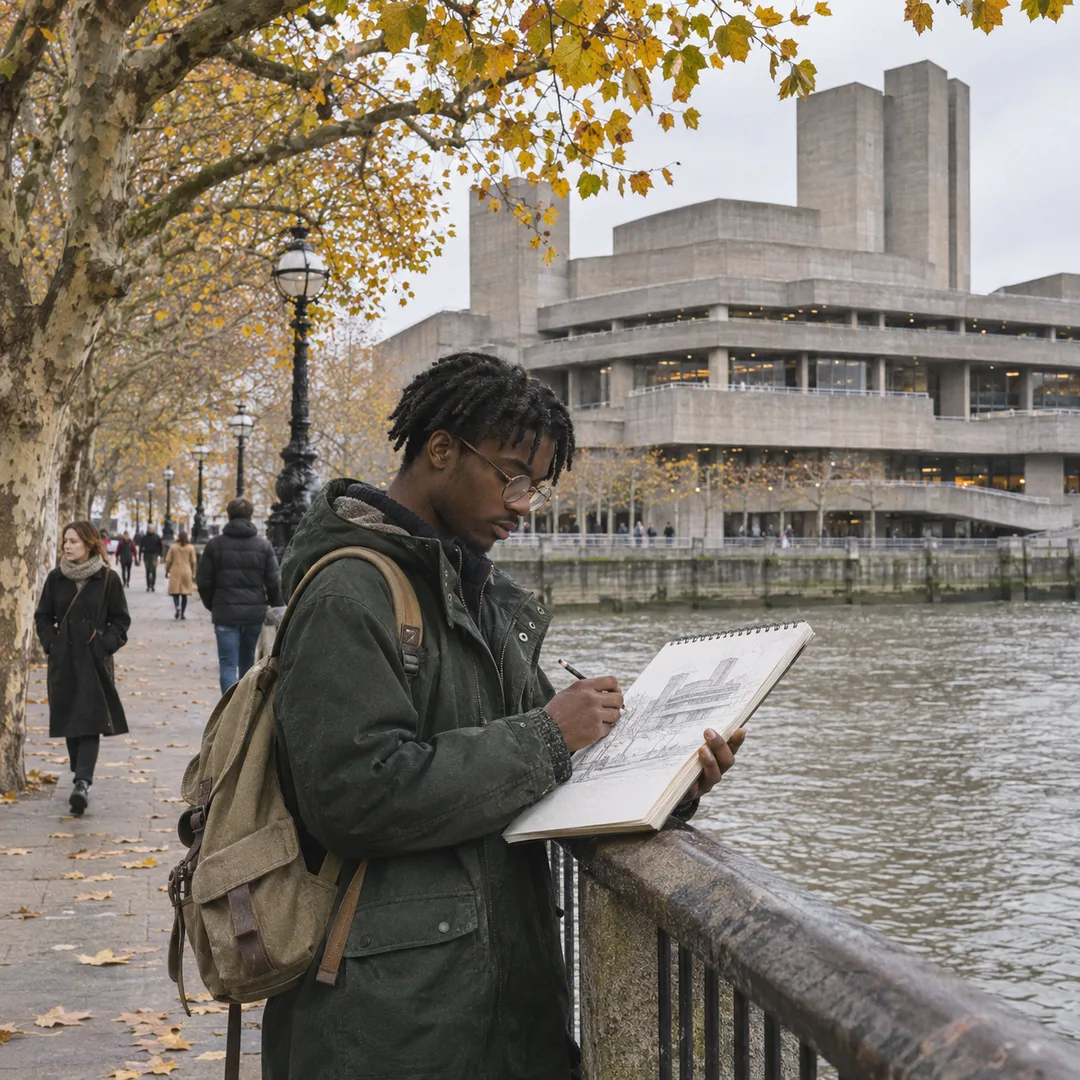
Kofi is in his second year of architecture school, and his tutor set a simple task for the autumn: walk one London neighbourhood with a sketchpad and find out why its buildings look the way they do. He chose the South Bank, because he had always thought of it as a stretch of grey concrete beside the river. This neighborhood walking guide is the loop he drew, and it turned a place he passed through into one he now visits on purpose.
Begin at the Hall That Started It All
Kofi began at the Royal Festival Hall, the large concert hall near the foot of Hungerford Bridge. It was built for the Festival of Britain, a national celebration held after the war to lift spirits and show off modern design, and it is the only major building left from that festival. Its glass front, open foyers and clean lines made it a template for public architecture across the country.
Inside, the foyers are open to everyone during the day, and people treat them as a living room: students on laptops, older couples with tea, children running along the wide levels. Kofi spent his first half hour here drawing the staircases, which flow up through the building in long, generous lines. It was meant to feel democratic, a palace for ordinary people, and it still does.
Step out onto the terraces facing the river for a view across to the Embankment and up and down the Thames. It is a good spot to understand the layout of the walk ahead. Everything you are about to see is lined up along the river, so you can keep the water on one side and simply walk east.
Raw Concrete, Walkways and a Skaters' Undercroft
Next door, the Queen Elizabeth Hall and the Hayward Gallery form one of the most famous groups of raw concrete buildings in Britain. Walkways and terraces were stacked at different levels, so people could move above the traffic, and the buildings look more like a landscape than a block. Some visitors find them harsh. Kofi found them full of hidden corners, and they filled several pages of his sketchpad.
Underneath, beside the river path, is the undercroft, a covered space where skaters, BMX riders and graffiti artists have gathered for decades. When plans were made to move them on, a long campaign saved it, and it is now protected as a community space. Kofi watched for a while, sketching the skaters against the painted pillars, and realised the concrete was being used exactly as a public space should be.
Be respectful here. The undercroft is a working space for the skaters, not a backdrop, so stay out of the lines they ride, ask before photographing anyone up close, and keep the sketching to the edges. You will get a better picture of the place by watching quietly than by stepping in.
The Theatre Built Like Layers of Rock
Walking east under Waterloo Bridge, Kofi passed the riverside stalls selling second-hand paperbacks and old prints, a long-running fixture beneath the bridge and a nice place to pause. The BFI's cinemas sit under the bridge too, tucked into its arches, with a cafe and bar for warming up on wet days.
Just beyond is the National Theatre, designed by Denys Lasdun, a great stack of concrete terraces and towers. Lasdun said the horizontal terraces were meant to echo geological strata, layers of rock along the riverbank. Look closely at the concrete and you will see the grain of the wooden boards used to cast it, a texture that softens the building in the right light. It was famously criticised by a future king, and it has since become one of the most admired buildings in the country.
Kofi climbed onto the open terraces, which anyone can wander, and sketched the view west towards Westminster. If you visit at dusk, the building is lit in changing colours. It is a good place to sit for a while before heading on, and the cafes inside make it an easy stop on a cold day.

A Wharf, a Tower and a Name in the Windows
Further east, Gabriel's Wharf is a small cluster of colourful low buildings with independent shops and cafes, a lighter, playful contrast to the heavy concrete behind. It grew out of a community campaign to keep this part of the riverside for local people rather than office blocks, and that same group went on to restore the tower just beyond it.
That is the Oxo Tower, an old power station turned into a cold store for a meat extract company. When the owners were refused permission to put an illuminated advertising sign on the tower, they designed its windows in the shape of the letters of the brand, so the name glowed out anyway. It is one of the cheekiest pieces of architecture on the river, and Kofi drew the windows with a grin.
The tower now holds homes, design studios and a restaurant at the top, and the ground floor has small craft shops. Walk through the ground-floor passage to see how the building has been opened up to the river, then carry on along the promenade towards the last stop.
Finish at the Power Station Turned Gallery
The walk ends at Tate Modern, housed in the former Bankside power station. It was designed by Giles Gilbert Scott, the same architect behind the red telephone box, and its tall central chimney and long brick walls dominate this stretch of the river. The huge turbine hall inside, where the generators once stood, is now used for large installations that change over the year.
Kofi sat on the steps outside and drew the chimney with the Millennium Bridge in front of it, the footbridge that wobbled so badly when it first opened that it had to be closed and fixed. Looking back west along the river, he could see every building he had drawn that day in one long line, from the festival hall to the power station.
If you have time, go inside and climb to the viewing level of the newer extension for a view over the rooftops of Southwark and across the river to St Paul's. It is a fitting end to a walk about how London has rebuilt and reused itself along the water.
Practical Notes for a South Bank Architecture Walk
Allow three hours with sketching or photography stops. The route is flat and step-free along the riverside path, so it works with a pram or a wheelchair. Weekday mornings are calmest. The promenade can be windy, so bring a warm layer, and a small stool if you plan to draw for long.
If you want to find more buildings worth walking to, open the Karpo APP and ask for architecture walks or quiet galleries near the South Bank. Use it to plan your next sketching route, perhaps across the river in the City or further east along the Thames.
Ask Karpo for more information.
Keep reading
- Knightsbridge Festive Shop Window Walk Planner: Dusk Loop
 Covent Garden Festive Shop Window Walk Planner: Night Loop
 Mayfair Festive Shop Window Walk Planner: Arcade Dusk Loop