 Knightsbridge Festive Shop Window Walk Planner: Dusk Loop
Neighborhood Guides
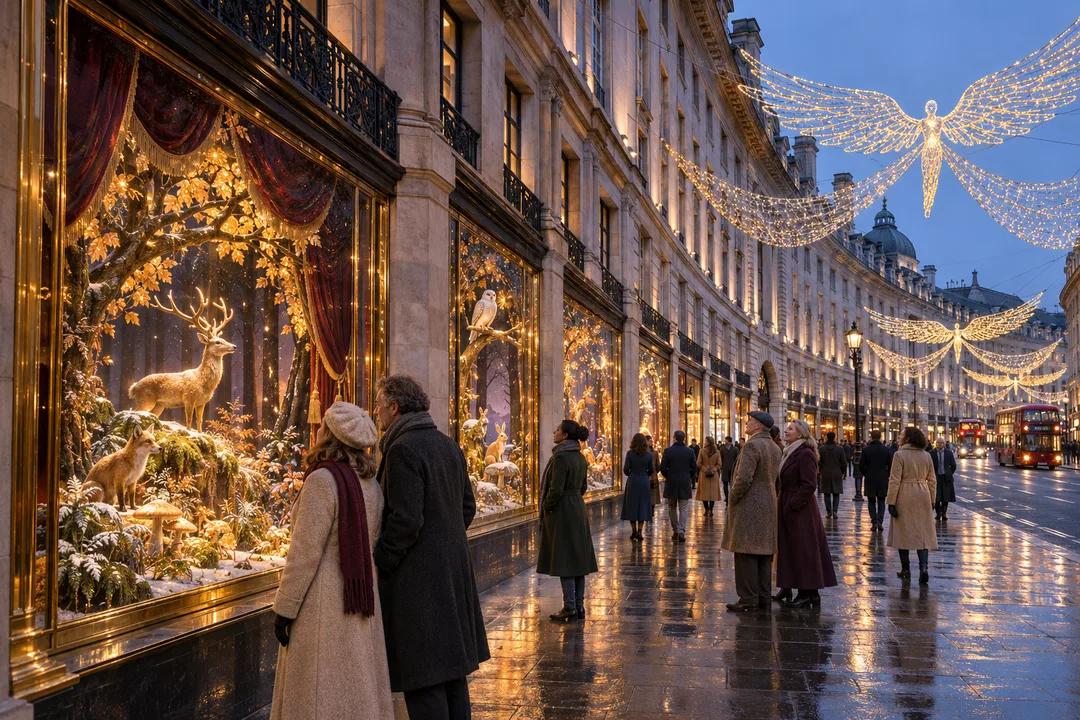
Regent Street Festive Shop Window Walk Planner: Dusk Route
Plan a Regent Street festive shop window walk from Oxford Circus to Piccadilly, linking Liberty's timber bays and Carnaby lanes while skipping bus glare.
Stepping out of Oxford Circus just as the late-afternoon sky turns deep indigo reveals why a Regent Street festive shop window walk planner starts with sightlines rather than a simple straight line down the pavement. Maya, a theatre lighting technician, and her sister Clare, up from Bristol for a winter midweek visit, begin on the western pavement where the long Portland stone curve bends south toward Piccadilly Circus. Because the overhead canopy of winged light spirits mirrors off the curved plate glass whenever a red double-decker bus idles at the kerb, walking the main boulevard without a side-street plan means staring into headlight glare or getting wedged behind stationary tripod clusters. Threading from the wide Nash colonnade into the mock-Tudor timber bays of Great Marlborough Street, the glowing pedestrian lanes of Carnaby, and the sheltered courtyard of Heddon Street turns a crowded West End thoroughfare into a layered theatrical promenade.
Starting at the Northern Curve Before Theatre Crowds Peak
Arriving as twilight settles over Oxford Circus gives you a rare window when the interior window spotlights already burn at full theatrical warmth while the sky above the stone cornices still holds a cobalt glow. Maya always guides visiting friends onto the western pavement first, walking south from the Langham-facing bend so the grand sweep of the curve unfolds ahead of you rather than behind your shoulder. Starting at the northern top and drifting downhill toward Piccadilly Circus works with the natural gravity of the street and keeps you moving in the same direction as the calmer early-evening foot traffic.
Skip the urge to cross back and forth across Regent Street at every traffic island whenever a bright display across the tarmac catches your eye. The central islands fill quickly with commuters waiting for green pedestrian phases, and zig-zagging across four lanes of buses breaks the visual rhythm of the architecture. Instead, treat the avenue as a horseshoe loop: trace one side via its quiet rear lanes on the way down toward Piccadilly, then return along the opposite frontage or cut across at Beak Street and Conduit Street where the crossing phases feel far less frantic.
Reading Multi-Bay Storytelling Windows vs Timbered Side Panes
The flagship department stores and heritage toy emporiums along the central stretch of Regent Street build their winter displays like multi-act stage productions. Rather than cramming unrelated gift stock behind a single pane, window dressers link six to eight consecutive bays with a continuous colour palette, kinetic pulley mechanisms, and custom scenic backdrops painted in layered gauze. Maya shows Clare how to stand two paces back from the brass stall-riser at the first corner bay to take in the full proscenium frame before stepping right up to the glass to spot the tiny clockwork mice, spun-sugar clouds, and hand-stitched felt costumes hidden in the foreground corners.
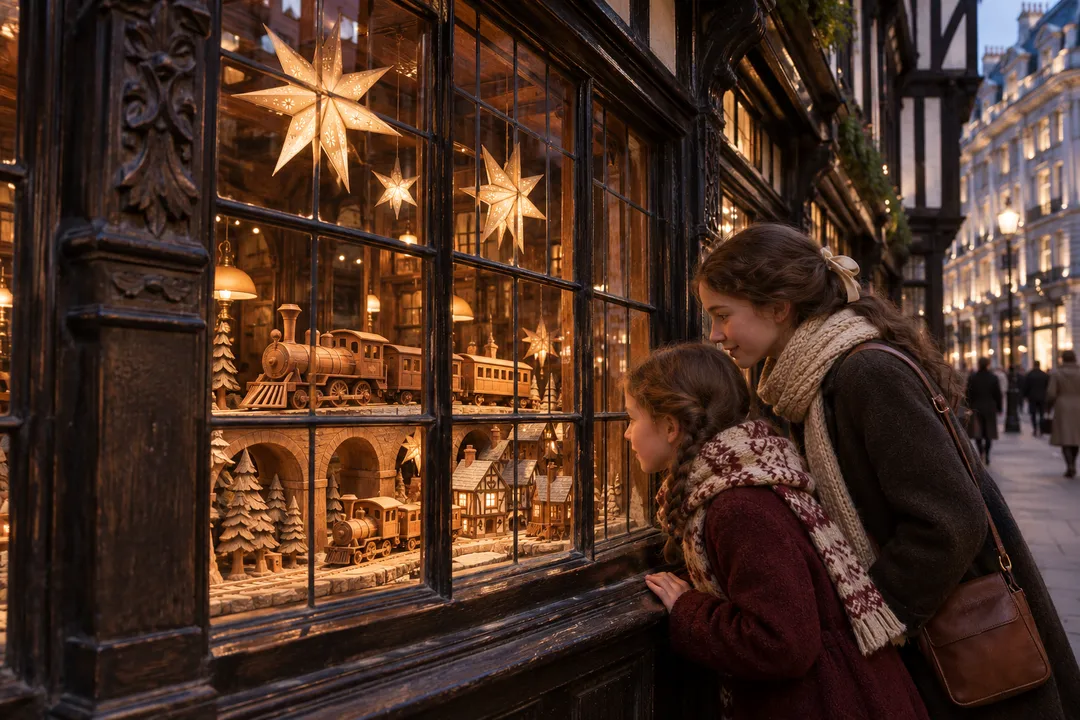
When the main pavement narrows beside the toy store entrance queue, pivot east down Great Marlborough Street where the architecture shifts abruptly from neoclassical Portland stone to dark ship-timber beams and leaded casements. Here the window bays sit lower to the pavement and wrap around recessed corner turret doors, allowing you to view suspended paper installations, woven tapestries, and glass ornaments from two perpendicular angles at once. Because there are no bus lanes along the pedestrianized flank beside the timbered store, reflections disappear almost entirely and you can study the grain of the woodwork and the warm filament lighting without shielding your eyes.
Beating Plate-Glass Glare and Pavement Pinch Points
Curved Victorian and Edwardian plate glass is notorious for bouncing streetlamp and bus-top glare straight back at viewers standing at the kerb edge. A simple lighting-crew trick solves the problem immediately: step inside the shadow line cast by the fabric awnings or stone pilasters and angle your shoulders slightly toward the direction of oncoming traffic. From that oblique pocket, the dark wool coats of passersby act as a natural black velvet baffle, letting the deep amber and emerald tones inside the vitrine pop with crisp contrast.
Keep your hands free and your bag zipped flat under your coat before entering the busier blocks between Foubert's Place and Glasshouse Street. Carrying bulky paper shopping totes through a dense viewing crowd makes it awkward to pause at recessed doorway vitrines. If you pick up fragile ceramic ornaments or boxed confectionery along the way, save those purchases for the final leg of your walk or open the Karpo APP to pin the shop location so you can circle back once you finish inspecting the outdoor displays.
Threading Carnaby Lanes, Kingly Court, and Heddon Street
Halfway down the boulevard, duck through the brick archway at Foubert's Place into Carnaby Street and Newburgh Street, where the scale drops from monumental stone facades to narrow three-storey shopfronts painted in jewel tones. Independent menswear ateliers, heritage bootmakers, and small perfumery counters dress their narrower panes with witty, prop-heavy vignettes—think vintage brass instruments, stacked leather hatboxes, and neon script reflected in wet flagstones. Newburgh Street in particular rewards slow browsing because its corner windows wrap into quiet cobbled courts where you can step back across the lane without blocking anyone's path.
On the western flank of Regent Street, slip through the stone portal into Heddon Street, a historic cul-de-sac that curves into a sheltered pedestrian pocket away from the traffic roar. Even when a sharp November breeze funnels down the main avenue from Oxford Circus, Heddon Street and nearby Golden Square stay remarkably still, offering heated outdoor terraces, calm bakery counters, and brick steps where you can rest your feet, sip a spiced hot chocolate or mulled apple juice, and compare notes on which window scenes had the cleverest mechanical details.
Using Karpo APP to Sequence Warm Stops and Piccadilly Cut-Throughs
Planning a winter window walk on the fly often breaks down when cold fingers make everyone want a warm drink at the exact moment you reach the busiest stretch near Piccadilly Circus. Before setting off from Oxford Circus, Maya and Clare use the Karpo APP to plot a clean sequence that pairs the major window clusters along Regent Street and Great Marlborough Street with quieter Soho squares and St James's arcades just two blocks off the main drag. Having a visual route in your pocket means you never waste energy backtracking through the same bottleneck twice.
To finish the walk on a calm, unhurried note, follow the southern sweep of Regent Street past the curved stone quadrants of Air Street and cross into Jermyn Street or St James's Square. Here the glowing overhead crowds thin out instantly, replaced by traditional shirtmakers, cheesemongers, and wood-panelled tea parlours whose small bow windows glow softly against the dark brick. From St James's, you can stroll down toward Green Park or loop back to Piccadilly's quieter side entrances with warm hands and a camera roll full of reflection-free window stories.
Ask Karpo for more information.
Keep reading
- Knightsbridge Festive Shop Window Walk Planner: Dusk Loop
 Covent Garden Festive Shop Window Walk Planner: Night Loop
 Mayfair Festive Shop Window Walk Planner: Arcade Dusk Loop