 Knightsbridge Festive Shop Window Walk Planner: Dusk Loop
Neighborhood Guides
Marylebone Festive Shop Window Walk Planner: Calm Lane Loop
Plan a Marylebone festive shop window walk from Manchester Square to Chiltern Street, linking cheesemonger bays and red-brick lanes while skipping crowds.
Clipping a leather lead onto a brindle whippet beside the iron railings of Manchester Square shows why a Marylebone festive shop window walk planner thrives on village geometry rather than monumental boulevard scale. Owen and Elena, two graphic designers who spend their weekends comparing typography and window craft across West London, use this north-of-Oxford-Street pocket whenever they want warm winter displays without megaphone traffic or subway-exit crushes. Because Marylebone Lane still traces the meandering curve of a lost medieval stream, its brick shopfronts angle gently toward the walker, revealing timber-mullioned cheesemonger panes, Scandinavian homeware studios, and red terracotta tailoring bays one bend at a time. Linking Manchester Square, Marylebone High Street, Paddington Street Gardens, and Chiltern Street creates a relaxed loop where dogs, strollers, and unhurried browsers never have to compete for kerb space.
Beginning at Manchester Square and Turning Off Oxford Street Early
The single smartest decision you can make when planning a Marylebone window walk is to avoid approaching directly from the central Oxford Street pavement crunch. Starting instead at the calm oval garden of Manchester Square—or slipping through the narrow pedestrian throat of St Christopher's Place and Barrett Street—drops you immediately into a neighborhood rhythm of Georgian brickwork and low cast-iron bollards. As dusk settles over the plane trees in the square, the surrounding townhouses throw long purple shadows that make the first glowing shopfronts on Duke Street and Bentinck Street stand out like warm lanterns against the dark masonry.
From the northern edge of the square, swing onto Marylebone Lane where the roadway narrows and bends northwest. Because delivery vans are scarce in the evening and through-traffic prefers Baker Street or Portland Place, the pavements stay quiet enough to walk two abreast with a dog on a short lead. Every curve of the lane introduces a fresh cluster of independent cornices, painted wooden fascias, and brass hanging signs wrapped in winter spruce, while the angled brick walls shield walkers from crosswinds blowing off Regent's Park.
Cheesemonger Slate Displays, Pantry Jars, and Literary Panes
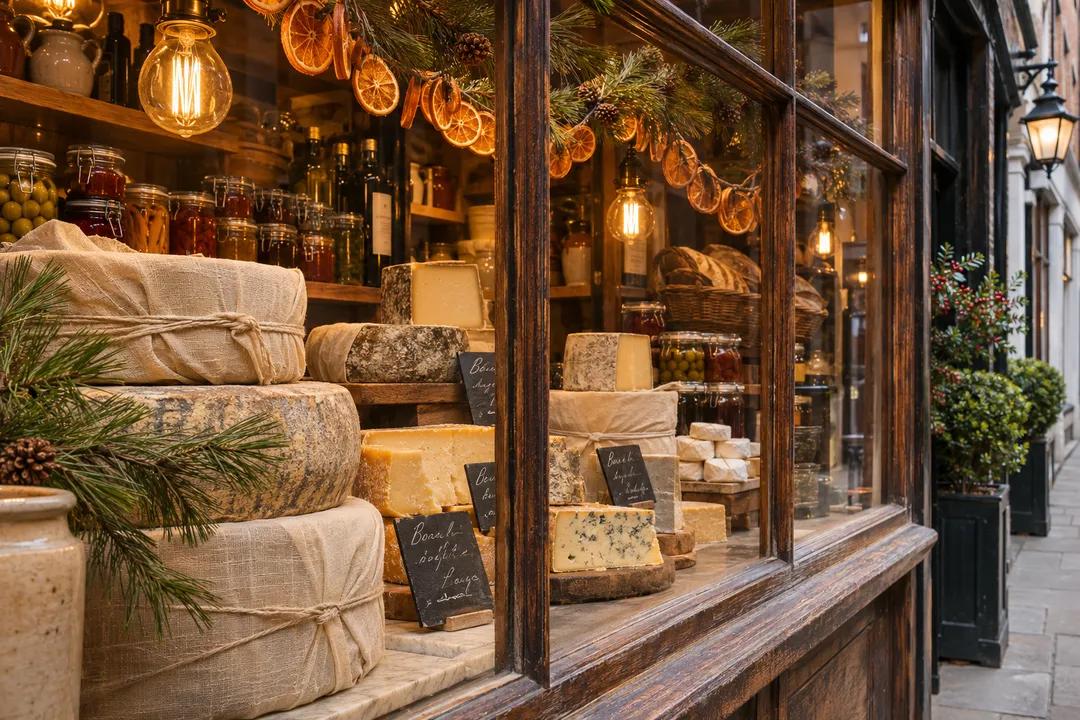
Where grand West End flagships rely on motors and theatrical spotlights, Marylebone Village excels at tactile, eye-level craft. Halfway up Marylebone Lane, pause outside the dark-green timber frontage of the neighborhood's celebrated cheesemonger and pantry counter. Behind the glass, whole clothbound farmhouse wheels sit tiered beside wooden crates of quince paste, chestnut honey jars, and garlands of bay leaves and dried clementines. The warm tungsten glow reflecting off waxed rinds and hand-chalked slate markers feels more like a Flemish still-life painting than a modern retail display, and a brass tie-ring near the door lets dog walkers pause comfortably on the flagstone margin.
Crossing onto Marylebone High Street brings you past Edwardian red-brick parades where literary parlours, cashmere knitwear ateliers, and botanical chocolatiers dress their windows with hand-folded origami stars, linen-bound winter journals, and miniature woodland scenes built from birch bark and moss. Because the sills sit at waist height with recessed tiled entrance lobbies, you can step into each threshold mosaic with your dog tucked neatly beside your boots while inspecting the hand-lettered calligraphy cards, glazed stoneware mugs, and blown-glass baubles inside.
Pacing the High Street Parades and Paddington Street Gardens
Marylebone High Street runs north-south with wide pavements shaded by mature street trees wrapped in warm white pea-lights. To keep your walk fluid, trace the eastern pavement heading north toward New Cavendish Street first, then cross at the calm zebra crossings near Devonshire Street to work your way south along the opposite frontage. Skip doubling back down the same side of the High Street once you reach the northern end; the parallel red-brick canyon of Chiltern Street lies just two short blocks west and offers a completely different architectural mood without repeating a single shopfront.
Before cutting across to Chiltern Street, detour half a block into Paddington Street Gardens. The raised brick paths, historic mausoleum stonework, and quiet lawn benches provide an ideal mid-walk breather where dogs can sniff the frosty leaf mould and walkers can sip a flat white or spiced cardamom bun picked up from a nearby Nordic bakery counter. Even on crisp November evenings, the old brick garden walls block the wind coming down from Regent's Park and give your eyes a rest from backlit glass before you step into the red-brick lanes to the west.
Inspecting Chiltern Street's Red Terracotta Bays and Craft Studios
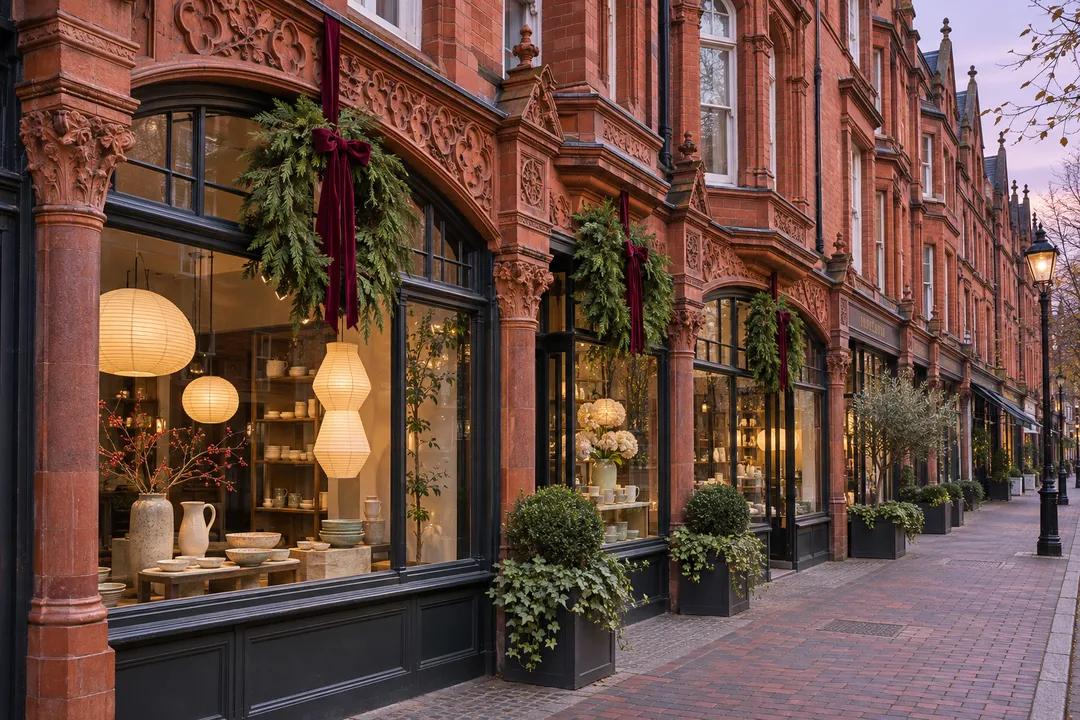
Stepping onto Chiltern Street feels like entering a film set carved entirely from warm Victorian red brick and moulded terracotta. The continuous sweep of Gothic-revival gables, octagonal turrets, and arched ground-floor bays gives every shop window a deep architectural frame before the shopkeeper adds a single seasonal branch. Independent spectacle makers, bespoke trunk smiths, monocle perfumers, and contemporary ceramic galleries keep their winter dressing understated—often a single pine wreath tied with raw linen ribbon, a cluster of beeswax tapers in brass holders, or a sculptural stack of wool blankets illuminated by a low warm lamp.
Because Chiltern Street attracts design-minded regulars rather than hurried gift crowds, you can stand across the narrow roadway on the opposite kerb to admire how the upper-floor terracotta arches align with the ground-floor shopfronts, then step back across to inspect the fine stitching on leather travel bags, hand-marbled endpapers, and horn-rimmed frames up close. Notice how the recessed portico doorways cast warm amber triangles across the red-brick steps, creating natural pockets where two people can linger and talk through the details of each craftsman's display.
Mapping Dog-Friendly Stops and Mews Extensions on Karpo APP
A great village window walk depends on knowing which side lanes welcome four-legged companions and where to find a warm table or sheltered bench when the evening chill bites. Owen and Elena use the Karpo APP to link their favourite window bays on Marylebone Lane and Chiltern Street with dog-friendly espresso bars, neighbourhood gastro-pubs in Moxon Street and Blandford Street, and quiet mews cut-throughs. Having those pins organized on the Karpo APP lets you adapt your loop effortlessly if rain starts falling or if a particular corner bakery has a lively evening crowd gathered by the door.
To wrap up your circuit without touching the busy Oxford Street artery, follow Chiltern Street south to George Street or Blandford Street and loop back toward Manchester Square or Wigmore Street's historic apothecary and chamber-music facades. You finish the evening having seen dozens of meticulously dressed independent windows while keeping the pace calm, conversational, and thoroughly local from the first Georgian railing to the final terracotta arch, with time left to pick up a warm loaf or pastry for the walk home.
Ask Karpo for more information.
Keep reading
- Knightsbridge Festive Shop Window Walk Planner: Dusk Loop
 Covent Garden Festive Shop Window Walk Planner: Night Loop
 Mayfair Festive Shop Window Walk Planner: Arcade Dusk Loop