 Knightsbridge Festive Shop Window Walk Planner: Dusk Loop
Neighborhood Guides
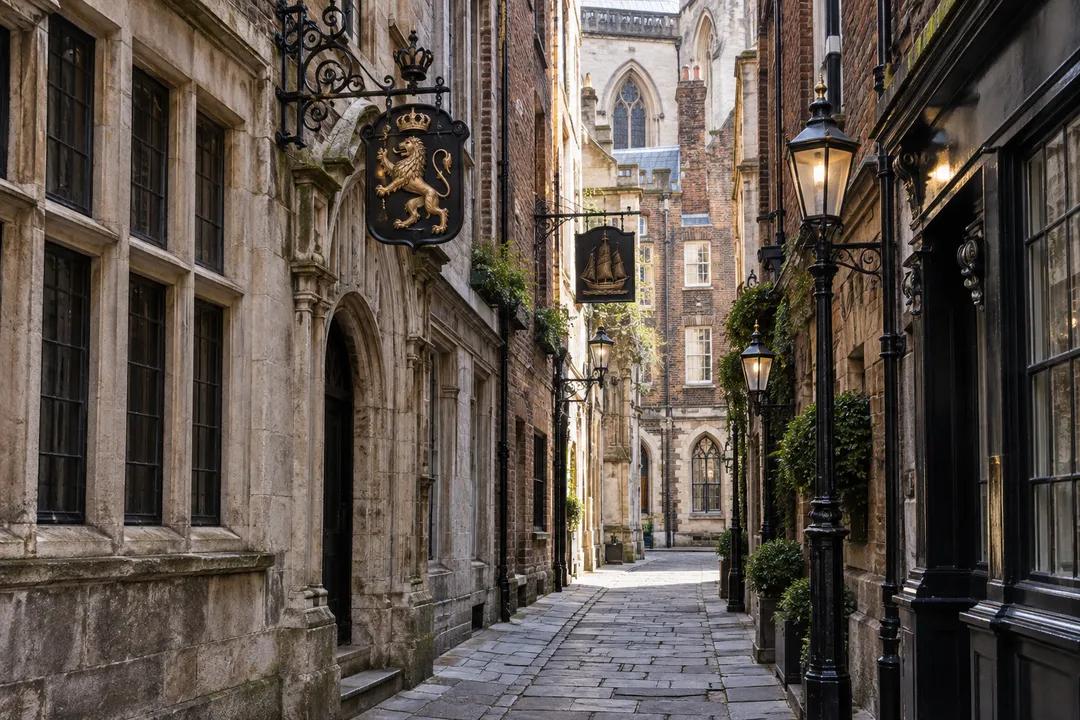
Historic City Walking Loop Planner: Ancient London Alleys
Plan a circular City of London walking loop through historic alleys and churchyards from Bank to Leadenhall Market and St Dunstan in the East.
Beneath the towering steel and glass skyscrapers of London's modern financial district lies an intricate, ancient labyrinth of medieval passageways, secluded churchyard gardens, and cobblestone courtyards that have survived the Great Fire and the Blitz. This compact 3.2-mile circular pedestrian itinerary functions as an architectural time machine, linking hidden historic enclaves into a continuous walking circuit. Commencing at the grand neoclassical hub of Bank junction, this specialized city walking loop planner steers pedestrians away from motorized main roads and into narrow stone alleys that date back to Roman Londinium and medieval trade guilds. The route winds through the Victorian painted iron arcades of Leadenhall Market, descends into the overgrown gothic ruins of St Dunstan in the East, passes the fluted doric column of The Monument, and traces historic banking lanes back to the Royal Exchange. Completing the circuit takes roughly an hour and forty minutes of engaged exploration, revealing an astonishing concentration of London history tucked behind modern office facades.

Starting from Bank Junction and the Royal Exchange
The circular walk originates at the pedestrian plaza outside Bank underground station, surrounded by three monumental pillars of civic power: the Bank of England, the Mansion House, and the Royal Exchange. After taking in the commanding eight-columned portico of the Royal Exchange, walkers slip quietly around its eastern flank into Royal Exchange Buildings. Here, the thrum of vehicle traffic abruptly drops away as pedestrians enter wide, pedestrianized granite lanes. The route turns south down Finch Lane, quickly plunging into the shadowy labyrinth of Cornhill's historic alleyways. Narrow passages like Newman's Court and Ball Court preserve historic timber-framed facades, bracketed gas-style street lamps, and centuries-old tavern signboards. It was inside these very alleys during the seventeenth and eighteenth centuries that London's commercial coffee houses operated, serving as the informal breeding grounds for insurance syndicates, maritime shipping registries, and modern stock trading.
Navigating the Hidden Courtyards of Cornhill
Slipping through St Michael's Alley leads past the towering stone tower of St Michael Cornhill, a church rebuilt by Sir Christopher Wren following the Great Fire of 1666. Just opposite the church porch sits the Jamaica Wine House, occupying the historic site of London's very first coffee house established in 1652 by Pasqua Rosée. Following the flagstone pavement through George Yard and Bengal Court brings you into quiet brick-walled courtyards where gas lanterns still illuminate recessed doorways. These historic alleys remain entirely inaccessible to vehicular traffic, giving pedestrians an intimate perspective on how human-scaled medieval London once was. Walking eastward toward Gracechurch Street, small connecting tunnels and archways pierce modern commercial developments, providing discreet shortcuts between parallel thoroughfares that casual tourists frequently walk past without noticing.
Traversing the Victorian Splendor of Leadenhall Market
Crossing Gracechurch Street guides walkers directly into the western portal of Leadenhall Market, one of the oldest and most spectacular covered markets in Europe. Designed by Sir Horace Jones in 1881, the grand Victorian market structure features ornate wrought-iron roof trusses, intricate glass skylights, and painted timber shopfronts adorned in rich maroon, bottle green, and gold leaf. Walking beneath the soaring octagonal crossing dome allows you to appreciate the elaborate decorative mouldings and iron grilles that once housed Victorian butchers, poultry merchants, and cheesemongers. The cobblestone floor beneath your boots originally accommodated medieval livestock stalls dating back to the fourteenth century. Exiting through the eastern archway onto Lime Street creates a striking visual juxtaposition, as the Victorian cast-iron canopy opens abruptly to the soaring glass and external steel elevator tubes of the iconic Lloyd's Building designed by Richard Rogers.
Discovering the Gothic Ruin Garden of St Dunstan in the East
From Lime Street, the walking loop turns south toward the River Thames via Fenchurch Street and Mincing Lane, steering down the gentle slope of St Dunstan's Hill. Tucked discreetly between modern corporate offices sits the enchanting public garden of St Dunstan in the East. Originally constructed around 1100 and enhanced with a graceful gothic steeple by Christopher Wren in 1697, the church was largely destroyed during the 1941 Blitz, leaving only its exterior walls and stone window tracery standing. Instead of demolishing the shell, the City of London transformed the consecrated ruins into a lush public park in 1971. Today, climbing ivy, trailing vines, and fragrant climbing roses weave through gothic stone arches surrounding a central bubbling fountain. Stepping through the arched doorways into the open-air nave reveals wooden benches where office workers and solitary walkers pause amidst tranquil greenery, completely sheltered from metropolitan bustle.
Circling The Monument and Returning via Lombard Street
Departing the peaceful courtyard of St Dunstan via Idol Lane, the circuit trends westward along Great Tower Street toward Monument Street. Rising dramatically ahead stands The Monument, a fluted 202-foot doric column of portland stone designed by Christopher Wren and Robert Hooke to commemorate the Great Fire of 1666. Its exact height equals the precise distance eastward to Thomas Farriner's bakery on Pudding Lane where the catastrophic blaze erupted. Circling the broad paved base of the column leads onto King William Street, before ducking right into Lombard Street. As the historical center of English merchant banking since the fourteenth century, Lombard Street features distinctive gilded metal trade signs hanging from facades, including the golden grasshopper of Sir Thomas Gresham and the black spread eagle of Barclays. Following Lombard Street northwest leads seamlessly back to Bank junction, bringing the historic loop to an elegant close.
Navigation Practicalities and Weekend Timing Insights
This historic alley loop follows stone flagstones, cobbled courtyards, and smooth asphalt walkways, making sturdy, comfortable walking shoes ideal for the varied paving surfaces. While the route is rich in weekday financial buzz and open sandwich delis, exploring on a Saturday or Sunday morning offers an entirely different, almost cinematic stillness when the narrow alleys and churchyards fall completely quiet. St Dunstan in the East garden is open daily to the public from eight in the morning until dusk with free entry. Bank station connects to the Central, Northern, Waterloo & City lines and the Docklands Light Railway, with Monument station providing direct access to the District and Circle lines via the connected underground concourse. In the Karpo APP, pedestrians can view GPS-linked historic alley maps, check elevation shifts, and pinpoint secluded courtyard benches for a peaceful pause during their City of London circuit.
Ask Karpo for more information.
Keep reading
- Knightsbridge Festive Shop Window Walk Planner: Dusk Loop
 Covent Garden Festive Shop Window Walk Planner: Night Loop
 Mayfair Festive Shop Window Walk Planner: Arcade Dusk Loop