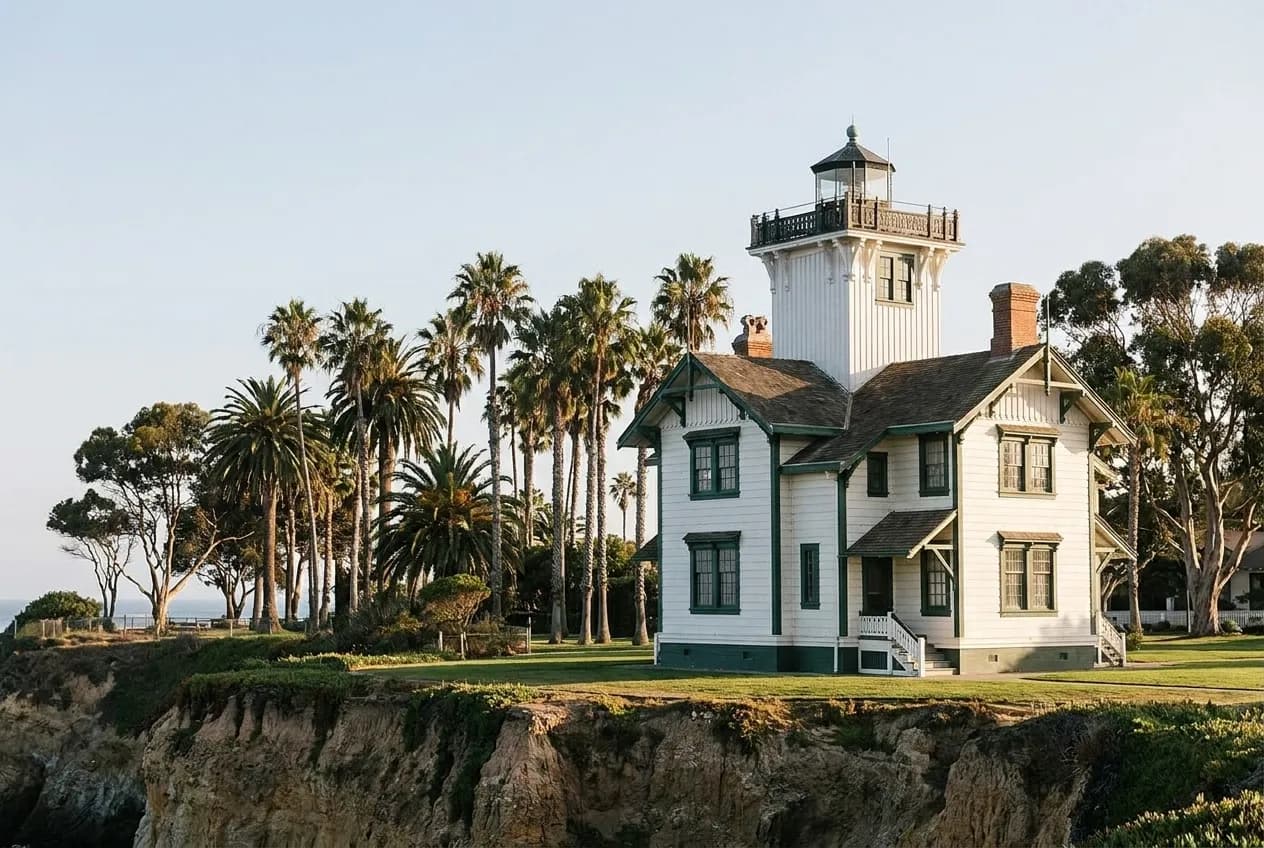
Los Angeles ends in San Pedro, at a bluff where the land gives out and the Pacific starts, and a things to do near me search this far south returns almost nothing that a visitor would recognise. On the cliff edge at Point Fermin there is a wooden lighthouse from 1874 — a Victorian timber house with a lantern room on the roof, one of very few of its kind still standing — surrounded by a public park that costs nothing and has one of the widest ocean horizons in the county.
Ask Karpo whether the lighthouse is open for tours the day you are going, when the whales are running, and what else in San Pedro is worth the drive south.
A lighthouse that looks like a house
The stick-style architecture is the giveaway. In the 1870s, before concrete towers became standard, a number of American lighthouses were built as elaborate timber dwellings with the light mounted on the roof, so the keeper lived inside the structure rather than beside it. Most of that generation has been demolished or lost to weather. This one survived, was restored, and reads today as a piece of domestic architecture with an industrial function bolted on top.
The first keepers here were sisters, which is a detail worth knowing because lighthouse keeping was one of the few federal jobs open to women in the period. The light operated for decades before being extinguished during the Second World War, when coastal illumination became a liability rather than an aid.
Tours are docent-led and the hours move
Entry to the building is free and by guided tour, run by volunteers, in a limited afternoon window on most days of the week. Published hours vary between sources and the schedule depends on volunteer availability, so this is a case where checking on the day is worth the two minutes rather than assuming. The park around it is open regardless.
If the house is closed, the visit still works. The bluff, the lawn, the view and the walk are the larger part of what you came for, and the exterior is the thing that photographs. Treat the interior as a bonus rather than the plan, and go with the expectation that a volunteer-run building keeps volunteer-run hours.
Sunken City is next door, and it is closed
Immediately east of the lighthouse is a stretch of collapsed ground where a section of clifftop neighbourhood slid toward the ocean in the 1920s, leaving broken roadway, foundations and graffiti-covered slabs tilted at angles. It is photogenic, it is widely posted about, and it is fenced off and closed indefinitely. Entering it is trespassing, the ground is actively unstable, and people have been seriously hurt there.
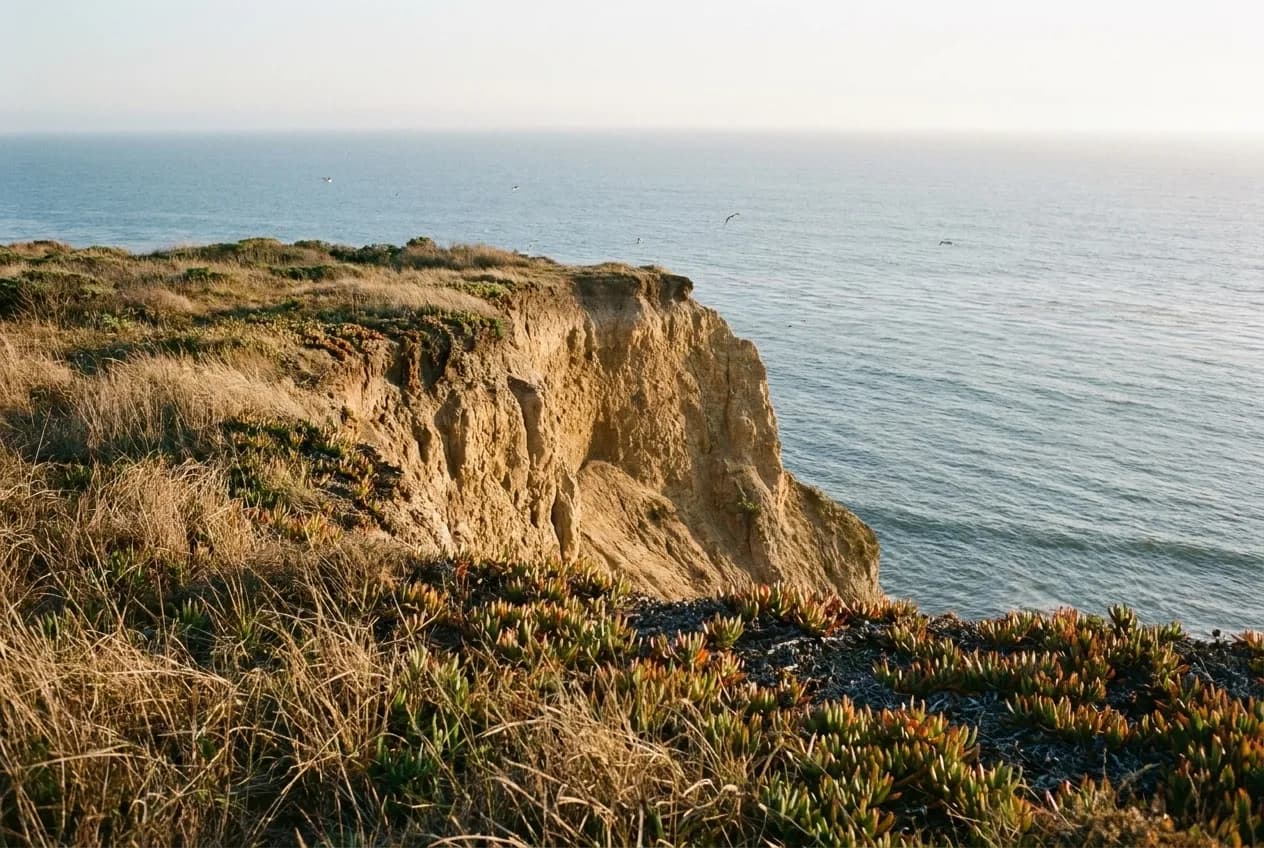
That is the honest version and it is worth stating plainly rather than winking at. If the geology of a collapsing coastline is what interests you, the bluff path gives you the same unstable cliff edge legally, and the interpretive material around the park explains what happened without requiring you to climb a fence.
Whales, from the land
This headland sits directly on the migration route, and grey whales pass close to shore heading south and then north between roughly December and April. You do not need a boat. A clear day, a bench on the bluff and a pair of binoculars is a legitimate whale-watching setup, and the volunteers and regulars along the railing will point out spouts long before you spot them yourself.
Outside the season the same view carries container traffic into the port, which is its own kind of spectacle: the largest port complex in the western hemisphere is immediately east of here, and the ships queue visibly offshore. Sunset from this bluff is the other reliable reason to come, and it is free.
Wind is the thing to dress for. A bluff at the end of a peninsula with nothing between it and the open Pacific is reliably ten degrees colder and considerably breezier than inland Los Angeles, and visitors who drive down in shorts on a warm afternoon spend the visit in the car. Bring a layer, hold onto anything light, and expect the marine layer to sit over the headland on summer mornings and burn off in the early afternoon. Winter, counterintuitively, is often the clearest and the best time for the view.
What else is down here
San Pedro is far enough from the rest of Los Angeles that the trip deserves more than one stop. Angels Gate Park above the lighthouse holds the Korean Bell of Friendship, a large bronze bell in an ornate pavilion with its own view; the Cabrillo Marine Aquarium sits near the beach below; and the waterfront in town has been slowly filling in with places to eat.
Drive, and accept the drive: this is forty-five minutes to an hour from most of central Los Angeles without traffic. Build a half day rather than an errand, go on a clear day, and start in the afternoon so the visit ends with the sun going into the water.
Practical notes
Point Fermin Lighthouse stands in Point Fermin Park on Paseo del Mar in San Pedro, Los Angeles. It dates from 1874 and is one of the few surviving timber stick-style lighthouses in the country. Entry is free and by docent-led tour in limited afternoon windows; hours vary, so check before travelling. The park, bluff and views are open regardless. The adjacent Sunken City is fenced, unstable and closed to the public. Grey whale migration runs roughly December to April.
Tags: #ThingsToDoNearMe #SanPedro #PointFermin #Lighthouse #FreeThingsToDoLA #LANeighborhoods #WhatToDoInLA #WhaleWatching #LAOutdoors #SouthBay #PacificCoast #LAHistory #CoastalLA #LAViews
All trademarks are the property of their respective owners.
Ask Karpo first
Want to know whether the lighthouse is open for tours the day you are going, when the whales are running, and what else in San Pedro is worth the drive? Ask Karpo for today's opening window, a half-day route that takes in the bell and the aquarium, and a sunset timing for the bluff.


