 El Sereno Urban Staircase Walk Planner for a Study Break
Free Things to Do
Arts District LA Scenic City Skyline Viewpoint Guide
Walk an Arts District LA scenic city skyline viewpoint route across historic river viaducts using Karpo APP to sequence public bridge overlooks.
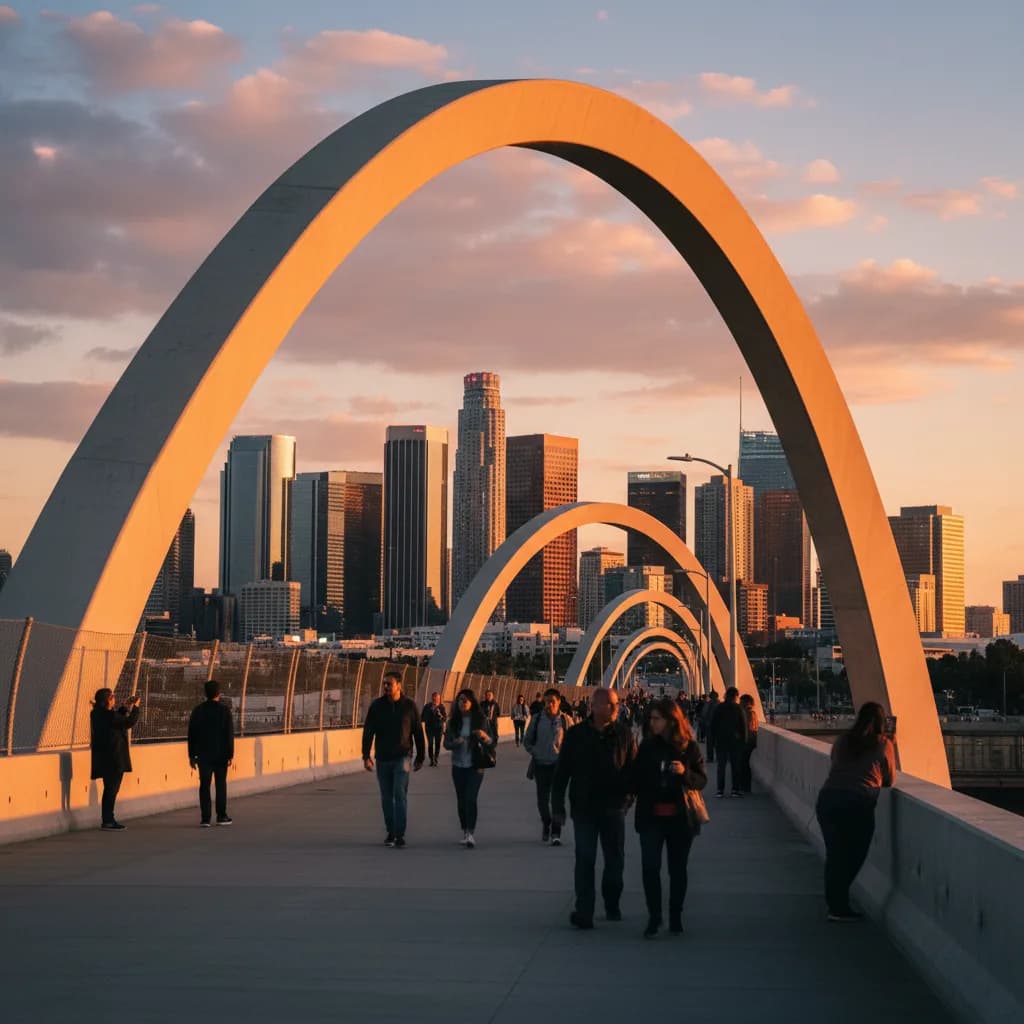
Walking out onto the northern pedestrian sidewalk of the Sixth Street Viaduct above Mateo Street and Santa Fe Avenue, twenty pairs of canted concrete arches frame the entire vertical wall of Downtown Los Angeles rising beyond the rail yards and old brick citrus warehouses. Finding a dramatic scenic city skyline viewpoint in the Arts District relies on the monumental concrete bridges built to carry pedestrians and traffic high above the Los Angeles River channel and railroad tracks. Because the interior warehouse streets between Traction Avenue and Industrial Street sit flat on the river floodplain, climbing onto the neighborhood's three historic viaducts lifts your camera thirty to forty feet into the air. Organizing a bridge-to-bridge walking sequence in the Karpo APP lets you compare modern sculptural arches against classic 1920s and 1930s masonry spans in one afternoon.
Sixth Street Viaduct Pedestrian Ramps And Ribbon Of Light Arches
Reopened to the public in 2022 after replacing the original span from 1932, the Sixth Street Viaduct stretches thirty-five hundred feet across the rail corridors and the concrete channel of the Los Angeles River. Designed by Michael Maltzan with sweeping concrete arches nicknamed the Ribbon of Light, the bridge features wide pedestrian walkways and protected bike lanes separated from vehicle traffic by concrete barriers. Ascending the western approach ramp near Mateo Street and Santa Fe Avenue lifts you above the surrounding industrial roofs and opens a panoramic northwestern sightline across every major tower in Downtown Los Angeles.
From the mid-span viewing alcoves above the river channel, the pyramid-topped tower of Los Angeles City Hall, completed in 1928, stands on the right side of the frame while the 1989 U.S. Bank Tower and the 2017 Wilshire Grand Center anchor the central skyline. Evening runners, architectural photographers, and local families walk the span during the final hour before sunset when warm western light turns the downtown glass facades gold and the bridge arches begin their nightly LED illumination. Saving the Mateo Street pedestrian ramp in the Karpo APP ensures you step onto the northern sidewalk where the downtown view is completely unobstructed.
Fourth Street Bridge Gothic Parapets And Classic Axial Sightlines
Four blocks north along Santa Fe Avenue, the Fourth Street Viaduct offers an entirely different architectural mood while pointing dead-center at the Bunker Hill and Financial District skyscrapers. Completed in 1931 in a striking Gothic Revival concrete style, the bridge features pointed arch relief panels, heavy stone-textured balustrades, and ornate vintage lantern standards along both sidewalks. Because Fourth Street aligns directly with the core of Downtown Los Angeles, standing on the northern sidewalk above the Santa Fe rail tracks lines up the tall downtown towers symmetrically down the center of the roadway.

Generations of cinematographers and street photographers have used this historic viaduct because the low red-brick warehouses of Traction Avenue and Colyton Street sit in the lower foreground, emphasizing the sheer scale of the glass high-rises behind them. Unlike the busy weekend promenade on Sixth Street, the Fourth Street Bridge sidewalks remain relatively quiet on weekday afternoons, giving you ample space to compose long-lens shots through the historic concrete lamp posts. Adding the Fourth Street and Santa Fe Avenue stair approach to your Karpo APP route notes lets you connect both bridges via a flat ten-minute walk through the warehouse grid.
First Street Viaduct And Historic Warehouse Street Corridors
At the northern gateway of the Arts District between Alameda Street, Hewitt Street, and the river, the First Street Viaduct rounds out the trio of historic river crossings. Completed in 1929 with neoclassical pylons and classical relief carvings, the bridge carries the Metro E Line light rail tracks down its center while preserving wide pedestrian sidewalks on both flanks. Looking west and northwest from the western arch of the bridge places the 1928 Los Angeles City Hall tower and the Civic Center complex in sharp focus above the brick lofts of Little Tokyo and the northern Arts District.
Down at street level along Traction Avenue, Hewitt Street, and Third Street, wide industrial loading bays and low two-story brick factories dating back to the early twentieth century keep western sky channels surprisingly open. When you pause at the intersection of Third Street and Traction Avenue in the late afternoon, the sun drops directly behind the downtown high-rises, casting long dramatic shadows across the mural-painted brick walls. Using the Karpo APP to group street-level mural corners with elevated viaduct spans gives your photo walk rich variety.
Midday Glare And Construction Zones To Skip Plus Metro Backups
Skip walking across the exposed concrete decks of the Sixth Street Viaduct or Fourth Street Bridge between eleven in the morning and three in the afternoon during summer heatwaves, as the monumental spans have no shade canopy and white concrete surfaces reflect intense glare. Visit during the ninety minutes before sunset or on clear winter afternoons instead. You should also avoid unmarked industrial freight alleys south of Palmetto Street when delivery trucks are maneuvering, staying on the wide sidewalks of Santa Fe Avenue, Mateo Street, and Traction Avenue.
If rare winter rain or gusty evening winds cut your bridge walk short, follow First Street or Traction Avenue west to the Little Tokyo and Arts District Metro station at First Street and Alameda Street, which serves both the Metro A Line and E Line light rail networks, or catch Metro Bus Line 18 along Sixth Street and Line 60 along Santa Fe Avenue. The covered Japanese Village Plaza walkways just west of Alameda Street provide dry shelter near the subway station while you check your saved transit connections in the Karpo APP.
Sequencing A North-To-South Three-Bridge Sunset Walk
Begin your two-hour Arts District skyline route at the Little Tokyo and Arts District Metro station on First Street and Alameda Street two hours before sunset, walking east past Hewitt Street onto the western sidewalk of the First Street Viaduct to capture the Civic Center and City Hall skyline in crisp afternoon light. Descend to Santa Fe Avenue and stroll south through the historic brick blocks of Traction Avenue and Third Street.
Climb onto the northern sidewalk of the historic Fourth Street Bridge one hour before sunset for the classic axial view into Bunker Hill, then continue south down Santa Fe Avenue to ascend the Sixth Street Viaduct thirty minutes before dusk. Watching the sun sink behind the Downtown Los Angeles towers while the Ribbon of Light arches glow over the river provides an unforgettable finale before you take Sixth Street or Mateo Street back toward transit. Keeping this north-to-south bridge progression saved in the Karpo APP makes every connection effortless.
Ask Karpo for more information.
Keep reading
- El Sereno Urban Staircase Walk Planner for a Study Break
 Santa Monica Urban Staircase Walk Planner Before Meetings
 Mount Washington Urban Staircase Walk Planner: Hike Prep