 Mar Vista Winter Farmers Market Picker for Weekend Cyclists
Weekend Plans

LA Rainy Day Museum Planner: 3 Westside Cultural Pavilions
The Getty Center, the Hammer Museum and UCLA's Fowler Museum make a rainy Westside LA day: European masters on the hill, then contemporary and global art.
On a clear day the Getty Center is all about the view, a white hilltop campus looking out over the Pacific, downtown and the whole basin. On a rainy day it becomes something else: a quiet, cloud-wrapped set of pavilions where you can spend a whole morning with paintings, drawings and old books while weather rolls past the windows. Pair it with two museums ten minutes down the hill in Westwood, the Hammer and UCLA's Fowler Museum, and the Westside gives you a full rainy day that covers European masters, contemporary art and the art of the wider world.
Morning on the Hill
The Getty Center opened in 1997 on a ridge above the 405 freeway. Richard Meier designed it as a cluster of pavilions faced in pale Italian travertine and white enamel panels, linked by courtyards and terraces. You leave the car, or the bus, at the bottom of the hill and ride a driverless tram up through the chaparral, and on a misty morning the ride feels like climbing into a cloud.
The museum's collection is spread across several pavilions, with covered walkways and lobbies linking most of them, though you will cross a few open terraces. The paintings galleries on the upper floors hold Van Gogh's Irises, which almost everyone wants to see first, along with Rembrandt, Manet, Monet and Cézanne. Lower floors show decorative arts, sculpture and rotating exhibitions of drawings, photographs and illuminated manuscripts, some of the most beautiful objects in the building and perfect for a slow, dry hour.
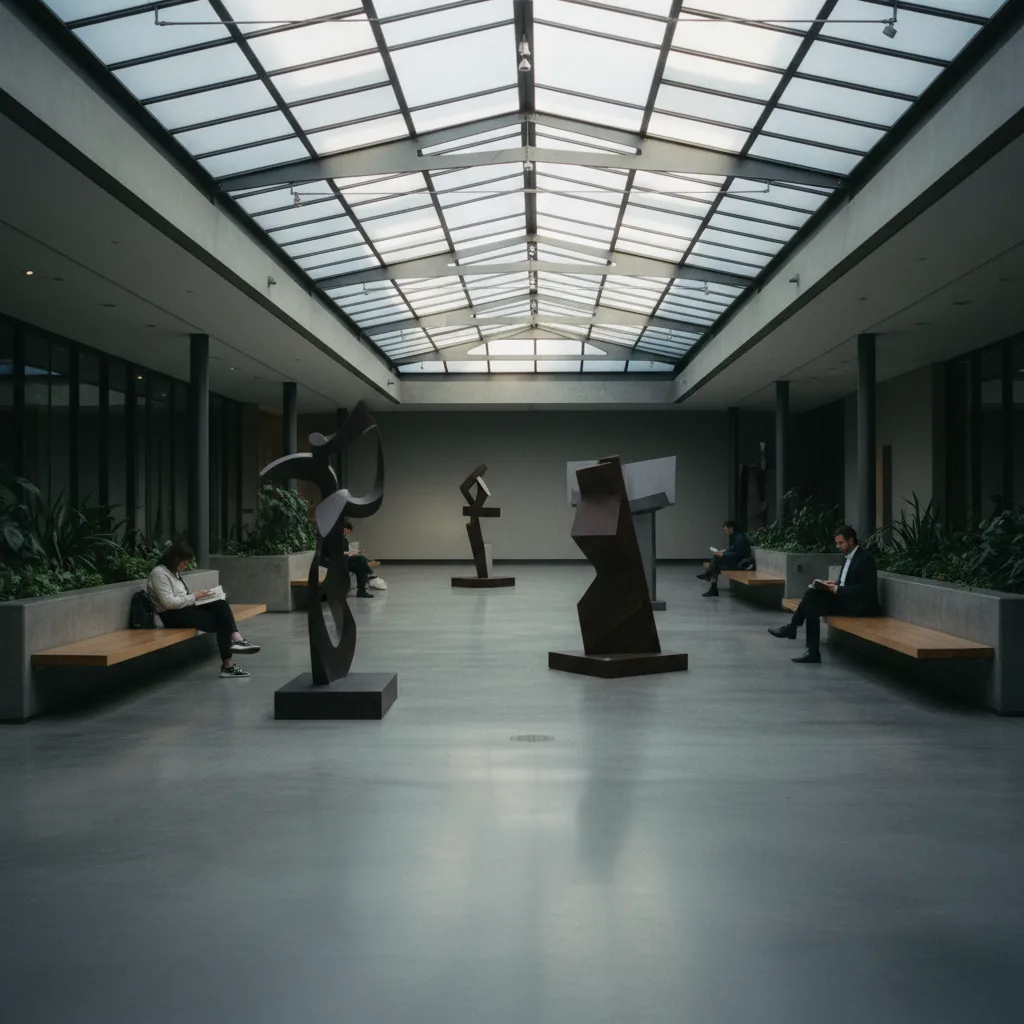
Robert Irwin's Central Garden, the terraced garden that spirals down to a maze of azaleas, is the Getty's other great sight. In heavy rain, most people admire it from the terraces above rather than walking the switchback path, and there is no shame in that.
If You Only Have an Hour Up There
Short on time, head straight for the West Pavilion's upper floor for Irises and the Impressionists, then walk through the drawings or manuscripts gallery, whichever has an exhibition on, on the way out. The manuscripts rooms are kept dim to protect the pages, and on a grey day the gold leaf seems to glow even more against the low light. Leave ten minutes for the window bays in the pavilions, where the view on a stormy morning is all moving cloud and silver light over the city.
Lunch and the Move Down
The Getty has a café and a restaurant on site, so you can eat before heading down. From the tram station at the bottom, Westwood is a short drive south along Sepulveda Boulevard or the 405, or a ride on Metro bus line 761 toward Westwood. Allow time, because Westside traffic thickens quickly in the rain.
Afternoon at the Hammer
The Hammer Museum sits at the corner of Wilshire and Westwood Boulevards. Armand Hammer opened it in 1990 to show his own collection, and UCLA has run it since 1994. A long renovation by Michael Maltzan Architecture, completed in 2023, opened the building up to Wilshire Boulevard with a new entrance and lobby.
The Hammer is best known for contemporary art, especially its Made in L.A. exhibition of artists working in the city, as well as a historical collection that includes works by Rembrandt and John Singer Sargent and the Grunwald Center's prints and drawings. The galleries wrap around an open courtyard with a café. On a wet afternoon, the courtyard is pleasant from the covered walkways, and the galleries are rarely as busy as the big downtown museums.
The Fowler Across Campus
The Fowler Museum at UCLA was founded in 1963 and focuses on the arts and cultures of Africa, Asia, the Pacific and the Americas. Its exhibitions often center on textiles, ritual objects and contemporary artists responding to those traditions, and they reward close reading. The building is on the UCLA campus, a walk of about fifteen minutes north from the Hammer through Westwood Village and onto the campus paths.
That walk is the one real outdoor stretch of the afternoon. On a heavy rain day, many visitors take a short ride to the campus parking structures instead. Once inside, the Fowler is calm and intimate, and its courtyard and shop make a good place to sit while the shower passes.
Westwood Village, the shopping district between the Hammer and campus, was laid out in the late 1920s in a Spanish and Mediterranean style, and the white tower of the Fox Village Theatre still marks its center. It is a good place to stop for coffee or a bowl of noodles on the way to the Fowler, and the narrow streets give a little shelter from the wind.
Three Ways to Run the Day
The full day is Getty in the morning, Hammer after lunch and Fowler late in the afternoon. Art lovers who want depth over breadth can skip the Fowler and stay longer at the Getty. Families with older children might prefer the Getty's tram ride and terraces followed by Westwood Village for food, and leave the university museums for another day.
If the weather is truly bad, reverse it. Start in Westwood, where the walks are shorter, and head up to the Getty after lunch, when the clouds sometimes lift enough to show a sliver of the view.
Practical Notes
The Getty charges for parking at the base of the hill and asks visitors to reserve timed entry, which is easy to do online. The Hammer and Fowler are both small enough to visit without much planning, though both close at least one day a week. Bring layers, because the Getty's hilltop is breezier and colder than the flats, and wear shoes with grip for the wet travertine.
Karpo for the Westside
Karpo APP takes what you tell it, how many hours you have, whether you are driving, and which of old masters, contemporary art or global art matters most, and suggests an order for these three museums, compares a full day with a shorter Westwood afternoon and recommends a lunch or dinner stop that suits your group. Reservations, bus times and opening days come from the museums and Metro.
Ask Karpo for more information.
Keep reading
- Mar Vista Winter Farmers Market Picker for Weekend Cyclists
 Downtown LA Winter Farmers Market Picker for Car-Free Hosts
 Larchmont Winter Farmers Market Picker for Kimchi-Making Day