 Crepe Cafe Near Me in Sherman Oaks: Crave Cafe Folds
Coffee & Dessert
A Stool at the Original Philippe's: LA's Oldest Lunch Counter Since 1908
Downtown LA's sawdust-floored cathedral of the French dip serves nine-cent coffee and sandwiches dipped in jus at communal tables where strangers become neighbors for twenty minutes.
The accidental invention
Philippe Mathieu didn't set out to create LA's most enduring sandwich in 1918. He dropped a sliced French roll into a roasting pan filled with hot meat drippings, served it anyway to a police officer who returned the next day requesting "that dipped sandwich." A century later, you'll stand in the same kind of line, watching countermen in paper hats dunk bread into steel pans of jus with the practiced efficiency of assembly line workers who've done this ten thousand times. The technique hasn't changed: they hold the roll with tongs, dip it quickly—one second for single-dipped, three for double—and the bread emerges darkened and glistening. The counter crew executes each dip with the muscle memory of decades, the rhythm of tongs and jus and bread as reliable as the sunrise.
The sawdust question
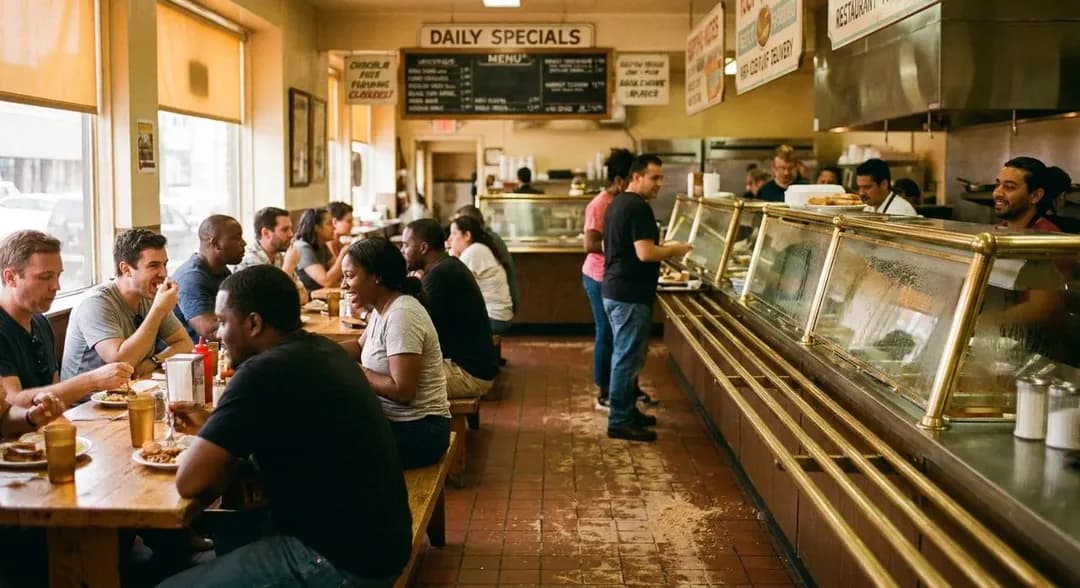
Your shoes will crunch. The floor at Philippe's has been covered in sawdust since the beginning, originally to soak up ice melt from the refrigeration system, now maintained because regulars would riot if they swept it away. They spread fresh sawdust every morning before the first customers arrive at six. The smell hits you before the visual does—that dry, woody scent mixed with coffee and beef fat that defines the space more than any architectural detail. Old-timers kick the sawdust into small piles under their tables, an unconscious territorial marking. You'll find yourself doing it too by the end of your sandwich, your feet shuffling the wood shavings into patterns while you finish your coffee and watch the room.
Eleven o'clock intelligence
Arrive at 11am sharp, before the lunch rush floods in at quarter to noon. You want one of the long communal tables nearest the left wall, a position that gives you a clear view of both the ordering counter and the room's human theater, plus you're close enough to the coffee station for easy refills but far enough from the door to avoid the draft. The sweet spot lasts about forty minutes. By 11:30, the line extends to the door. By noon, you're standing with your tray, scanning for eighteen inches of open bench space. The midday crowd eats fast and cycles through, but the window between 12:15 and 12:45 turns Philippe's into a standing-room calculation of angles and patience.
The legendary coffee
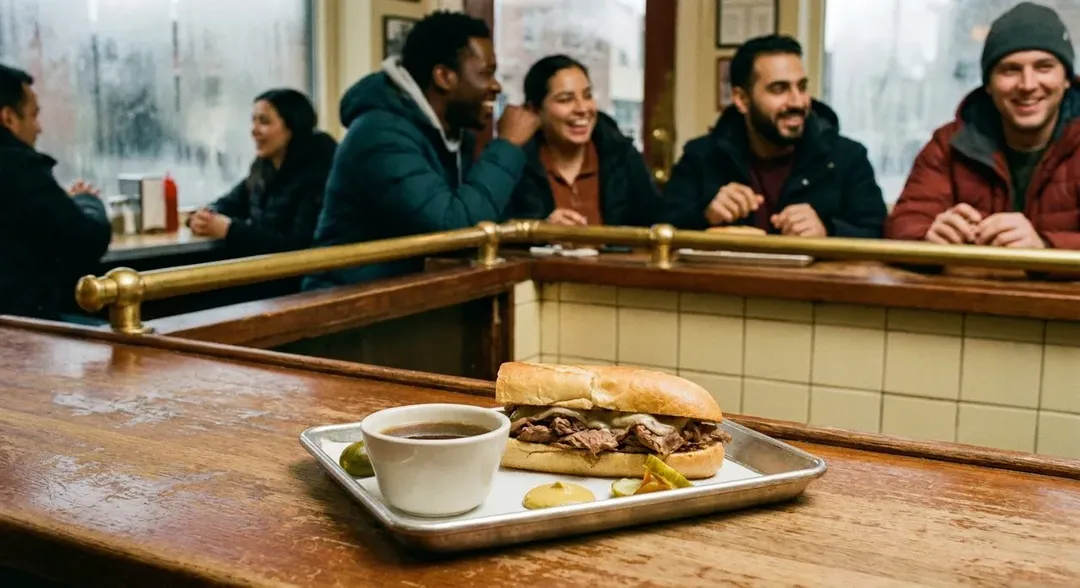
The legendary 9-cent coffee—a price that held from 1977 until 2012—now costs 50 cents, still the best deal in Los Angeles. It pours from industrial urns that brew hundreds of cups per batch. The coffee itself tastes like coffee tasted before third-wave roasters convinced everyone to care about altitude and processing methods—it's hot, it's strong enough, it costs half a dollar. You pay at the register after ordering your sandwich, and the cashier doesn't blink when you ask for six refills over the course of an hour. Regulars bring their own mugs; the staff fills them without comment. The cups are heavy ceramic, the kind that chip at the rim and stain at the bottom, and you'll see tables of retirees nursing them through entire afternoons, sawdust collecting around their chair legs like snow.
What to order, specifically
The lamb French dip, double-dipped, on the end cut of the French roll. The end cut gives you more crust-to-interior ratio, and lamb—less popular than beef—gets pulled from a fresher pan. Add the hot mustard, the kind that clears your sinuses, not the yellow squeeze bottle. Skip the pickle spear; it's decorative. The cole slaw comes pre-portioned in small paper cups and tastes exactly like cafeteria cole slaw from 1985, which is somehow correct here. If you're hungry enough for sides, the potato salad disappears by mid-afternoon. The pie case near the register displays several varieties, but the apple is the standout—served at room temperature, which makes the filling taste more intensely of cinnamon and less of sugar.
The communal table negotiation
You'll sit next to strangers. This isn't optional at Philippe's—the tables seat ten to fourteen, and unless you arrive at an odd hour, you're sharing. The protocol: claim your section of table with your tray, nod to your neighbors, then ignore them unless they speak first. Conversations start accidentally, usually over the mustard caddy or when someone asks you to pass the napkins. You might sit next to a Superior Court judge, a Metro driver on break, a tourist from Frankfurt, and a woman who's eaten here every Tuesday for decades. The tables equalize everyone into temporary citizens of this sawdust republic, united by meat and bread and the democratic principle of first-come seating.
Practical notes
Philippe the Original sits at 1001 N Alameda Street, one block north of Union Station, where the downtown grid starts to fragment into industrial angles. Open daily 6am–10pm. The French dip sandwich—carved to order, the roll dipped in hot jus—remains the signature. Coffee is 50 cents. The Gold Line stops at Union Station; from there it's a four-minute walk north on Alameda. Street parking exists on nearby streets. The restaurant holds 200 people, and on weekday lunches, all 200 seats fill. They don't take reservations. They don't do call-ahead. You stand in line like everyone else, and somehow that feels appropriate—a place this old has earned the right to make you wait.
Tags: #PhilippeTheOriginal #FrenchDipSandwich #DowntownLA #LunchCounter #LAHistory #Since1908 #CommunalDining #NineCentCoffee #SawdustFloor #LALandmark #UnionStation #LAEats #HistoricRestaurant #AuthenticLA #PullUpAChair
Sources consulted: philippes.com · laist.com
All trademarks are the property of their respective owners.
Ask Karpo for more information.
Keep reading
- Crepe Cafe Near Me in Sherman Oaks: Crave Cafe Folds
 Crepe Cafe Near Me in Eagle Rock: Crepes Hollywood Sweets
 Crepe Cafe Near Me in Hollywood: Solar de Cahuenga Plates