 El Sereno Urban Staircase Walk Planner for a Study Break
Free Things to Do

LA Local Event Finder: Stay Within Your Travel Limit
Set a travel boundary for a local event finder in LA, then ask the Karpo APP for nearby ideas that respect your starting point and return journey.
A nearby event is only useful if the journey feels nearby to you. In Los Angeles, your starting point, transport choice, and return arrangement belong in the search from the beginning. A local event finder request should describe the trip you are willing to make, not just a circle around the city's name. Open the Karpo APP with an area and a travel boundary, then ask for ideas that keep that boundary visible in the comparison.
Should I give a distance or a travel time?
Use the measure that reflects your actual limit. A walking distance can help describe a small local search. A time allowance can be more useful when a trip involves transit, driving, or several stages. Explain what the allowance includes. If you mean the whole journey from leaving your starting point to entering the event, say that. A vehicle journey alone leaves out the parts before and after it.
Keep the number a personal planning limit rather than a prediction. “I want to spend no more than half an hour getting there” expresses a preference. It does not establish that a particular route takes that long. If a suggestion has no supported journey information, do not treat its inclusion as proof that it fits. You can use the conversation to narrow the geographic search, then assess the actual candidate on its own details.
How precise does my starting point need to be?
A neighborhood or a nearby public landmark is often enough to begin a discovery brief. You do not need to give a private home address just to explain which side of LA you are starting from. The important point is to avoid a citywide request when you only want to explore a small area. Name the starting neighborhood and whether nearby districts are acceptable, then make the transport choice explicit.
For instance, “Start with ideas around my neighborhood in Pasadena, and keep the outing local rather than suggesting a separate cross-city trip.” This is a sample request, not a claim about any Pasadena event or travel time. If the initial search area is too broad, reduce it in the next message. You can describe a familiar boundary in words without asking the tool to infer where you live or where you are currently standing.

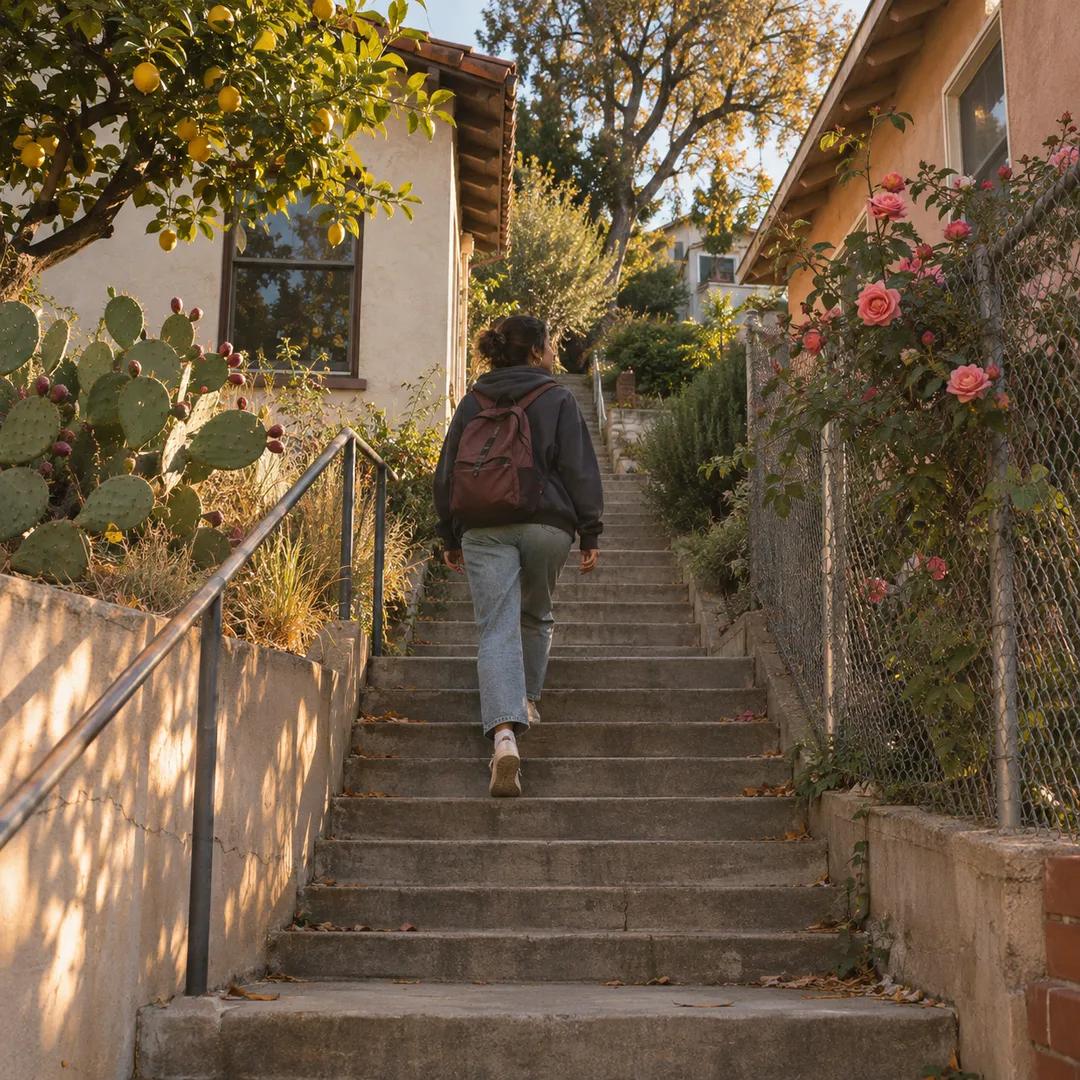
Generated neighborhood walking scene that conveys travel scale without representing a mapped route.
Does the limit apply in both directions?
Decide whether you are comfortable with the same effort on the way home. An outbound journey can feel easy when you have energy and daylight, while the return may need a different arrangement. Include the deadline for being back and whether your transport mode will remain the same. If someone is dropping you off but cannot collect you, the search needs a return plan that works independently of that lift.
You can ask for ideas near the place you will finish your day instead of near home. Someone already spending an afternoon in Long Beach might prefer an event in that area before heading back, while another person may want an outing reachable from their own neighborhood. These are different starting assumptions. Stating which one applies prevents a recommendation from being geographically reasonable in the abstract but inconvenient for your actual day.
What counts as travel effort besides moving time?
Think about transfers, walking between stages, parking, finding the entrance, and waiting for other people. Include the parts you particularly want to avoid. You might accept a longer direct trip while rejecting a shorter one with several changes. A route involving a steep walk could be unsuitable even if its distance looks modest. Describe those preferences as conditions for the outing, without assuming anything about an unidentified venue's access.
A focused request could say: “I prefer a simple journey with little walking after arrival. Give priority to event ideas close to my starting area, and keep the main practical tradeoff visible.” That wording does not promise a route calculation or an accessible entrance. It tells the discovery conversation how to prioritize. For a particular event, access arrangements still need to come from information about that site and session rather than from a general neighborhood description.
What if the first shortlist stretches the boundary?
Bring the conversation back to the limit directly. “Those ideas involve more travel than I want. Keep the next set in the starting neighborhood, even if that means a smaller selection.” This gives the search a clear preference order. If you are willing to broaden something, choose the dimension yourself. You could consider another date, a different activity format, or a nearby district. There is no need to loosen every condition at once.
A small set of plausible options is more useful than a long set that quietly ignores the brief. Ask for fewer ideas if the area is restrictive. If there is no supported event that fits, you can choose an ordinary neighborhood outing instead or save the event search for another day. The absence of a suitable suggestion does not require inventing a program, describing an old listing as current, or claiming a venue has something scheduled.
How do I compare two options inside the same area?
Once geography is settled, compare the event itself. Look at the commitment, the participation expected, and the reason you want to attend. A location that is convenient does not automatically make an activity appealing. You can ask for two different formats within the boundary, then decide which use of the time feels worthwhile. Keep the travel limit fixed while you make that comparison so it remains a useful constraint.
If friends are joining from elsewhere, explain that your boundary is personal rather than universal. Someone else's shorter trip does not cancel your return deadline. Agree on whether you will meet at the event or at a shared starting point. The final arrangement may change which option works, but it should do so openly. An event recommendation cannot settle where everyone is willing to travel without those people making a decision.
What should I include in the final message?
Combine the details in the order you would explain them to a person helping you plan: starting area, day, transport, maximum effort, return requirement, and activity preference. You might write, “Help me find a small LA outing near where I will already be this weekend. I want a straightforward journey, limited walking, and enough time to get home comfortably. Suggest a few event directions rather than a whole-day itinerary.” Add the actual neighborhood before sending.
Use that message in the Karpo APP as a starting conversation. Read any proposed event alongside its established date and location, and keep your own journey boundary in view when choosing. This page supplies a way to frame the request, not mapped routes or live arrival estimates. A successful result is an idea you can assess without discovering at the last moment that most of the outing would be spent getting there.
Ask Karpo for more information.
Keep reading
- El Sereno Urban Staircase Walk Planner for a Study Break
 Santa Monica Urban Staircase Walk Planner Before Meetings
 Mount Washington Urban Staircase Walk Planner: Hike Prep