 El Sereno Urban Staircase Walk Planner for a Study Break
Free Things to Do
Arts District Indoor Art Exhibition Finder: 4 Loft Walks
Use an Arts District indoor art exhibition finder along Traction and Mateo. Connect brick flour-mill and warehouse shows in Downtown Los Angeles.
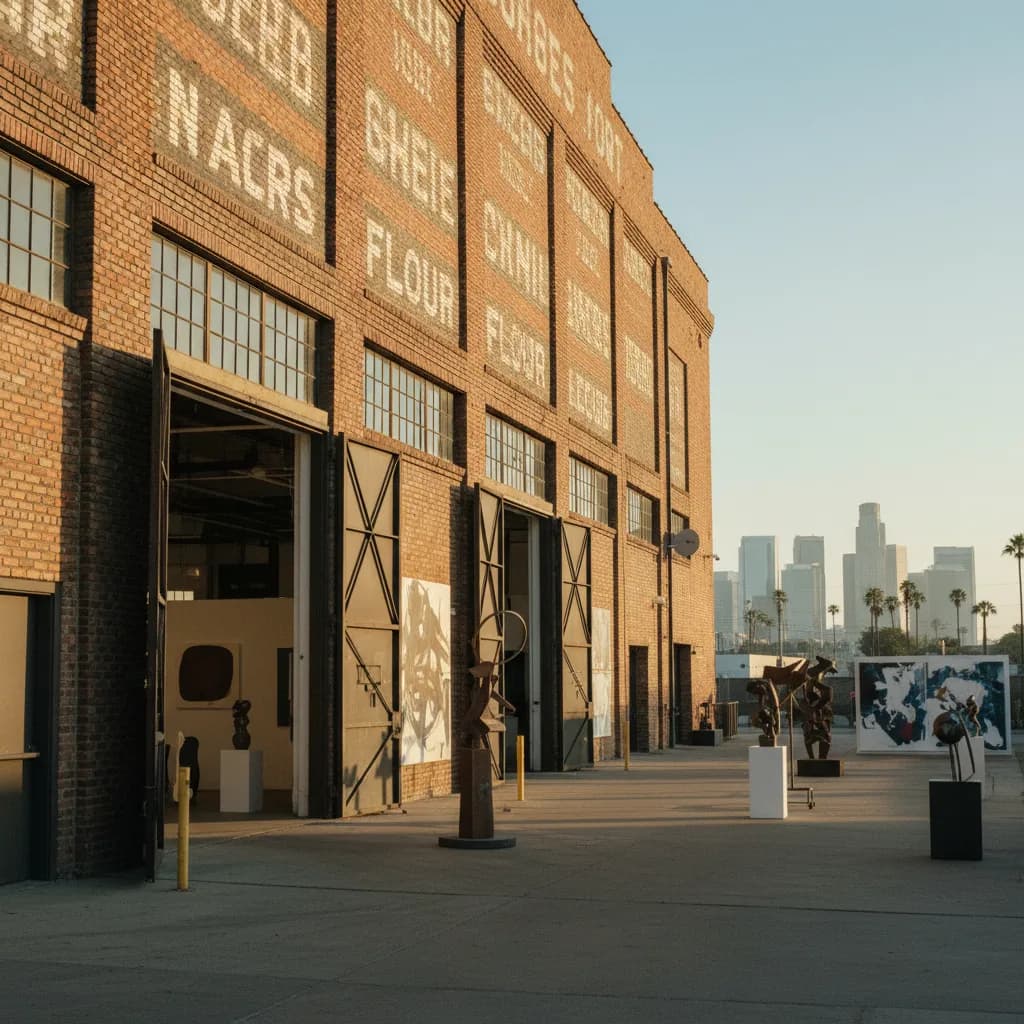
Former citrus packinghouses, flour mills, and railroad freight depots between Alameda Street and the Los Angeles River channel provide Southern California's largest column-free exhibition volumes, making an indoor art exhibition finder essential before you step out of the Little Tokyo/Arts District Metro A and E Line station. Catalyzed by the 1981 Los Angeles Artist-in-Residence Ordinance that legalized live-work loft conversions inside vacant early twentieth-century manufacturing buildings, the Arts District divides into a northern courtyard hub around Traction Avenue and East 3rd Street and a southern heavy-warehouse spine along Santa Fe Avenue, Mateo Street, and East 7th Street. Because crossing the concrete viaduct approaches of the Fourth Street and Sixth Street Bridges on foot in midday sun takes fifteen minutes between clusters, grouping your stops into northern and southern halves keeps your afternoon focused on viewing rather than trekking beside freight sidings.
Separating the Traction Avenue Triangle from Southern Mateo Lofts
Scale is the first surprise for anyone walking the Arts District for the first time. A single former railroad depot or baking-company complex along East 3rd Street and Traction Avenue can span an entire city block, wrapping five or six distinct exhibition halls, bookshops, and print studios around a central brick courtyard.
South of the Fourth Street Viaduct, the street grid stretches out into long industrial blocks along Mateo Street, Imperial Street, and Santa Fe Avenue, anchored by five-story reinforced-concrete factories built between 1912 and 1928. When you plan your route using an indoor art exhibition finder workflow in the Karpo APP, treat the Traction Avenue, Hewitt Street, and Merrick Street triangle as Cluster One, and save the southern Mateo Street and 7th Street warehouse corridor for Cluster Two.

Inside Sawtooth Flour Mills and Freight-Siding Compounds
Because these buildings were engineered a century ago to move grain sacks and automobile chassis directly from Santa Fe Railway boxcars onto raised concrete loading docks, their interior proportions dwarf conventional storefront galleries. Along Traction Avenue and East 3rd Street, multi-building brick compounds preserve original timber roof trusses, steel fire doors hung on inclined iron tracks, and twenty-five-foot skylights.
Curators use these museum-scale halls for solo retrospectives, architectural earthworks, monumental welded steel sculptures, and multi-channel video projections that require forty-foot throw distances. Walking up the wide concrete freight ramps on Hewitt Street or Palmetto Street puts you directly onto the raised dock level, where shaded outdoor breezeways connect indoor viewing wings without forcing you back onto the asphalt street.
Fabricators, Curators, and Warehouse Compound Etiquette
Spend a Thursday or Sunday afternoon inside Arts District warehouse galleries and you will encounter the fabricators, architects, and educators who shape Los Angeles contemporary art. Metalworkers and foundry technicians from Vernon and Boyle Heights examine weld seams and patina treatments on large floor sculptures. SCI-Arc architecture students from the neighboring freight-depot campus on Merrick Street sketch truss spans in graph-paper notebooks, and visiting museum registrars review multi-room retrospectives.
Inside these sprawling brick-and-concrete compounds, visitors follow a clear spatial etiquette. Many warehouse complexes house working architectural offices, print presses, or conservation labs alongside public exhibition halls, so stay within the signed gallery wings and courtyard pathways rather than wandering down unmarked loading corridors. Keep water bottles capped inside your bag, and give wide clearance around floor-standing sculptures that rest directly on the concrete slab without rope barriers.
Timing Desert Basin Heat and Concrete Viaduct Shade
Surrounded by wide asphalt avenues and the concrete bed of the Los Angeles River, the Arts District absorbs intense afternoon sun between noon and three o'clock. During those peak hours, stay inside the multi-wing brick complexes around East 3rd Street, Traction Avenue, and Hewitt Street, where three-foot-thick masonry walls and shaded central courtyards keep interior rooms cool and comfortable.
After three-thirty in the afternoon, as the sun drops behind the Downtown Los Angeles skyline to the west, long architectural shadows stretch across Santa Fe Avenue and Mateo Street. Late afternoon is the ideal window to walk south toward Palmetto Street, 6th Street, and 7th Street, when golden western light illuminates the historic concrete arches of the viaducts and pours sideways into west-facing loading-dock galleries.
Notice how the wide tree-planted courtyard passages between East 3rd Street and Traction Avenue cut wind and glare simultaneously, letting you move between three or four indoor rooms while barely stepping into direct sun.
What to Skip and Your Hewitt Street Courtyard Plan B
Skip walking north-to-south along the industrial truck lanes of Alameda Street between 3rd Street and 7th Street to connect exhibition stops. Alameda Street carries heavy wholesale produce and freight traffic with minimal shade, whereas parallel Mateo Street, Hewitt Street, and Santa Fe Avenue offer calmer sidewalks and converted warehouse facades.
You should also skip trying to walk across the entire mile-and-a-half span from 1st Street down to Olympic Boulevard and back in a single ninety-minute window. Pick either the northern Traction Avenue hub or the southern Mateo Street and 7th Street hub if you have less than two hours.
If an independent warehouse space on Mateo Street or Palmetto Street is closed for crane rigging between exhibitions or a rare afternoon heat spike hits ninety degrees, trigger your Plan B at Traction Avenue and Hewitt Street. The interconnected brick courtyards, covered loading-dock arcades, and indoor art-book and print lounges between East 3rd Street and Traction Avenue let you spend a full hour indoors within a six-minute walk of the Little Tokyo/Arts District Metro station.
Sequencing Your Warehouse Loop in the Karpo APP
Because Arts District buildings occupy oversized industrial superblocks where streets like Garey Street and Hewitt Street stop and restart around former rail spurs, organizing your pins in the Karpo APP before leaving the train prevents dead-end detours. Group your northern stops around East 3rd Street, Traction Avenue, and Merrick Street first, then check the walking connection south along Santa Fe Avenue toward Mateo Street and 7th Street.
Using the Karpo APP to review your block sequence also helps you spot which warehouse entrances sit on courtyard alleys rather than main avenues, saving ten minutes of circling full-block brick walls.
For a complete two-hour afternoon route, exit the Metro A or E Line at Little Tokyo/Arts District station at 1st Street and Central Avenue, walk two blocks east to Traction Avenue and Hewitt Street to tour the northern flour-mill and depot galleries, and continue south along Mateo Street to East 7th Street where frequent DASH and Metro buses return you downtown.
Ask Karpo for more information.
Keep reading
- El Sereno Urban Staircase Walk Planner for a Study Break
 Santa Monica Urban Staircase Walk Planner Before Meetings
 Mount Washington Urban Staircase Walk Planner: Hike Prep