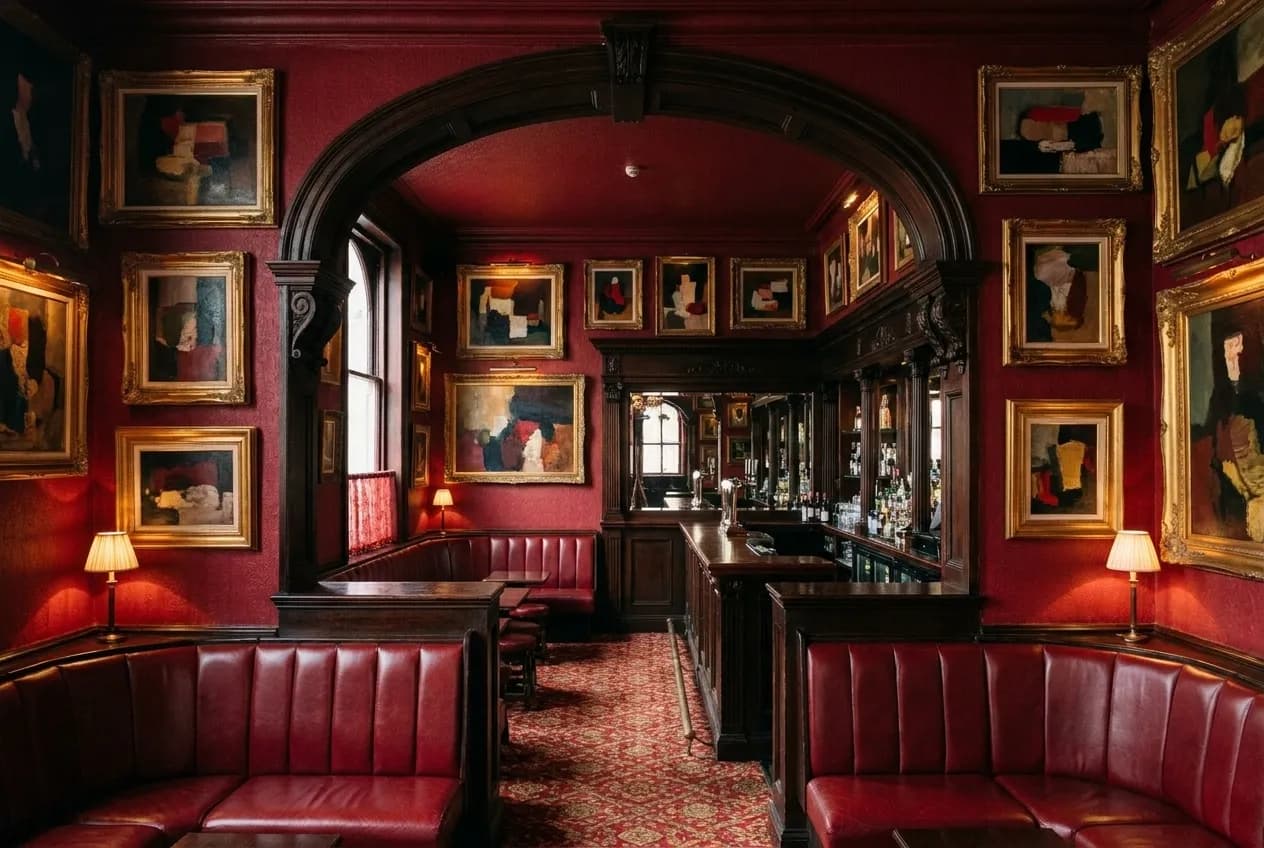
There is a specific pleasure in a bar that has not been redecorated since before you were born, and Los Angeles has almost none left. The Prince at 3198 West 7th Street in Koreatown opened in the 1920s as part of a hotel, kept the crimson banquettes, the oil paintings and the carved wood, and now serves Korean fried chicken until two in the morning. A happy hour near me search will file it as a bar. It is more accurate to think of it as a room with a kitchen attached.
Ask Karpo how busy the booths are tonight, what to order alongside the chicken, and what else on Seventh Street runs past two.
The room is the reason
Everything inside is red: the banquettes, the wallpaper, the carpet, the light. That, plus the gilt frames and the dark wood, gives it the look of a 1940s film set, which is why it has been used as one repeatedly — the room has appeared in film and television often enough that many people recognise it without ever having been.
What that means practically is that the booths are the thing to aim for. They are high-backed, deep and dark, and they are the whole experience; sitting at a table in the middle of the room is a lesser version of the same evening.
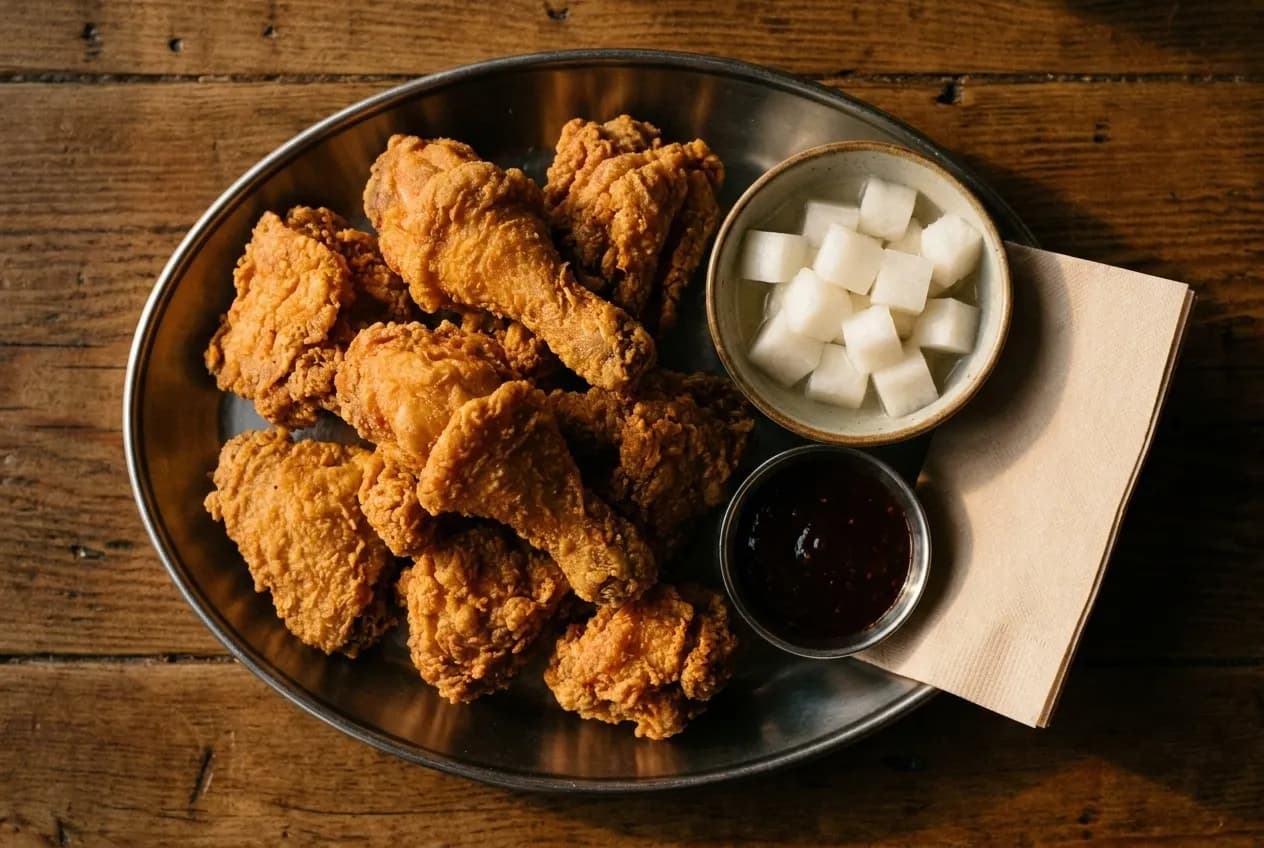
Korean fried chicken in a Prohibition-era bar
The kitchen is Korean and the signature is fried chicken, which arrives as a platter rather than a plate and is built for sharing over drinks rather than as a main course. Korean-style frying produces a thinner, crisper, less greasy coating than the American version, and it holds that crispness longer, which is exactly what you want from something eaten slowly.
Order it with pickled radish and something cold, and add one or two other dishes rather than a starter and a main each. The menu runs beyond the chicken into Korean bar food and a handful of American holdovers, and the bar food is the better half.
A drinks list that has not chased trends
The cocktails are the classic canon made strong rather than a modern programme — margaritas, sours, the kind of list a hotel bar had in 1975 and never revised. That is not a criticism. A room like this would be diminished by a menu of foams and infusions, and the drinks do exactly what they need to do next to a plate of fried chicken.
Beer and soju are the other half of the room's drinking, as they are everywhere in Koreatown, and a table splitting a bottle of soju with a platter of chicken is the most common order in the building for good reason.
Koreatown is denser than it looks from a car window. This is one of the most densely populated districts in the United States, built on mid-century apartment blocks and mini-malls, where much of what is worth finding sits on the second or third floor of a building with nothing at street level to advertise it. The Prince is unusual precisely because it is on the ground floor and looks like what it is.
Late hours, and the neighbourhood around them
The bar runs until around two in the morning, which lines up with Koreatown's general rhythm — this is the part of Los Angeles that stays open latest and has the deepest concentration of late-night food anywhere in the county. Confirm the opening hour before an early arrival, since it shifts.
Within a few blocks there are pocha rooms, karaoke, barbecue and twenty-four-hour kitchens, which makes this a good first stop rather than a last one. Start in the red room at eight, move on at eleven, and you will have seen two completely different versions of the same neighbourhood.
A note on Korean fried chicken as a category, because it is not simply fried chicken made by a Korean kitchen. The technique usually involves frying twice at different temperatures, which drives off more moisture and produces a thin, glassy crust that stays crisp under sauce — which is why the sauced versions work at all. Plain, soy-garlic and a sweet chilli glaze are the standard three, and ordering a half-and-half platter is normal.
Pickled radish is not a garnish either. The cubes of white mu are there to cut fat and reset your palate between pieces, which is exactly what a long evening of chicken and beer requires, and asking for more is ordinary rather than greedy.
Getting there and back
The Metro B and D lines stop at Wilshire and Vermont and Wilshire and Normandie, both a short walk, and both stop running well before the bar closes. Parking exists around Seventh Street but is heavily restricted, and Koreatown enforcement is not forgiving.
If the evening is going to run late, plan the ride home before you start. Rideshare pricing in Koreatown at closing time is a predictable feature of any night out here, and the alternative — driving after a bottle of soju — is not an alternative.
One more reason to come early rather than late: this is a film location as much as a bar, and shoots do occasionally take the room out of service. It is not frequent, but it is the kind of thing that closes a hundred-year-old bar for an evening with very little notice, and a call before you drive over costs nothing.
Practical notes
The Prince is at 3198 West 7th Street in Koreatown, Los Angeles, in a 1920s hotel building, open until around 2am; confirm the opening hour before arriving early. The kitchen is Korean with fried chicken as the signature, served as a sharing platter. The booths are the seats to aim for. Metro rail stops nearby but finishes earlier than the bar does — plan the ride home in advance.
Tags: #HappyHourNearMe #Koreatown #ThePrince #KoreanFriedChicken #LABars #LANightlife #LANeighborhoods #WhereToDrinkLA #LAFoodGuide #ClassicLA #LateNightLA #KtownLA #SeventhStreet #LAEats
All trademarks are the property of their respective owners.
Ask Karpo first
Want to know how busy the booths are tonight, what to order alongside the chicken, and what else on Seventh Street runs past two? Ask Karpo for tonight's hours, a table order built around the platter, and a second stop deeper into Koreatown.