 Mar Vista Winter Farmers Market Picker for Weekend Cyclists
Weekend Plans
Glassblowing Studio Near Me in Downtown LA: The Glass Studio
Discover flameworking, torch-blown glass, and kilnforming classes at The Glass Studio on South Los Angeles Street in DTLA, founded in 2007 by glass artist Cathi Milligan.
Situated right on South Los Angeles Street on the vibrant perimeter where the historic Civic Center meets Little Tokyo, The Glass Studio serves as an urban sanctuary for hot glass manipulation and glass art education. Established in 2007 by celebrated glass artist, author, and jewelry designer Cathi Milligan, the studio has spent nearly two decades introducing curious Angelenos to the transformative possibilities of fire and silica. The intimate street-level storefront combines a retail gallery of original glass creations with an active teaching studio equipped with multiple dual-fuel torch stations, kilnforming ovens, and cold-working lapidary wheels. While many regional hot shops require massive industrial warehouse footprints to house heavy furnace infrastructure, The Glass Studio specializes in the refined disciplines of flameworking, torch glassblowing, and kiln casting, while collaborating with South Bay hot shops to provide comprehensive furnace glassblowing courses.
Precision Flameworking and Torch-Blown Glass Techniques
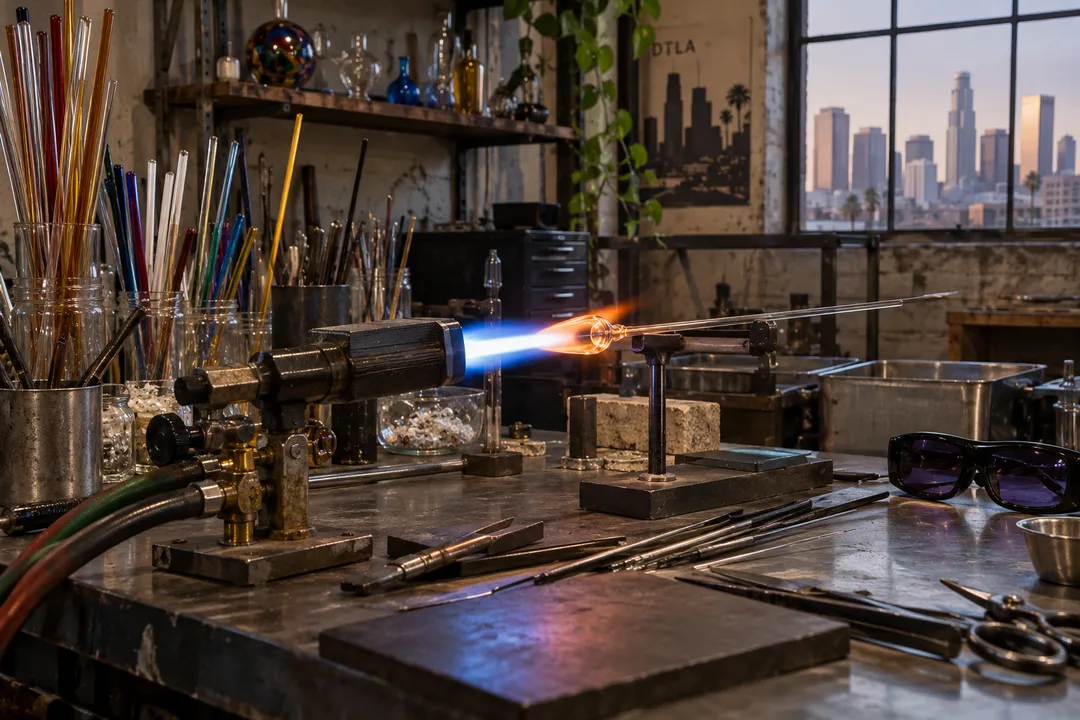
Flameworking, often referred to as lampworking, offers students an extraordinary level of control over molten glass that contrasts with the heavy physical exertion of large furnace pipes. Seated at dedicated fire-resistant workbenches, each participant operates an oxygen-propane bench burner capable of producing pinpoint torch flames exceeding 2800 degrees Fahrenheit. The instructor guides you through adjusting the fuel mix, dialing from a gentle, bushy yellow annealing flame to a razor-sharp, hissing blue cone of intense oxidizing heat.
Students begin by working with rods and hollow tubes of Italian Moretti soft glass and durable borosilicate glass. Rotating a clear glass tube between your fingertips in the outer mantle of the flame, you observe the precise moment when the solid cylinder turns pliable and radiant. By sealing one end of the tube and gently puffing through a lightweight blowhose swivel, you learn to blow delicate, hollow glass bubbles, perfume bottles, and miniature pendant vessels directly at the torch bench. The immediate proximity to the flame provides unmatched insight into surface tension and liquid viscosity.
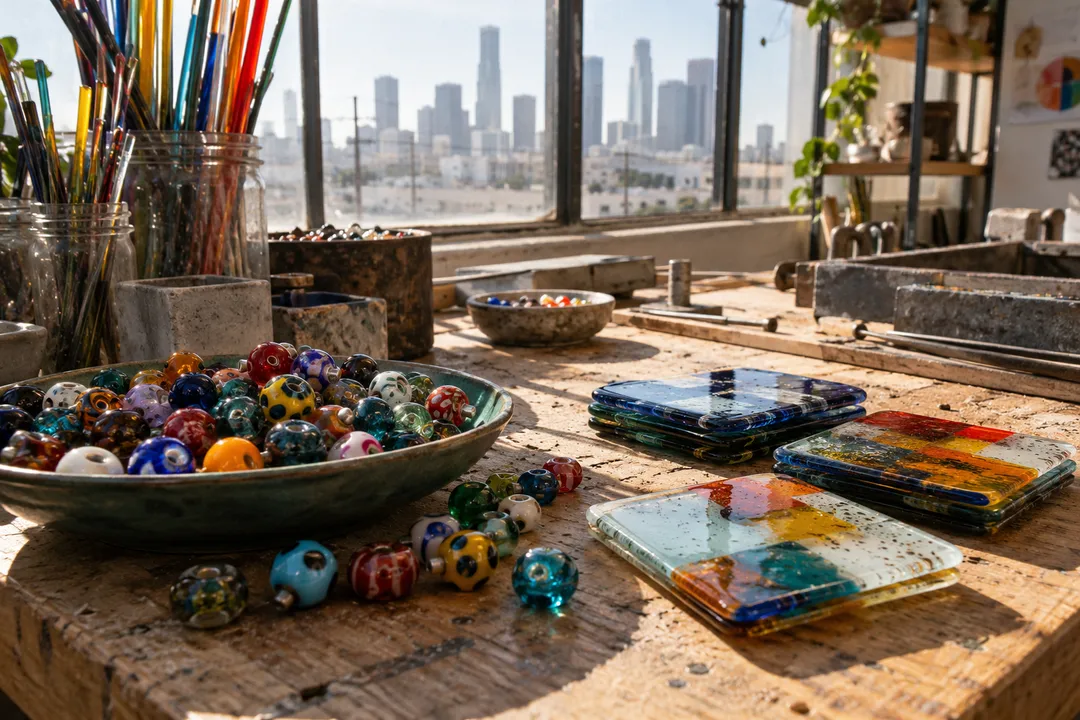
In addition to hollow blown forms, the studio teaches the ancient Italian art of beadmaking and murrine construction. Working with stainless steel mandrels coated in ceramic bead release, students wind molten glass threads around the spinning rod to build decorative core beads. You then apply fine stringers of contrasting colored glass, dotting floral patterns and swirling organic feathers across the surface before smoothing the bead into a perfect sphere. The meditative rhythm of turning the glass in the flame makes torchwork exceptionally accessible for beginners.
Author and Artist Mentorship with Cathi Milligan
Learning at The Glass Studio means working directly under the personal tutelage of Cathi Milligan, whose authoritative books on glass crafting have guided makers nationwide. Milligan approaches glass education with infectious enthusiasm and deep technical rigor, breaking down intimidating chemical concepts into intuitive, muscle-memory actions. Her teaching philosophy emphasizes creative exploration, encouraging students to embrace accidental asymmetries and discover how subtle variations in heat change the optical depth of transparent glass.
Class sizes at the downtown studio are intentionally kept small, typically capped at four to six students per session. This low student-to-teacher ratio guarantees that an experienced instructor is always hovering close by to troubleshoot uneven flame exposure, adjust torch gas balances, or demonstrate intricate tool maneuvers. Whether you are learning how to cold-work a rough rim on a diamond lap disk or assembling complex glass frit layers for a kiln firing, the guidance is patient and personal.
Beyond technical instruction, the studio fosters an enduring creative community where independent hobbyists and seasoned jewelers work side by side. Intermediate and advanced students who complete prerequisite courses gain access to open studio bench rental hours, allowing them to utilize professional torches and annealing equipment to develop independent art lines without investing thousands of dollars in home ventilation systems.
Course Pricing Structure, Hot Shop Bundles, and Registration
The Glass Studio maintains an accessible and clearly posted tuition structure across its diverse workshop offerings. Beginner single-session introductory workshops in flameworking, torch beadmaking, or fused glass jewelry start at $85 per person for a comprehensive two-and-a-half-hour session, which includes all torch gas, rod materials, tools, and kiln firings. Specialized three-hour weekend workshops focusing on hollow torch-blown ornaments or botanical glass sculptures run $125 per seat.
For students interested in traditional large-scale furnace glassblowing, Cathi Milligan partners directly with Pacific Art Glass to co-host comprehensive Glass Blowing 1 & 2 immersion courses. These multi-session collaborative hot shop programs are priced at $350 per student, granting participants hands-on time gathering from commercial furnace tanks and working traditional bench pipes in an industrial hot shop. Additionally, introductory kiln-fused glass plate and mosaic dish workshops are available at $75 per participant.
All workshop registrations must be completed in advance through the studio website to ensure adequate bench preparation and fuel supply. Private one-on-one torch intensives are available at $150 per two-hour block, providing customized technical focus for artists seeking to develop specific studio lines. Workshop tuition is non-refundable within five days of the scheduled class date, though students may transfer their seat to another individual if illness or scheduling emergencies arise.
Safety Standards, Ventilation Systems, and Kiln Cycles
Operating intense gas torches in an urban downtown storefront requires sophisticated environmental and personal safety precautions. The Glass Studio is equipped with a high-volume commercial exhaust hood system that pulls combustion fumes and hot air continuously away from the workbenches, venting them safely above the building roofline. Every torch station features integrated flashback arrestors, stainless steel gas lines, and automated shutoff solenoids that meet stringent municipal fire safety codes.
Personal protection is mandatory for every person entering the torch area. The studio provides specialized didymium optical glasses, which filter out the blinding yellow sodium flare produced when heating soda-lime and borosilicate glass, allowing you to clearly see the glowing workpiece while shielding your eyes from ultraviolet radiation. Students must wear natural fiber clothing, specifically 100 percent cotton tops and long denim pants. Synthetic fabrics like nylon, polyester, and rayon are strictly prohibited due to heat melting risks.
Hair must be pulled back securely, and closed-toe leather or canvas shoes are required on the studio floor. Completed torch-worked and kiln-formed pieces cannot be immediately taken home; they must undergo controlled overnight annealing in computerized digital kilns held at 960 degrees Fahrenheit to relieve thermal stress. Students can pick up their finished, stabilized glass creations starting 48 hours after class, or arrange for careful postal packaging and domestic mailing.
Exploring Historic Downtown LA and Little Tokyo Culture
The studio's location on South Los Angeles Street places students at the dynamic cultural crossroads of Downtown Los Angeles and historic Little Tokyo. After spending hours focused intently on the micro-world of torch flames, stepping out into the bustling downtown atmosphere provides an immediate sensory lift. Walking just two short blocks east brings you directly into the Little Tokyo Japanese Village Plaza, an iconic pedestrian mall lined with paper lanterns, tranquil gardens, and authentic eateries.
For post-workshop dining, head to Daikokuya on East 1st Street for steaming bowls of rich tonkotsu ramen with seasoned bamboo shoots and tender chashu, or visit Marugame Monzo to watch chefs hand-roll fresh udon noodles behind glass view screens. If you prefer coffee and quiet conversation, Demitasse Coffee Roasters on San Pedro Street crafts exceptional siphon brews and artisanal Kyoto-style iced drip coffees served in minimalist glassware.
Those interested in extending their creative day can wander through the Japanese American National Museum or visit the Geffen Contemporary at MOCA, located just five minutes away on North Central Avenue. The juxtaposition of historic brick loft architecture, modern civic plazas, and generations-old neighborhood establishments makes a workshop visit to The Glass Studio a rich, full-day urban cultural excursion.
Transit Directions, Parking Options, and Arrival Logistics
The Glass Studio is located at 260 S Los Angeles St, Los Angeles, CA 90012, between East 2nd and East 3rd Streets in Downtown Los Angeles. The street-level storefront features large glass picture windows displaying student and artist work, with the studio name clearly signposted above the entrance. The facility is fully accessible on the ground floor with wide doorways and flat thresholds.
Parking in Downtown Los Angeles requires advance planning. Metered street parking along South Los Angeles Street and adjacent blocks of 2nd and 3rd Streets is available, but parking is strictly enforced with one- to two-hour limits that may not cover an entire class session. The most convenient option is utilizing public paid parking garages nearby, such as the Little Tokyo Mall Garage at 318 E 1st Street or the public parking structure at 220 S Spring Street, both of which offer flat daily maximum rates ranging between $10 and $15.
Public transit is strongly encouraged and exceptionally convenient. The studio sits within a five-minute walk of the Metro A and E Lines at the Little Tokyo/Arts District Station, as well as the Metro B and D Lines at the Civic Center/Grand Park Station. Students should plan to arrive ten minutes before their scheduled class time to check in, stow backpacks, and adjust their didymium eyewear.
Ask Karpo for more information.
Keep reading
- Mar Vista Winter Farmers Market Picker for Weekend Cyclists
 Downtown LA Winter Farmers Market Picker for Car-Free Hosts
 Larchmont Winter Farmers Market Picker for Kimchi-Making Day